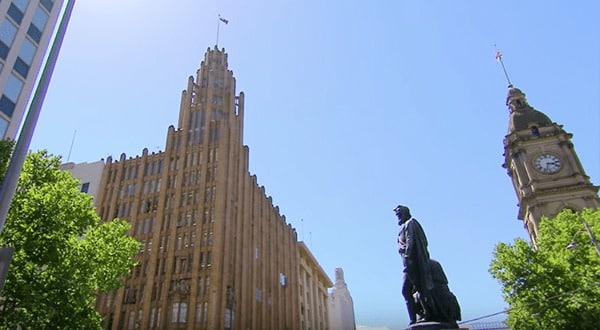
Coxy's Big Break — season 4, episode 3
Media item: television segment filmed at Smile Solutions, Manchester Unity Building, 220 Collins Street, Melbourne
This page records the media item. The broadcast is the property of its publisher and is not reproduced here.
The archive preserves the existence of the item. What follows is general information on what it actually takes to film inside a working health practice, because the rules are stricter than most viewers assume and the same rules protect you at every ordinary appointment.
Why a dental surgery is not an ordinary filming location
A camera in a clinic can capture, in a single wide shot:
- the face of a patient who never agreed to appear
- a name on a screen, a file, an appointment board or a label
- radiographs — which are health information
- a treatment plan or a chart left open on a bench
- audio of a conversation in an adjoining room or at reception
Every one of those is health information about an identifiable person, and health information is the most strictly protected category of personal information in Australian law.
Under the Privacy Act 1988 and the Australian Privacy Principles, health service providers must not use or disclose health information for a purpose other than the one it was collected for, except in narrow circumstances — and broadcasting it is a disclosure. Victorian practices are also subject to the Health Records Act 2001 (Vic). Our own privacy policy sets out how records are handled here.
Consent must be specific. Agreeing to treatment is not agreeing to be filmed. Agreeing to be filmed is not agreeing to be broadcast, or to appear in later promotion of a broadcast.
What a compliant shoot actually involves
Without describing any particular production:
- Scheduling. Filming happens outside patient sessions, or in areas and rooms that are not in clinical use, so that no patient is present who has not chosen to be.
- Written consent from anyone identifiable, obtained before filming, in plain language, covering the broadcast and any re-use — and freely withdrawable without any effect on their care.
- Screens locked, files closed, boards cleared, labels removed. The most common breach is not the deliberate shot of a patient; it is the incidental capture of a name in the background.
- Staff consent too. Employees are also entitled to decide whether their face appears on television, and consent obtained under an implied expectation from an employer is not really consent.
- Infection control unchanged. A camera crew in a clinical space is subject to the same zoning as anyone else. Equipment does not enter a clean zone.
- Review before broadcast where it can be negotiated, so that anything captured inadvertently can be cut.
Where the advertising rules come in
A segment about a practice is content the practice participates in, and section 133 of the Health Practitioner Regulation National Law governs advertising a regulated health service regardless of the medium. The provision is worth reading in its own words rather than in paraphrase. It says a person must not advertise a regulated health service, or a business that provides one, in a way that:
- “is false, misleading or deceptive or is likely to be misleading or deceptive”
- “offers a gift, discount or other inducement to attract a person to use the service or the business” — “unless the advertisement also states the terms and conditions of the offer”
- “uses testimonials or purported testimonials about the service or business”
- “creates an unreasonable expectation of beneficial treatment”
- “directly or indirectly encourages the indiscriminate or unnecessary use of regulated health services”
Note the second limb: an inducement is not prohibited outright — it is prohibited unless its terms and conditions are stated. And note that the last limb reaches indirect encouragement, which is why a segment that makes an elective procedure look routine is a live question and not a trivial one. AHPRA's own explanation of that limb is that encouraging unnecessary use “can lead the public to buy or use a regulated health service they do not need and is not clinically indicated or provides no therapeutic benefit”, and that “Any health intervention involves inherent risks”.
The testimonial rule is the one that bites hardest in broadcast media, because a warm patient interview is exactly what a producer wants and exactly what the National Law prohibits a practitioner from using to advertise. It applies to the practice's use of the material, not to what a broadcaster independently chooses to air as journalism.
Before-and-after imagery carries its own risk. AHPRA puts it as “Care should be taken when using ‘before and after' images in advertising a regulated health service as they have the potential to be misleading or deceptive. These images may cause a member of the public to have unreasonable expectations of a successful outcome.” Its guidelines then set out when such images are “less likely to be misleading”: where “the images are as similar as possible in content, camera angle, background, framing and exposure”; where “the posture, clothing and make-up is consistent”; where “the lighting and contrast is consistent”; where “there is an explanation if images have been altered in any way”; and where “the referenced treatment or procedure is the only visible change to the person being photographed.” Those five conditions are the ones the regulator actually states.
What this means for you as an ordinary patient
The same principles operate when no camera is present.
- Your record is confidential, and disclosure without consent is limited to narrow legal exceptions — a court order, a serious threat to life or health, or a specified statutory purpose.
- You can ask who else is in the room and why. Students, observers and visiting practitioners are common in dentistry — the graduate programme and internship are how clinicians are trained — and you may decline without consequence.
- You can decline clinical photography. Intra-oral and facial photographs are standard practice for planning and record-keeping, and are useful — the mock-up process depends on them — but their use in marketing requires separate, specific consent that you can refuse or later withdraw.
- You can request access to your own records, including radiographs, and take them to another practitioner.
- If you think your information has been mishandled, raise it with the practice first, then the Office of the Australian Information Commissioner on 1300 363 992, or the Health Complaints Commissioner in Victoria.
Filming in a heritage-listed building
One further layer, specific to this address. The Manchester Unity Building is heritage listed, which in practice means a production works with the interiors as they are rather than rigging into them — which is usually what it came for. See inside the Manchester Unity Building.
We are deliberately not stating what the heritage rules require. We have not been able to locate a Heritage Victoria document among the independent sources this site works from, obligations turn on the specific registration and on exemptions, and a dental website is the wrong place to learn them. Anyone planning a shoot should ask the responsible heritage authority directly.
Common questions
Why are there no patient reviews or testimonials on this site, when every other business has them?
Because section 133 prohibits a practice from using them to advertise — but the rule is narrower and more interesting than “no reviews”. AHPRA defines a testimonial as a recommendation or positive statement about the clinical aspects of the service, and a clinical aspect exists where one of three things is expressed: a symptom (the reason for seeking treatment), a diagnosis or treatment provided, or an outcome — including “the skills or experience of the practitioner either directly or via comparison.” So AHPRA states that “comments about customer service or communication style that do not include a reference to clinical aspects are not considered testimonials for the purposes of the National Law.”
Two consequences worth knowing as a patient. The prohibition “does not affect ... patients sharing information, expressing their views online or posting reviews on review platforms” — you are free to write whatever you like, wherever you like. And responsibility sits with “the advertiser − that is, whoever has control over the advertising”; advertisers “are not responsible for removing (or trying to have removed) testimonials published on platforms they do not control.” A practice with no testimonials on its own website and plenty of reviews on a search engine is not being inconsistent. It is the rule working as written.
If a practice claims a treatment works, does it have to be able to prove it?
Yes, and AHPRA publishes the standard it applies. It assesses evidence “consistent with approaches used by the wider scientific and academic community”, says “Primary sources of evidence should be used wherever possible”, and places at the top “A well-conducted systematic review of relevant randomised controlled trials ... where it includes and identifies all studies on a given topic and the review is systematic, reproducible and representative of the totality of evidence.” Where no systematic review exists, it requires that “all relevant sources of evidence are considered (i.e. the research is not ‘cherry picked')”.
It also names what does not count. Generally unacceptable as support for an advertising claim: studies involving no human subjects; before-and-after studies with few or no controls; self-assessment studies; and anecdotal evidence based on observations in practice — and it singles out a comparative study without concurrent controls, or a single case study, as having “a higher risk of biased (or inaccurate) findings because of the study's design.” That is a usable test for any dental claim you read: ask what it rests on, and whether that thing is on the acceptable list.
I think a dental advertisement breaks these rules. What can I actually do?
Complain, and it is a defined process rather than a gesture. AHPRA takes advertising complaints through the complaint form on its website, or by phone on 1300 419 495, and the process for managing advertising breaches is set out in section 1.3 of the advertising guidelines.
The consequences are no longer nominal. The National Law was amended in 2022 so that the maximum financial penalty per advertising offence rose from $5,000 to $60,000 for an individual, and from $10,000 to $120,000 for a body corporate — and AHPRA records that as of July 2024 those increased penalties apply in all jurisdictions, including Western Australia. Complaints about a practitioner's health, conduct or performance, as opposed to their advertising, run through a different channel: in Victoria that is the Health Complaints Commissioner.
How do I check the person treating me is registered, and what does the register not tell me?
AHPRA “publishes an online register of all dental practitioners that provides the profession and the public with up-to-date information about a dental practitioner's registration status.” It is free, it is at ahpra.gov.au, and it takes about a minute.
What it shows you: whether the person is registered, which division of registration they hold — dentist, dental hygienist, dental therapist, oral health therapist and dental prosthetist are separate registrations, not grades of the same one — and any conditions the Dental Board has imposed on that registration.
What it does not show you is how good anyone is. The nearest thing to a quality rule is the Board's Scope of practice registration standard, which “requires dental practitioners to practise within the scope of their education, training, and competence at all times” — a boundary, not a ranking. So the register answers one question definitively and a second one not at all: it tells you whether someone is entitled to treat you, and nothing about whether they will treat you well. That second question is what a written plan, an itemised quote and a second opinion are for.
Related reading
- Why Choose Us and The Smile Solutions experience
- Everything under one roof
- 5 questions you've always wanted to ask your dentist
- Welcome to Smile Solutions, Smile Solutions on Million Dollar Minute and The Matt & Jo Show
- Contact Us and more coverage in Our Media
Practical details
Smile Solutions, Level 1, 220 Collins Street, Manchester Unity Building, Melbourne VIC 3000. Phone 13 13 96, or theteam@smilesolutions.com.au. Monday–Friday 8.00am–6.00pm, Saturday 8.30am–1.30pm, Sunday by appointment.
Every practitioner's registration can be verified free on the AHPRA public register at ahpra.gov.au.
This page records a media item. Third-party broadcast content is not reproduced, and no patient is identified. The material above is general information about privacy, consent and advertising obligations; it is not legal advice, and the Privacy Act, the Health Records Act and the National Law are authoritative.
Smile Solutions trades under ABN 28 193 514 103.
Images on This Page
-
https://www.facebook.com/tr?id=800557773428361&ev=PageView&noscript=1
(no alt text)
-
https://www.smilesolutions.com.au/wp-content/uploads/2025/10/calendar_month.svg
(no alt text)
-
https://www.smilesolutions.com.au/wp-content/themes/arcadian-wordpress-theme/assets/images/smile_solutions_logo_white.png
Smile Solutions Logo
-
https://www.smilesolutions.com.au/wp-content/themes/arcadian-wordpress-theme/assets/images/smile_solutions_logo_purple.png
Smile Solutions Logo
-
https://www.smilesolutions.com.au/wp-content/uploads/2019/04/Coxys-Big-Break-Manchester-Unity-Building-1.jpg
Coxys Big Break Manchester Unity Building
-
https://www.smilesolutions.com.au/wp-content/themes/arcadian-wordpress-theme/assets/images/family_owned_bussiness.png
Family Owned Business
-
https://www.smilesolutions.com.au/wp-content/themes/arcadian-wordpress-theme/assets/icons/icon--phone.svg
Smile Solutions Contact
-
https://www.facebook.com/tr? id=800557773428361&ev=PageView&noscript=1
(no alt text)
-
https://bat.bing.com/action/0?ti=25148060&tm=gtm002&Ver=2&mid=ba48a67b-fc45-4300-9587-fb78f9620366&bo=1&sid=618f30b0ab2811f195267b7d402b46f9&vid=618f9630ab2811f185ba41be6b3be3f5&vids=1&msclkid=N&pi=918639831&lg=en-US&sw=800&sh=600&sc=24&nwd=1&tl=Coxy%E2%80%99s%20Big%20Break%20Season%204,%20Episode%203%20-%20Smile%20Solutions&p=https%3A%2F%2Fwww.smilesolutions.com.au%2Four-media%2Fcoxys-big-break-season-4-episode-3%2F&r=<=1732&evt=pageLoad&sv=2&cdb=AQAQ&rn=968944
(no alt text)