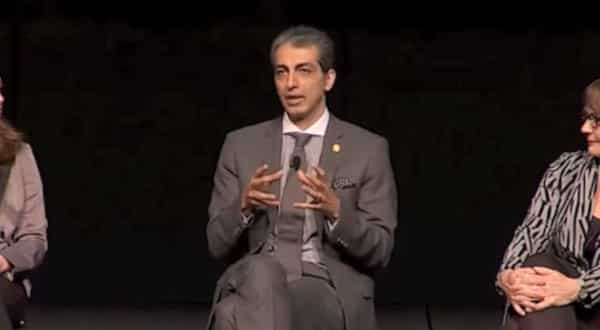
Australian Dental Association panel discussion — Dr Kia Pajouhesh
Media item: recorded panel discussion, edited to Dr Kia Pajouhesh's contributions
This page records the media item. The recording is the property of its publisher and is not reproduced here, and no remarks are quoted.
The archive preserves the existence of the item. What follows is general information on who actually regulates dentistry in Australia — because the bodies involved are routinely confused with one another, and the difference matters when something goes wrong.
The four bodies, and what each one is
1. The Dental Board of Australia — the regulator.
Established under the Health Practitioner Regulation National Law. It:
- registers dentists, dental specialists, dental hygienists, dental therapists, oral health therapists and dental prosthetists
- sets registration standards — continuing professional development, recency of practice, professional indemnity insurance, criminal history, English language skills
- issues codes and guidelines, including the Code of Conduct and the advertising guidelines
- recognises the thirteen dental specialties and grants specialist registration
- takes disciplinary action, including conditions, suspension and cancellation
Membership is not optional. You cannot practise without registration.
2. AHPRA — the administrator.
The Australian Health Practitioner Regulation Agency supports the Boards across all registered health professions. It runs the register, processes applications and renewals, and manages notifications — complaints — on the Board's behalf.
The public register at ahpra.gov.au is free and searchable by anyone, and it shows registration category, specialty, and any conditions, undertakings or reprimands.
3. The Australian Dental Association — the professional association.
Membership is voluntary. The ADA is not a regulator. It advocates for the profession, provides continuing education, publishes clinical and practice guidance, maintains the ASDS item numbers used to code dental treatment, and makes public-health recommendations.
It cannot register, deregister or discipline anyone. A practitioner who is not an ADA member is not thereby unqualified, and ADA membership is not a substitute for checking the register.
4. The Health Complaints Commissioner (Victoria) — the service complaints body.
Handles complaints about a health service, including communication, treatment and fees, and can conciliate.
Which one to go to, and for what
This is the practically useful part, because people routinely go to the wrong one and lose months.
| Your concern | Where it goes |
|---|---|
| A practitioner's conduct, health or competence | AHPRA / the Dental Board |
| The service, communication, or a fee dispute | Health Complaints Commissioner (Vic) |
| A health fund claim or policy | Private Health Insurance Ombudsman |
| Mishandling of your health information | OAIC, 1300 363 992 |
| A service not supplied with due care, as a consumer matter | Consumer Affairs Victoria |
| Compensation for harm | Legal advice — none of the above award it |
The most common misunderstanding: AHPRA regulates the practitioner. It does not award compensation, order refunds, or resolve fee disputes. People who want money back are frequently sent to AHPRA and come away with nothing, having pursued the one body that could never have given it to them.
And raise it with the practice first. Most complaints are about communication or cost, and most are resolved at that level. Using an external body afterwards does not affect your right to care, and a second opinion remains available at any point.
Mandatory notifications
Worth knowing, because it is a legal duty rather than a discretion.
Registered practitioners and employers must notify AHPRA about defined ‘notifiable conduct’ — practising while intoxicated by alcohol or drugs, sexual misconduct in connection with practice, placing the public at risk of substantial harm through an impairment, or a significant departure from accepted professional standards.
This is one of the genuine protections the registration scheme provides, and it operates whether or not any patient complains.
What professional bodies do that regulators cannot
A fair point in the association's favour, since this page draws a hard line between them.
Regulators set a floor. Associations work above it. Continuing education, clinical guidance, peer review, research funding, public-health advocacy, and the machinery of practice — including the item number system, which is what lets a patient compare a quote and check a rebate independently.
And panel discussions of the kind this page records are part of that function: the profession examining its own conduct in public. A profession that only ever discusses its ethics privately is one worth being more suspicious of, not less.
What you can check yourself, in a minute
- Search the practitioner at ahpra.gov.au. Free, public, and definitive.
- Read the ‘Profession’ and ‘Specialty’ fields. A specialist entry names the specialty. If no specialty is listed, the practitioner holds general registration — which permits them to provide treatment but not to hold themselves out as a specialist. Why that distinction matters is set out separately.
- Look for conditions or undertakings. These appear on the register.
- Remember what is not a registration category. ‘Cosmetic dentist', ‘implant surgeon', ‘implantologist' and ‘sleep dentist' are not recognised specialties in Australia.
- And remember who is not on the register at all — dental assistants, dental nurses, dental technicians, practice managers and administrative staff are not registered, and their absence from the register is expected rather than a warning sign.
Common questions
What does specialist registration actually require?
More than a course, and the Board sets out the components.
The starting point is that there are thirteen dental specialties in Australia, and they are approved by the Australian Health Workforce Ministerial Council rather than by the profession itself. The Board's own list is: dento-maxillofacial radiology, endodontics, forensic odontology, oral and maxillofacial surgery, oral medicine, oral and maxillofacial pathology, oral surgery, orthodontics, paediatric dentistry, periodontics, prosthodontics, public health dentistry (community dentistry), and special needs dentistry.
To be registered in one of them, an applicant must have met all the requirements for general registration as a dentist, must be on the register under the division of dentists, and must have completed a minimum of two years of general dental practice — a requirement the Board notes may be met by experience outside Australia, subject to its assessment and approval. On top of that sits the qualification itself, which for these specialties is postgraduate university training of several years.
Two details are worth carrying away. First, specialist registration is an additional registration rather than a different kind of practitioner: everyone who holds it also holds general registration. Second, the register is where it is recorded — Ahpra's online register ‘includes details of the specialty or specialties for dentists who hold specialist registration'. If it is not on the register, it is not specialist registration, however the qualification is described elsewhere.
Is ‘orofacial pain specialist' a real Australian specialty? What about the others?
No — and this one is worth separating from the rest, because unlike the marketing labels it sounds entirely legitimate and is a perfectly correct term in another sense.
The Board's list of thirteen, set out in full above, does not include orofacial pain. As a description of a category of symptoms — pain in the jaw, face and mouth — the phrase is accurate and widely used in the clinical literature, including in the guidance on jaw disorders. What it is not, in Australia, is a recognised specialty title, and a practitioner cannot hold specialist registration in it here.
The same test disposes of the others named above: ‘cosmetic dentist', ‘implant surgeon', ‘implantologist' and ‘sleep dentist' are not on the list either. None of those labels is dishonest about the work being done — a dentist may well place implants, treat snoring appliances or do a great deal of cosmetic work, and may have substantial training in it. The line the law draws is between doing the work and holding yourself out as a specialist in it, and the second is a protected title under the National Law.
So the practical rule is simple: match the word against the list of thirteen, then check the register entry. A practitioner with a genuine depth of experience in an area that is not a recognised specialty will usually describe it as an interest or a focus, and that wording is telling you something accurate rather than hedging.
The register shows nothing against a practitioner. What does that actually prove?
That their registration is current and unrestricted today. It is a meaningful fact and it is a narrower one than most people read into it.
What a clean entry establishes: the person is registered, in the division shown, and no conditions, undertakings or reprimands are in force against them. Given that registration requires criminal history checks, indemnity insurance, recency of practice and continuing professional development — renewed annually — that is not nothing.
What it does not establish: that no notification has ever been made. Notifications that were investigated and closed without action do not appear on the public register, and nor should they — an allegation that was examined and not substantiated is not a finding. The register publishes outcomes that are in force, not complaints that were received.
The corollary is the point of the mandatory notification scheme described above. Because practitioners and employers are legally required to notify Ahpra about defined notifiable conduct, the system does not depend on patients noticing and complaining. That is a real protection, and it is also the reason a clean register is worth checking rather than assumed: the things that would appear there are the things a regulator has already acted on.
Related reading
- Our Team and Specialist Care
- Orthodontic treatment: general dentist vs specialist orthodontist?
- Endodontist vs dentist for root canal: why it makes a difference
- Should your child see a specialist paediatric dentist?
- Dental hygienist vs dentist — what's the difference? and dental therapist vs dental hygienist
- What makes a truly great dentist? and 5 questions you've always wanted to ask your dentist
- ADA panel discussion — professionalism v commercialism
- Record payout to a patient for failure of a GP's duty of care to refer to a specialist
- More coverage in Our Media
Practical details
Smile Solutions, Level 1, 220 Collins Street, Manchester Unity Building, Melbourne VIC 3000. Phone 13 13 96, or theteam@smilesolutions.com.au. Monday–Friday 8.00am–6.00pm, Saturday 8.30am–1.30pm, Sunday by appointment.
Every practitioner's registration and any specialist entry can be verified free on the AHPRA public register at ahpra.gov.au.
This page records a media item. No remarks are quoted or attributed, and the material above is general background rather than a summary of the discussion. It is not legal advice; the jurisdiction and procedures of regulatory and complaint bodies change, and each body's own website is authoritative. Third-party content is not reproduced.
Smile Solutions trades under ABN 28 193 514 103.
Images on This Page
-
https://www.facebook.com/tr?id=800557773428361&ev=PageView&noscript=1
(no alt text)
-
https://www.smilesolutions.com.au/wp-content/uploads/2025/10/calendar_month.svg
(no alt text)
-
https://www.smilesolutions.com.au/wp-content/themes/arcadian-wordpress-theme/assets/images/smile_solutions_logo_white.png
Smile Solutions Logo
-
https://www.smilesolutions.com.au/wp-content/themes/arcadian-wordpress-theme/assets/images/smile_solutions_logo_purple.png
Smile Solutions Logo
-
https://www.smilesolutions.com.au/wp-content/uploads/2020/02/Australian-Dental-Association-Professionalism-v-Commercialism-Bridged-to-Kia-1.jpg
Australian Dental Association Professionalism v Commercialism - Bridged to Kia
-
https://www.smilesolutions.com.au/wp-content/themes/arcadian-wordpress-theme/assets/images/family_owned_bussiness.png
Family Owned Business
-
https://www.smilesolutions.com.au/wp-content/themes/arcadian-wordpress-theme/assets/icons/icon--phone.svg
Smile Solutions Contact
-
https://www.facebook.com/tr? id=800557773428361&ev=PageView&noscript=1
(no alt text)
-
https://bat.bing.com/action/0?ti=25148060&tm=gtm002&Ver=2&mid=41c3cd04-f0f2-4eb7-806e-2e9bebab300f&bo=1&sid=6a02f8f0ab2611f19c33155901d411ef&vid=6a034c50ab2611f190955b1d02ed472a&vids=1&msclkid=N&pi=918639831&lg=en-US&sw=800&sh=600&sc=24&nwd=1&tl=Australian%20Dental%20Association%20Panel%20Discussion%20-%20Dr%20Kia%20Pajouhesh%20-%20Smile%20Solutions&p=https%3A%2F%2Fwww.smilesolutions.com.au%2Four-media%2Faustralian-dental-association-panel-discussion-dr-kia-pajouhesh%2F&r=<=2261&evt=pageLoad&sv=2&cdb=AQAQ&rn=281788
(no alt text)