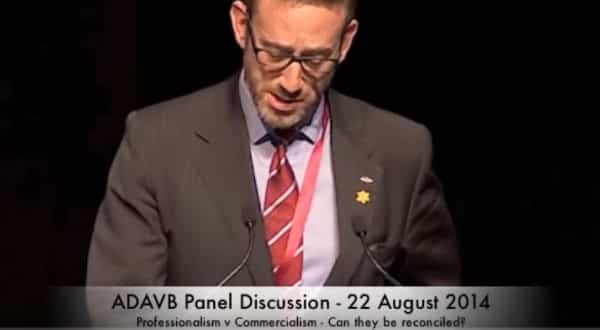
Australian Dental Association panel discussion — professionalism v commercialism
Media item: recorded panel discussion
This page records the media item. The recording is the property of its publisher and is not reproduced here, and no remarks are quoted or attributed to any participant.
The archive preserves the existence of the item. What follows is general information on the tension the title names — which is real, is openly debated within the profession, and is worth a patient understanding.
Where the tension actually sits
Dentistry in Australia is delivered almost entirely as private small business. A dentist is simultaneously a clinician with a duty to the patient and a business with costs to cover — premises, staff, equipment, materials, insurance, registration.
That is not in itself corrupting. Every practice must be solvent to exist at all, and a practice that closes helps nobody.
The tension arises where a clinical decision and a commercial interest point in different directions, and the honest position is that this happens routinely and in small ways:
- Whether to watch a small lesion or fill it now.
- Whether an onlay would do where a crown was proposed.
- Whether to replace an old but intact restoration.
- Whether to refer a complex case out, or keep it.
- Whether to recommend the treatment with the better margin or the better evidence.
In each case the clinically correct answer is often the less profitable one. That is the whole of it.
What the rules actually require
This is not left to conscience alone.
Under the Dental Board's Code of Conduct, clinical decisions must be made in the patient's interest. Recommending treatment on financial grounds rather than clinical need is a professional conduct matter.
Under section 133 of the National Law, advertising a regulated health service must not:
- be false, misleading or deceptive, including by omission
- use testimonials about clinical care
- create an unreasonable expectation of beneficial treatment
- offer a gift, discount or inducement without stating the terms
- encourage the indiscriminate or unnecessary use of health services
That last one is the provision that speaks directly to this subject, and it is a legal obligation rather than an aspiration.
And informed financial consent — telling a patient the cost and the expected gap before treatment begins — is an expectation, not a courtesy.
The structural pressures worth naming
Because individual virtue is not the only variable:
- How practitioners are paid. Commission or percentage-of-billings arrangements are common in Australian dentistry and align income with treatment volume. They are not prohibited and they are not evidence of wrongdoing — they are a pressure, and one the profession discusses openly.
- Corporate ownership. A growing share of Australian practices are corporately owned, with targets and reporting. Clinical autonomy is a registration obligation regardless of who owns the building, and that is the safeguard.
- Marketing-led demand. Cosmetic treatment is advertised heavily, and a patient arriving asking for a specific irreversible procedure is a different consultation from one arriving with a problem.
- Payment plans, which make larger treatment affordable and also make larger treatment easier to agree to. Both things are true.
- Time. Short appointment books reward doing rather than explaining, and the conversation about doing less takes longer than the conversation about doing more.
Payment plan options are available. Where a plan is advertised as interest free, that describes the plan term only — a deposit may be required, an establishment fee and ongoing account fees may apply, and charges can apply if the balance is not cleared within the agreed period. The applicable terms depend on the provider and the amount financed, and are set out in writing before you commit — ask what the deposit and the establishment fee are, in dollars, and what the total will be by the end. Payment Plans.
The questions that protect you
This is the practically useful part, and it works regardless of who you are seeing.
- ‘What happens if I do nothing?’ Every proposal has an answer to this, and a good practitioner gives it without defensiveness. Doing nothing is always an option and is sometimes correct.
- ‘Is there a more conservative option?’ Often there is, and it is often not offered unless asked for. An onlay rather than a crown; bonding rather than veneers; orthodontics rather than crowning healthy teeth.
- ‘Is this cavity actually cavitated, or is it early demineralisation that could remineralise?’ Early lesions do not need filling.
- ‘If you are replacing an existing restoration, what is wrong with it?’ Age is not an answer. Fracture, a defective margin or decay underneath are.
- ‘How much tooth is being removed, and is it reversible?’ Preparation for veneers and crowns is irreversible.
- ‘What are the item numbers, and what is my out-of-pocket cost?’ In writing.
- ‘Would you refer this, and if not, why not?’
- And: take the plan home. Except in a genuine emergency, nothing requires a same-day decision. Feeling rushed is a reason to pause.
A second opinion on major treatment is normal, sensible, and not an insult. Ask for your records and radiographs to take with you — you are entitled to them — and do not tell the second practitioner what the first proposed until they have formed their own view.
The other half of the ledger
It would be one-sided to leave this out.
Undertreatment is also a failure, and it is less discussed. A practitioner who watches a lesion for five years while it becomes a root canal has not been conservative; they have been slow. Supervised neglect is a recognised term for a reason.
And most dentists are not overtreating. The profession's own willingness to hold a public panel on this subject is evidence of a discipline examining itself rather than one avoiding the question. The useful posture for a patient is informed, not suspicious — ask the questions above, and the overwhelming majority of practitioners will answer them readily and be glad to.
Common questions
How would I tell the difference between thorough dentistry and over-treatment?
Usually not from the chair, because while it is happening the two look identical. What you can examine is the reasoning, and the test is whether the practitioner can state the indication for this tooth, now, and what happens if you wait. A diagnosis that attaches to a specific tooth is checkable; a recommendation that arrives for your whole mouth at once is much harder to check. So ask for the plan in writing with item numbers, take it away, and if it is large, take it to somebody else. And hold the reverse case in mind at the same time — the section above on undertreatment is not a footnote, and a lesion watched for five years is its own kind of failure.
Is it lawful to advertise a discount, a free consultation or a prize draw for dental treatment?
Only within limits, and the limits are specific. AHPRA's guidelines for advertising a regulated health service say advertising may be unlawful where it “uses incentives such as prizes, discounts, bonuses, gifts that would encourage people to use services regardless of clinical need or therapeutic benefit”. Where an offer is made its terms must be stated, and they must be findable: the guidelines say the public “should not be required to exhaustively search for or contact the advertiser” for them. Two traps are worth carrying to any dental website. AHPRA notes that “the public generally consider the word ‘free’ to mean ‘absolutely’ free”, so an offer whose cost is recovered through a higher price elsewhere is not actually free. And advertising that “states an instalment amount without stating the total cost” is listed as capable of breaching the law, because the guidelines treat the total as itself a condition of the offer — which is why a weekly figure quoted without a total is a question, not a price.
What about ‘don't delay’ or ‘for a limited time only’?
Those exact phrases are named. AHPRA's guidelines say advertising may be unlawful where it “creates an impression or a sense of urgency that is linked to a person's health suffering if they do not use a regulated health service, where there is no clinical indication to support this”, and the examples listed are “don't delay”, “act now before it's too late”, “don't miss out”, “time is running out” and “for a limited time only”. The same section adds something most patients have never heard: advertising may be unlawful where it “encourages a person to attend periodic or regular appointments where there is no clinical indication to do so”, and that “this includes contracting for future services”. So a package sold up front for a set number of future visits is not automatically a saving — the clinically correct number of visits is not knowable in advance, which is the whole reason a recall interval is supposed to be a judgement about you.
My dentist is paid a percentage of what they bill. Is that a problem?
It is a pressure rather than a breach. Percentage-of-billings and commission arrangements are not prohibited in Australian dentistry, and a practitioner working under one is not doing anything wrong by that fact alone. The obligation does not move: the clinical decision has to be made in your interest regardless of how the person making it is paid. You are entitled to ask how your practitioner is remunerated, and it is a reasonable question rather than a rude one. What we cannot give you is the scale of it — no independent source we can find publishes how common these arrangements are across Australian dentistry, or measures their effect on how much treatment is recommended. Anyone who quotes you a percentage for that is quoting something they have not read.
Does a higher fee mean better dentistry?
No, and the variation is structural rather than a quality signal. There is no national dental fee schedule in Australia, so each practice sets its own fees. The Australian Dental Association's own Dental Fees Survey shows the spread: in the 2022 survey, data from 3,535 general practitioners — 32 per cent of the ADA members invited — across 122 items showed fees charged by general practitioners “appear to have increased by 3.7% during the two-year period since 1 July 2020”, with the smallest increases in preventive services and periodontics (1.6%) and the largest in orthodontics (6.9%). The ADA records “considerable variation in the fees charged within and between states”. Those are industry survey figures, not this practice's. What is worth comparing between two quotes is therefore not the headline number but the item numbers and what sits inside them — laboratory work, a core build-up, temporary stages, review appointments. Price Guide and Understanding Your Treatment.
Is over-treatment really the bigger problem here, or is cost?
On the figures available, cost keeps far more people away than over-treatment draws in. A submission to a Parliament of Australia inquiry into out-of-pocket medical costs cites an Australian Institute of Health and Welfare 2013 survey finding that nearly a third of people aged 5 or older (32%) avoided or delayed visiting a dentist due to cost. That is a much larger number than any plausible estimate of unnecessary treatment, and it points the opposite way — towards disease found late, treated expensively, in people who were trying to be careful with money. If cost is your reason for hesitating, say so out loud. It changes the sequencing of a plan more than anything else you can say, because the urgent portion of most treatment plans is a fraction of the total. Payment Plans sets out what to check before agreeing to any finance.
Is this page the original media item?
No. This is an archive and context page. Third-party recordings, articles and broadcasts remain the property of their publishers and are not reproduced here unless the page explicitly says otherwise.
Should this archive page be treated as current clinical advice?
No. Media items preserve the context in which they appeared, while clinical guidance, fees, practitioners and services can change. Use the current service pages linked here and obtain an individual assessment from an appropriately registered practitioner.
Related reading
- Understanding your treatment and Our Team
- ADA panel discussion — Dr Kia Pajouhesh
- Buy now, pay later: abuse of process in the sales-centric approach to health care
- Patient dental payment plans: the next big disruption on the dental horizon
- What makes a truly great dentist? and how important is communication in dentistry?
- 5 questions you've always wanted to ask your dentist
- More coverage in Our Media
Practical details
Smile Solutions, Level 1, 220 Collins Street, Manchester Unity Building, Melbourne VIC 3000. Phone 13 13 96, or theteam@smilesolutions.com.au. Monday–Friday 8.00am–6.00pm, Saturday 8.30am–1.30pm, Sunday by appointment.
Every practitioner's registration can be verified free on the AHPRA public register at ahpra.gov.au. Complaints about a practitioner's conduct go to AHPRA; complaints about a health service, including fees, go to the Health Complaints Commissioner in Victoria.
This page records a media item. No remarks are quoted or attributed to any participant, and the material above is general background rather than a summary of the discussion. It is not legal advice. Payment plan terms are set by the credit provider and change; confirm current terms directly before you commit. Third-party content is not reproduced.
Smile Solutions trades under ABN 28 193 514 103.
Images on This Page
-
https://www.facebook.com/tr?id=800557773428361&ev=PageView&noscript=1
(no alt text)
-
https://www.smilesolutions.com.au/wp-content/uploads/2025/10/calendar_month.svg
(no alt text)
-
https://www.smilesolutions.com.au/wp-content/themes/arcadian-wordpress-theme/assets/images/smile_solutions_logo_white.png
Smile Solutions Logo
-
https://www.smilesolutions.com.au/wp-content/themes/arcadian-wordpress-theme/assets/images/smile_solutions_logo_purple.png
Smile Solutions Logo
-
https://www.smilesolutions.com.au/wp-content/uploads/2020/02/Australian-Dental-Association-Professionalism-v-Commercialism-1.jpg
Australian Dental Association Professionalism v Commercialism
-
https://www.smilesolutions.com.au/wp-content/themes/arcadian-wordpress-theme/assets/images/family_owned_bussiness.png
Family Owned Business
-
https://www.smilesolutions.com.au/wp-content/themes/arcadian-wordpress-theme/assets/icons/icon--phone.svg
Smile Solutions Contact
-
https://www.facebook.com/tr? id=800557773428361&ev=PageView&noscript=1
(no alt text)
-
https://bat.bing.com/action/0?ti=25148060&tm=gtm002&Ver=2&mid=f0ad4ae2-0c3f-4b57-bc11-a1dbdd9812ae&bo=1&sid=af39f550ab2711f191b571af89da3d48&vid=af3a2a20ab2711f1862e0b5ac671d747&vids=1&msclkid=N&pi=918639831&lg=en-US&sw=800&sh=600&sc=24&nwd=1&tl=Australian%20Dental%20Association%20Panel%20Discussion%20%3A%20Professionalism%20v%20Commercialism%20-%20Smile%20Solutions&p=https%3A%2F%2Fwww.smilesolutions.com.au%2Four-media%2Faustralian-dental-association-panel-discussion-professionalism-v-commercialism%2F&r=&evt=pageLoad&sv=2&cdb=AQAQ&rn=386281
(no alt text)