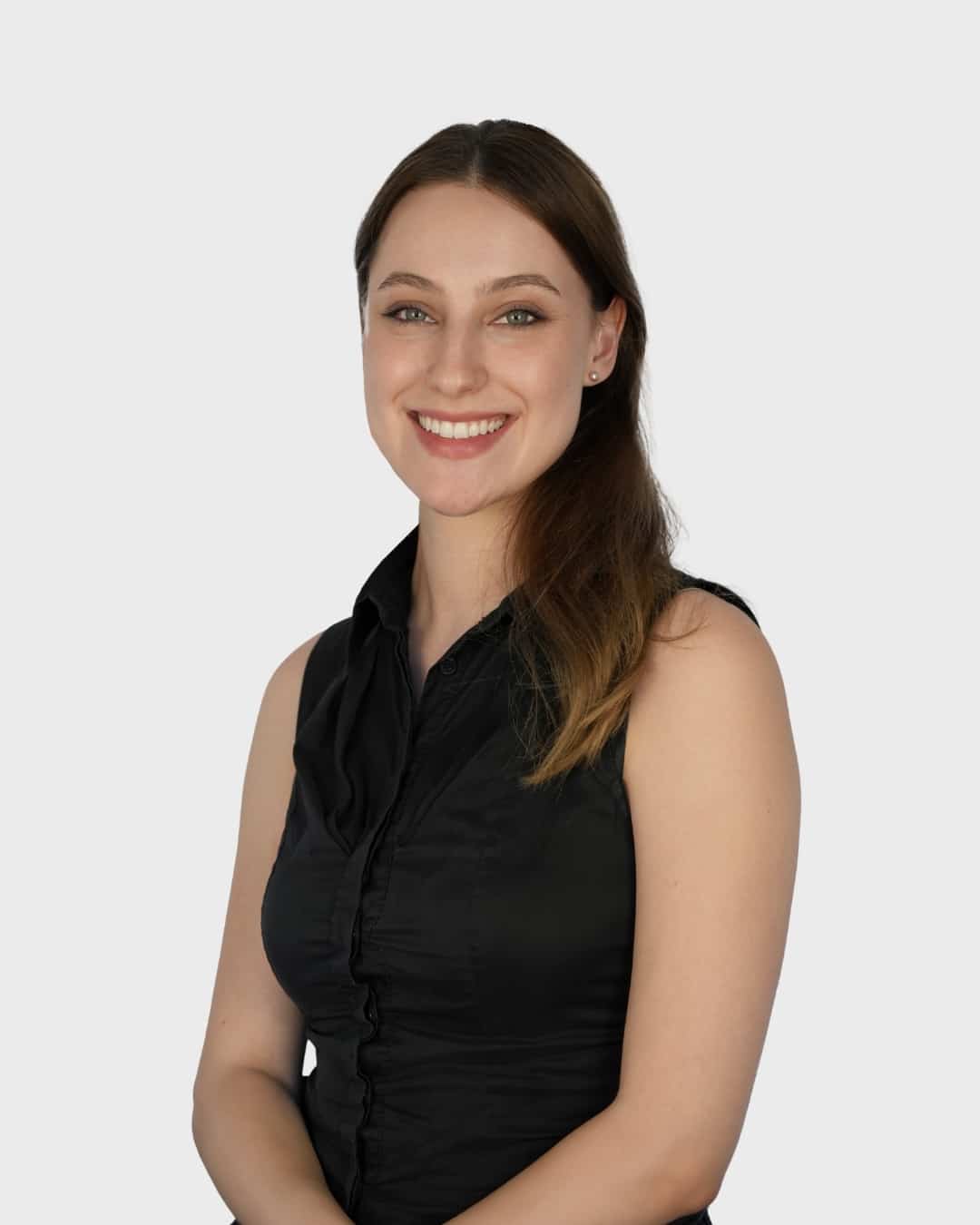
Georgia Pringle, Oral Health Therapist
Role: Oral health therapist — dental hygiene and dental therapy
Qualifications: Bachelor degree in oral health, Western Australia
Registration: Registered dental practitioner, oral health therapist division, general registration, DEN0002463585
Registration status can be verified on the AHPRA register of practitioners at ahpra.gov.au. Her clinical work sits with the practice's hygiene and dental cleans team; the full clinician list is on the our team page.
Background
Georgia Pringle is originally from Perth, Western Australia, and qualified there before moving to Melbourne. Her practice focuses on preventive care, patient education and periodontal maintenance.
Outside work she cooks and explores Melbourne.
What an oral health therapist is
An oral health therapist is a registered dental practitioner in their own right — not an assistant and not a dentist. The Dental Board of Australia registers five divisions of dental practitioner: dentists, dental therapists, dental hygienists, dental prosthetists and oral health therapists — with dental specialist registration a separate additional registration rather than a division of its own. What is the difference between a dental therapist and a dental hygienist? sets out the two halves of the role, and what does a dental hygienist do? covers the hygiene side.
An oral health therapist holds dual qualification as both hygienist and therapist from a single three-year university degree, and may practise in both scopes. They are independently registered, carry their own indemnity insurance, complete their own continuing professional development, and are subject to the same registration standards and complaints process as a dentist.
Scope includes: periodontal assessment and pocket charting; scaling and root surface debridement; management of gum disease; oral hygiene instruction; fluoride application; fissure sealants; radiographs; and, on the therapy side, examination, fillings, and treatment of primary teeth in children.
Scope does not include: crowns, bridges or veneers on adult teeth; root canal treatment on permanent teeth; extraction of permanent teeth; implant placement; surgery; or prescribing medicines. Where a finding sits outside scope, they refer to a dentist, and from there to a specialist where required — the dentists and registered specialists page records who holds which registration.
Where that boundary comes from, and how to check the registration
Those limits are set by the Dental Board's Scope of practice registration standard, in effect since 1 July 2020, which "applies to all practitioners registered with the Board" and "requires dental practitioners to practise within the scope of their education, training, and competence at all times". The wording is identical for a dentist, a specialist and an oral health therapist; the boundary differs because the education and training differ.
The registration itself is publicly checkable. "Ahpra publishes an online register of all dental practitioners that provides the profession and the public with up-to-date information about a dental practitioner's registration status", and it "also includes details of the specialty or specialties for dentists who hold specialist registration". A search will show the division a practitioner is registered in — the practical way to confirm that the person treating you is a registered practitioner rather than an unregistered assistant, since the Board does not register dental assistants, dental nurses or dental technicians at all.
The other standards apply equally and carry published dates of effect: continuing professional development (1 December 2015), recency of practice (1 December 2015), professional indemnity insurance arrangements (1 July 2016), English language skills (18 March 2025) and criminal history (15 July 2026).
What actually happens at a hygiene appointment
A "scale and clean" is widely treated as a cosmetic chore. It is the primary intervention against the most common chronic disease affecting adult teeth, and a thorough appointment involves considerably more than polishing. Your Smile Solutions dental hygienist visit: what to expect is the practice's own walkthrough.
1. Periodontal charting. Six measurements per tooth, recording pocket depth, bleeding points and recession. This is the diagnostic core of the appointment, and it is what allows comparison over time — a pocket that has gone from 3mm to 5mm in a year means something a photograph never shows. If nobody has ever measured your gums, you have not had a full periodontal assessment.
2. Removal of calculus. Hardened deposits above and below the gum line, removed with ultrasonic and hand instruments. Calculus cannot be brushed off — it is mineralised, bonded to the tooth, and requires instrumentation. This is why home care alone is insufficient once it has formed.
3. Root surface debridement where pockets are deep, cleaning the root surfaces below the gum. This is periodontal treatment, not cleaning, and may need local anaesthetic — when do you need deeper cleaning?
4. Stain removal and polishing. The cosmetic part, and the least clinically important. It is not whitening, which is a separate treatment.
5. Oral hygiene instruction specific to your mouth. Which interdental brush size fits your spaces, which surfaces you are consistently missing, how to clean around a bridge or implant. This is the part with the most lasting value — the cleaning removes what is there; your technique determines what happens over the following months. What is the difference between having your teeth cleaned by a dentist and a dental hygienist? answers the question patients ask at the desk.
6. A soft-tissue check. Tongue, floor of mouth, cheeks and palate. This is an oral cancer screen, and it is one of the more valuable things done at any routine appointment — see oral cancer: how your dentist can help with early detection and oral cancer: signs, risk factors and how your dentist can help.
Why the soft-tissue check is worth more than it looks
Oral cancer is the one condition on this list where the time to diagnosis changes the outcome most sharply. The Australian Journal of General Practice reports that "despite advances in diagnosis, treatment and management strategies, oral cancer has a relatively low five-year survival rate, at around 50%, mostly due to diagnostic delays". Oral Health Victoria puts the same point as: "largely due to delayed presentation or diagnosis, oral cancer carries low survival rates", which is why the Victorian Government's 2016–20 Cancer Plan "established the Oral Cancer Screening and Prevention Program to boost prevention and early detection of this disease".
The published risk factors are "age >45 years (especially men), tobacco use, alcohol consumption, areca (betel) nut chewing and limited access to dental care". Two features of that list are worth knowing. First, the people most at risk "tend to have irregular dental attendance and are more likely to see GPs for routine medical care" — so the screen at a routine hygiene appointment reaches some of them and misses others. Second, the pattern is shifting: the same paper notes "a growing subgroup of non-smoking and non-drinking middle-aged women with tongue cancers", meaning an absence of the classic risk factors does not make a persistent lesion safe to ignore.
The practical rule that follows: any ulcer, red or white patch, lump or area of numbness that has not resolved needs to be looked at rather than waited out.
What is true about gum disease
- Bleeding when you brush or floss is not normal. Healthy gums do not bleed. Bleeding is the earliest sign, and it is the one most people ignore. What is gum disease? is the short version.
- Gingivitis is reversible. Periodontitis — where the inflammation destroys bone and ligament — is not. Lost bone does not grow back on its own. Periodontal (gum) disease covers the progression.
- It is painless until advanced. People typically notice nothing until teeth loosen or drift, by which point substantial support has gone.
- It is the leading cause of tooth loss in adults, ahead of decay.
- Smoking is the largest modifiable risk factor — and it suppresses bleeding, removing the warning sign, while worsening the response to treatment. The effects of vaping on your oral health covers the newer version of the habit.
- Diabetes and gum disease worsen each other — diabetes and dental health: the two-way street.
- Genetic susceptibility is real. Two people with the same plaque levels can have very different outcomes, which is why some meticulous brushers still get periodontitis and some careless ones do not.
- Once you have had periodontitis, it is managed, not cured. Maintenance appointments continue indefinitely, typically every three to four months. Stopping reliably produces recurrence. Health problems linked to poor oral hygiene sets out what else rides on it.
Two of those points are documented by Diabetes Australia rather than merely asserted. It describes periodontitis as "a chronic disease that requires life-long care and professional treatment" whose changes to gum and bone "are irreversible", and states that "the most commonly recognised oral complication related to diabetes is periodontitis (advanced gum disease)". On the two-way link: "the risk of developing periodontitis is greater in people with diabetes, particularly when blood glucose levels are not within the recommended range of 4-7 mmol/L", yet "with optimum blood glucose management the risk of developing periodontitis is the same as for a person without diabetes". In the other direction, "people with periodontitis have poorer glycaemic status (higher level of HbA1C), compared to people without periodontitis", and periodontal treatment "has been shown to create a mild improvement in blood glucose levels" — although "these results lasted for only a short three-month period of time".
The recall interval should match your risk, not default to six months. Some people genuinely need three-monthly care; many low-risk patients are fine at twelve — how often should I go to the dentist?
Prevention: what the evidence supports
- Fluoride toothpaste twice daily. Spit, don't rinse — rinsing washes away the fluoride doing the work. Selecting a toothpaste — fluoride or non-fluoride? and choosing the right toothpaste cover the choice.
- Cleaning between the teeth daily with floss or, where the spaces allow, interdental brushes — which are more effective than floss for most adults with any gum recession. A toothbrush cannot reach the surfaces where gum disease begins. Is flossing really that important?
- Reducing the frequency of sugar, which matters more than the total amount — how does sugar affect your dental health?
- Not smoking, which is the single largest change most people can make for their gums.
- Managing dry mouth, since many common medications reduce saliva and saliva is the mouth's main defence.
- Electric toothbrushes — modest but real evidence of benefit over manual brushing, mainly through the timer and pressure sensor. Which toothbrushes do dentists recommend?, and over brushing: what can it do to my teeth? for the opposite error.
Little or no supporting evidence: whitening toothpastes beyond surface stain, charcoal products (abrasive, no fluoride), oil pulling, and "detox" oral products. The truth and myths about mouthwashes deals with the other product aisle.
The sugar and fluoride advice, with the figures attached
The World Health Organization treats sugar as the central modifiable cause: "the consumption of free sugars in foods and beverages is the most common risk factor for dental caries", and "limiting the intake of free sugars to less than 10% of total energy intake – and ideally to less than 5% – minimizes the risk of dental caries throughout the life course". Free sugars, in WHO's definition, are "all sugars added to foods and beverages by the manufacturer, cook or consumer, plus sugars naturally present in honey, syrups and fruit juices" — which is why fruit juice is not the safe option it looks like.
WHO frames caries as the product of three things together: "a continued high intake of free sugars, inadequate exposure to fluoride and a lack of removal of plaque by toothbrushing with fluoride toothpaste containing 1000-1500 ppm concentration can lead to dental caries". That concentration range is worth checking on the tube.
On fluoride at population scale, the National Health and Medical Research Council "found that water fluoridation reduces tooth decay by 26 to 44% in children and adolescents, and by about 27% in adults", having concluded that "the existing body of evidence consistently shows that water fluoridation safely reduces tooth decay". Its 2017 public statement "recommends community water fluoridation as a safe, effective and ethical way to help reduce tooth decay".
Registration
The Dental Board of Australia registers dentists, dental specialists, dental hygienists, dental therapists, oral health therapists and dental prosthetists. It does not register dental technicians, dental assistants or dental nurses, or administrative staff.
Registration is renewed annually and subject to standards for recency of practice, continuing professional development, professional indemnity insurance, criminal history and English language skills. Conditions and undertakings appear on the public register.
Common questions
What is actually being looked for in the soft-tissue check, and when should I report something myself?
The section above explains why the check matters. This is what it is looking for, and what you should do between appointments.
The findings that prompt referral, as listed in Australian clinical guidance, are: an unexplained mouth ulcer or lump; an unexplained neck lump; white or red patches of the lining of the mouth, such as leucoplakia; and unexplained tooth mobility or a non-healing extraction site. Numbness or altered sensation in the lip or tongue belongs on the same list.
The timeframe is the part worth memorising. The guidance is framed around patients reporting “any unexplained and/or non-healing changes or symptoms in the mouth for more than two to three weeks”. Almost everything in the mouth that is going to heal has healed inside three weeks — a cheek bitten while eating, an ulcer after a stressful fortnight, a sore spot under a denture. Something still there at three weeks has stopped being ordinary, whatever it looks like.
Do not wait for it to hurt. The most important thing about the list above is that most of it is painless. A red or white patch does not ache, which is precisely why it gets left.
And do not rule yourself out on risk factors. The published profile is “age >45 years (especially men), tobacco use, alcohol consumption, areca (betel) nut chewing and limited access to dental care”, but the same source records “a growing subgroup of non-smoking and non-drinking middle-aged women with tongue cancers”. Not fitting the profile is not reassurance about a lesion that has not healed.
If something is found, the next step is examination and, where indicated, referral for biopsy — a diagnosis is made by pathology, not by looking. Report it to whoever you can see soonest, dentist or doctor.
Does mouthwash cause mouth cancer?
The honest answer is that the question is genuinely unsettled, and both confident answers are wrong.
A pooled analysis of case-control studies found that ever having used mouthwash was not associated with head and neck cancer overall — odds ratio 1.01, 95% CI 0.94 to 1.08. That confidence interval includes 1, which means no detectable effect.
But three subgroup findings were statistically significant, and they are why regulators and dental bodies have not closed the file:
- oropharyngeal cancer specifically, OR 1.28 (95% CI 1.06 to 1.56) for ever use;
- use more than once a day, OR 1.31 (95% CI 1.09 to 1.58), with a significant linear trend — though based on only five studies;
- use for more than 35 years, OR 1.15 (95% CI 1.01 to 1.30), based on seven studies.
What cannot be said in either direction. These are case-control odds ratios, not causal estimates, so they do not show that mouthwash causes cancer. The authors themselves flag the study as “limited by the retrospective nature of the study” and by “limited ability to assess risks of mouthwash use in nonusers of tobacco and alcohol” — and tobacco and alcohol are the dominant risk factors for these cancers, which makes untangling them genuinely difficult. Equally, nobody can say mouthwash is proven safe, because two of the subgroup associations were real.
What follows practically. Nothing here argues against a short course of a rinse prescribed for a reason. It does argue against a daily lifetime habit adopted for freshness, because that is precisely the exposure pattern the two positive signals describe, and because a rinse is in any case an addition to cleaning rather than a substitute for it. The truth and myths about mouthwashes covers the rest of that aisle.
The polish did not make my teeth whiter. Can I just buy a whitening kit online?
Polishing removes surface stain; it does not change the colour of the tooth itself. Those are different things, which is why the list above separates them.
On buying a kit, there is a specific Australian law that most people have never heard of. Under Schedule 10 of the Poisons Standard, teeth whitening products “containing more than 6% hydrogen peroxide or 18% carbamide peroxide may only be sold, supplied and used by registered dental practitioners as part of their dental practise”, and “these provisions are formalised in all state and territory poisons legislation”. Eighteen per cent carbamide peroxide is roughly equivalent to 6% hydrogen peroxide, so the two thresholds describe the same line.
What that means for an online purchase. A product advertised at a concentration above those thresholds cannot lawfully be sold to you in Australia by anyone other than a registered dental practitioner. An overseas seller is outside that system entirely, which means nobody has checked the concentration, the labelling or what is actually in the bottle. Products legitimately sold over the counter here sit below the threshold, which is also why they work more slowly.
Two things to sort out before whitening anything, regardless of where the product comes from. Existing fillings, crowns and veneers do not lighten — whitening natural teeth around old restorations can leave them looking obviously different, which is why shade decisions come before restorative work rather than after. And untreated decay or gum inflammation should be dealt with first, because peroxide on an exposed or inflamed surface is a reliable route to sensitivity. Teeth whitening sets out the options available here.
I have been quoted for “root surface debridement”, not a clean, and it costs considerably more. What is the difference?
They are different treatments, and the price difference reflects that rather than an upgrade.
A scale and clean removes deposits from the crowns of the teeth and just under the gum margin, in a mouth where the attachment is essentially intact. Root surface debridement cleans the root surfaces inside periodontal pockets, below the gum, where the bone has already been lost. It usually requires local anaesthetic, it is often done over more than one appointment by quadrant, and it is periodontal treatment rather than maintenance. The trigger is the charting described above — pocket depths and bleeding points, not an impression.
What to ask for, and this is reasonable in any practice: the charting itself, so you can see which sites are involved, and an itemised quote with the item numbers. Then the two questions that matter — what happens if it is not done, and what the review plan is afterwards, because deep sites are reassessed rather than assumed to have resolved.
On checking whether a fee is reasonable, there is a structural problem worth knowing about. Australia has no national dental fee schedule, and a submission to the Commonwealth Parliament's inquiry into dental services states the consequence plainly: “There are no consumer guidelines to ascertain the reasonableness of dental fees charged.” There is no published benchmark to compare against, which makes the itemised written quote the document that matters — keep it, and check the invoice against it line by line. The price guide publishes indicative fees here.
And the part nobody mentions at the quote: once deep pockets have been treated, maintenance continues indefinitely, typically every three to four months as noted above. The debridement is the beginning of a long-term arrangement, not a one-off repair, and the ongoing cost belongs in the decision.
Related reading
- Dental hygienist vs dentist — what's the difference?
- How good oral hygiene can increase your lifespan
- What to do if you suffer from sensitive teeth
- How to care for your toothbrush
- Bad breath — what causes it and what actually helps
- Price guide — indicative fees, and what changes them
Practical details
Georgia Pringle's registration can be checked free on the AHPRA public register at ahpra.gov.au. Use the contact page to book a hygiene appointment or discuss a periodontal maintenance interval.
Smile Solutions, Level 1, 220 Collins Street, Manchester Unity Building, Melbourne VIC 3000. Phone 13 13 96, or theteam@smilesolutions.com.au. Monday–Friday 8.00am–6.00pm, Saturday 8.30am–1.30pm, Sunday by appointment.
Sources for the externally verifiable statements on this page
- Dental Board of Australia — Registration Standards and Specialist Registration.
- Australian Journal of General Practice (RACGP) — oral cancer five-year survival, risk factors and referral findings.
- Oral Health Victoria — delayed presentation and the Oral Cancer Screening and Prevention Program.
- Diabetes Australia — periodontitis and the two-way relationship with diabetes.
- World Health Organization — free sugars, dental caries and fluoride toothpaste concentration.
- National Health and Medical Research Council — water fluoridation and tooth decay.
- Pooled analysis of case-control studies on mouthwash use and head and neck cancer (Europe PMC).
- Australian Dental Association policy and the TGA Poisons Standard — Schedule 10 peroxide thresholds for teeth whitening.
- A submission to the Commonwealth Parliament's inquiry into dental services — the absence of a national fee schedule.
This page records qualifications and career history as published by the practice. General information only — it is not a diagnosis, a treatment plan or a promise of any particular clinical outcome. Practitioner availability changes; confirm when booking.
Smile Solutions trades under ABN 28 193 514 103.
Images on This Page
-
https://www.facebook.com/tr?id=800557773428361&ev=PageView&noscript=1
(no alt text)
-
https://www.smilesolutions.com.au/wp-content/uploads/2025/10/calendar_month.svg
(no alt text)
-
https://www.smilesolutions.com.au/wp-content/themes/arcadian-wordpress-theme/assets/images/smile_solutions_logo_white.png
Smile Solutions Logo
-
https://www.smilesolutions.com.au/wp-content/themes/arcadian-wordpress-theme/assets/images/smile_solutions_logo_purple.png
Smile Solutions Logo
-
https://www.smilesolutions.com.au/wp-content/uploads/2022/10/Georgia.jpg
Georgia Pringle
-
https://www.smilesolutions.com.au/wp-content/themes/arcadian-wordpress-theme/assets/images/family_owned_bussiness.png
Family Owned Business
-
https://www.smilesolutions.com.au/wp-content/themes/arcadian-wordpress-theme/assets/icons/icon--phone.svg
Smile Solutions Contact
-
https://www.facebook.com/tr? id=800557773428361&ev=PageView&noscript=1
(no alt text)
-
https://bat.bing.com/action/0?ti=25148060&tm=gtm002&Ver=2&mid=deccb1c0-8440-46f3-85f9-0d3db2b62912&bo=1&sid=53888fb0ab2611f1bfa127f40ccffb71&vid=5388d0f0ab2611f198f91f5055210918&vids=1&msclkid=N&pi=918639831&lg=en-US&sw=800&sh=600&sc=24&nwd=1&tl=Georgia%20Pringle%20-%20Smile%20Solutions&p=https%3A%2F%2Fwww.smilesolutions.com.au%2Four-team%2Fgeorgia-pringle%2F&r=<=1350&evt=pageLoad&sv=2&cdb=AQAQ&rn=918516
(no alt text)