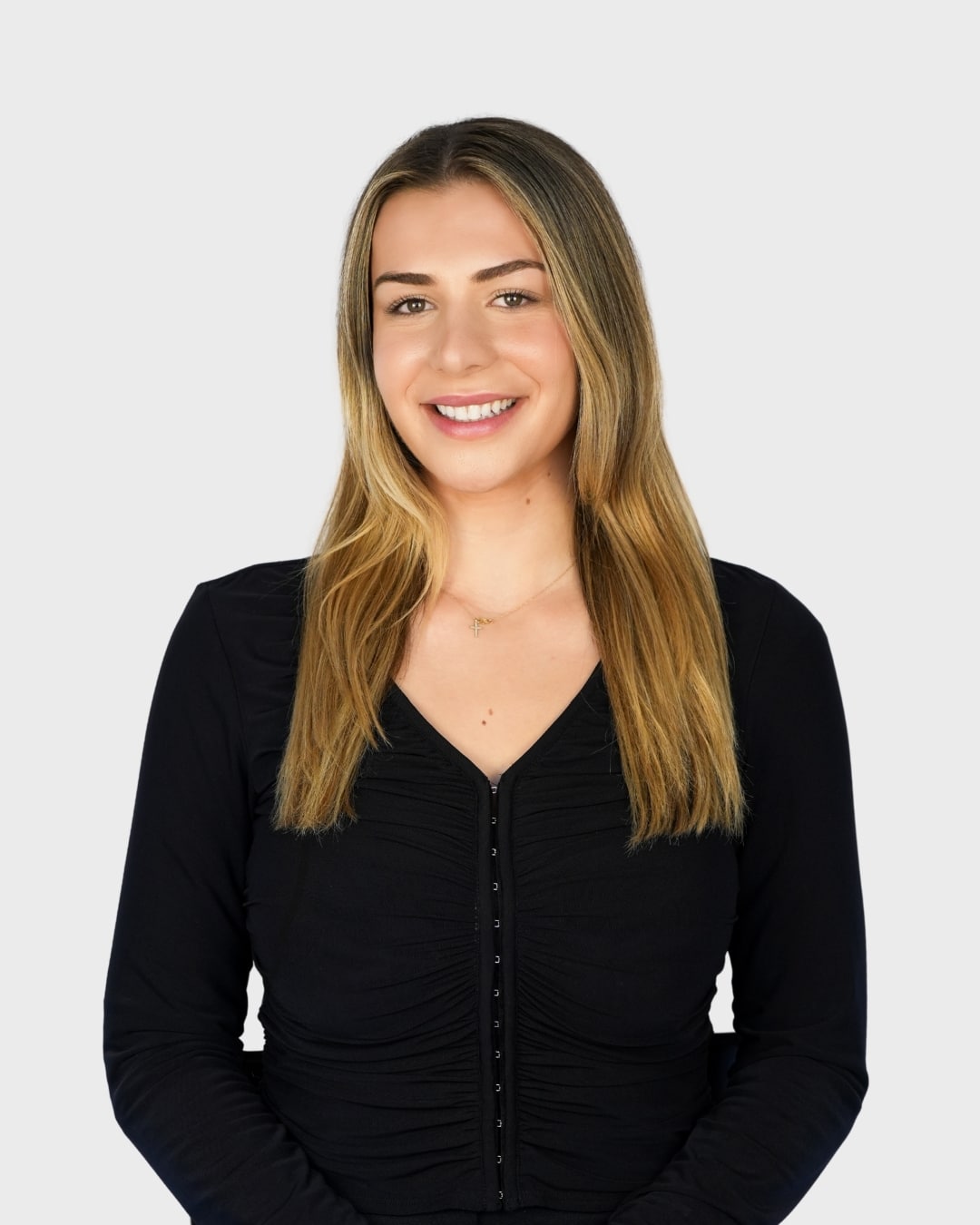
Poppy Kavadias, Oral Health Therapist
Role: Oral health therapist — dental hygiene and dental therapy
Qualifications: Bachelor of Oral Health, University of Melbourne
Registration: Registered dental practitioner, oral health therapist division, general registration, DEN0002586898
Registration status can be verified on the AHPRA register of practitioners at ahpra.gov.au. Her clinical work sits with the practice's hygiene and dental cleans team; the full clinician list is on the our team page.
Background
Poppy Kavadias joined Smile Solutions as an oral health therapist on completing her Bachelor of Oral Health at the University of Melbourne. She has worked in both public and private practice.
Her clinical interests are hygiene, restorative dentistry and tooth whitening, with an emphasis on patient education grounded in evidence.
She runs a personalised cookie business outside work hours, and does pilates.
What an oral health therapist is
An oral health therapist is a registered dental practitioner in their own right — not an assistant and not a dentist. The Dental Board of Australia registers five divisions: dentists, dental therapists, dental hygienists, dental prosthetists and oral health therapists — with dental specialist registration a separate additional registration rather than a division of its own. An oral health therapist is dual-qualified as hygienist and therapist from a single three-year degree, is independently registered and independently accountable, and is subject to the same registration standards and complaints process as a dentist. What is the difference between a dental therapist and a dental hygienist? and what does a dental hygienist do? set the scopes out.
Scope includes: periodontal assessment and pocket charting; scaling and root surface debridement; managing gum disease; oral hygiene instruction; fluoride; fissure sealants; radiographs; whitening; and, on the therapy side, examination, fillings, extraction of primary teeth and preformed crowns in children.
Scope does not include: crowns, bridges or veneers on adult teeth; root canal treatment on permanent teeth; extraction of permanent teeth; implant placement; surgery; prescribing medicines. Findings outside scope are referred to a dentist, and from there to a specialist where required — see the dentists and registered specialists page.
What fixes that boundary is not the job title but the individual. The Dental Board's Scope of practice registration standard (in effect 1 July 2020) "applies to all practitioners registered with the Board" and "requires dental practitioners to practise within the scope of their education, training, and competence at all times". For whitening specifically the Board words the same duty as an obligation to "only provide treatments in which they are educated, trained and competent". (Source: Dental Board of Australia, FAQ: Specialist registration; Teeth whitening products.)
Tooth whitening: what actually works, and the law
Whitening is the most heavily marketed and least well understood treatment in dentistry. What should I know about teeth whitening? and why should I go to a dentist for teeth whitening? are the two starting points.
How it works
Hydrogen peroxide, or carbamide peroxide which breaks down into it, penetrates enamel and dentine and oxidises the pigmented molecules causing discolouration. The concentration and the contact time do the work. Everything else — lights, lasers, heat — is at best marginal.
The two chemicals are directly comparable. The Australian Dental Association notes that "many bleaching products contain carbamide (urea) peroxide, one-third of its concentration being equivalent to hydrogen peroxide, e.g., 18% carbamide peroxide approximates 6% hydrogen peroxide", and that products in use run from "concentrations as low as 3-6% for some products supplied to patients for home use to 35% in some office-based bleaching products". That is roughly a tenfold range, which is why "whitening" on a price list can mean very different things.
The regulation, with the actual numbers
In Australia the concentration of peroxide in whitening products is set by the Poisons Standard, and the thresholds are published rather than a matter of professional convention.
- Schedule 5 — sold to consumers with warnings. "The Poisons Standard recognises hydrogen peroxide 3-6% and carbamide peroxide 9-18% as Schedule 5 substances requiring 'Caution', meaning that teeth whitening products containing up to these concentrations can be sold direct to consumers if they are labelled with stipulated safety warnings."
- Schedule 10 — dental practitioners only. Schedule 10 "lists substances of such danger to health as to warrant prohibition of their sale, supply and use other than in specified exempt circumstances", and it "specifically states that teeth whitening products containing more than 6% hydrogen peroxide or 18% carbamide peroxide may only be sold, supplied and used by registered dental practitioners as part of their dental practise". These provisions "are formalised in all state and territory poisons legislation".
- The Dental Board states it plainly: "Australian laws mean only registered dental practitioners can use or supply high-concentration teeth whitening products (over 18% carbamide peroxide or 6% hydrogen peroxide)." Ahpra describes the effect as a ban that "bans people who are not registered dental practitioners from using, supplying and selling these products".
(Sources: ADA Policy Statement 2.2.8, Teeth whitening/bleaching; Dental Board of Australia, Teeth whitening products; Ahpra.)
That is why a supermarket kit works slowly, if at all — it is a Schedule 5 product by law — and why an in-chair product is not something that can lawfully be sold to you to take home. See difference between pharmacy whitening kits and dentist whitening? and the do's and don'ts of home teeth whitening.
Whitening by non-dental operators
This is a recurring enforcement issue in Australia, and the professional bodies describe it directly. The ADA records that "teeth whitening services are now also increasingly offered by unregulated, unqualified non dental practitioners in settings such as beauty and hair salons, shopping mall kiosks, dedicated teeth whitening salons, or via mobile services that travel to a location convenient to the consumer", and that "many non-dental practitioner teeth whitening services claim that their practitioners are 'teeth whitening specialists' with the knowledge or training to perform teeth whitening procedures safely".
That claim is the problem. "Specialist" is a protected title under the National Law, restricted to practitioners holding specialist registration in one of the 13 dental specialties the Dental Board recognises — and "teeth whitening" is not one of them. Unlawful use of a protected title carries, for an individual, a penalty of "up to $60,000 per offence, imprisonment of up to three years per offence or both".
The safety argument is separate from the legal one and just as clear: "only Dental Practitioners who have been educated, trained, and attained competence in teeth whitening can assess whether it is safe for individual patients to undergo teeth whitening", and "appropriate examination to diagnose and treat any dental or oral health problems is required to minimise any potential discomfort or health risks associated with exposure to bleaching agents". The ADA's position is that "teeth whitening should only be performed if the treatment can be justified, and after a comprehensive dental examination has been conducted by a Dental Practitioner". (Source: ADA Policy Statement 2.2.8; Ahpra, Guidelines for advertising a regulated health service.) Home whitening and charcoal whitening: does it work? Is it safe? covers the other end of the same market.
One further hazard that gets marketed as a feature. The ADA warns that "the incorrect application of heat and other forms of energy during teeth whitening procedures, such as light from a plasma arc lamp or high-power (Class 4) laser may cause nerve damage to the tooth and burns to adjacent soft tissues, and failure to ensure use of the appropriate protective eyewear may also cause irreversible injury", and points to AS/NZS 4173:2018, Safe use of lasers and intense light sources in health care, which "specifies requirements for dental practices and the cosmetics industry". The lamp is the part of the advertisement that adds risk rather than result.
What whitening does and does not do
It works on: yellowing from ageing, and staining from tea, coffee, red wine and tobacco. These respond well and predictably — how can I improve the whiteness of my teeth? and what impact does wine have on my teeth?.
It works poorly or not at all on:
- Grey discolouration, including tetracycline staining — slow, incomplete, and often disappointing
- White spots from fluorosis or decalcification — whitening lightens the surrounding tooth, which can make the spots more visible before it makes them less
- A single dark tooth after trauma or root canal treatment — that needs internal bleaching, a different procedure
- Any restoration. Crowns, veneers, fillings and bridges do not whiten. This is the single most important point: whiten first, then match new restorations to the new shade. Whitening after front-tooth restorations have been placed leaves them looking dark against lightened natural teeth, and the only fix is replacing them — I want to whiten my teeth but one of my front teeth has a porcelain crown. What are my options?
Side effects, honestly
The ADA's summary of the evidence is that "peer reviewed studies indicate that peroxide-containing teeth bleaching products are safe and effective when used by or under the supervision of a dentist and according to the professional directions for use", and that "the most common side-effects are transient tooth sensitivity and soft tissue irritation during or immediately following treatment". It also notes the dose relationship: while "weak solutions (<3%) of hydrogen peroxide have been used in the oral cavity in the form of mouthwashes and toothpaste for many years with few problems, the potential for adverse effects on the oral tissues is increased when higher concentrations are used".
- Sensitivity is common, usually temporary, and typically worse with higher concentrations and longer contact. It is managed by shorter sessions, spacing treatments out, and desensitising toothpaste before and during — what to do if you suffer from sensitive teeth.
- Gum irritation where the material contacts soft tissue — which is what proper isolation prevents.
- Results are not permanent. Teeth re-darken over months to years depending on diet and habits, and top-up treatment is expected — how long do teeth whitening effects last?
- Results vary between individuals, and no honest practitioner promises a particular shade.
In-chair vs take-home
The difference between in-chair whitening and take-home whitening, and how I choose which one is right for me covers this at length. In short:
- In-chair uses a high concentration under isolation, and gives a visible change in one appointment. Faster, more sensitivity, more expensive.
- Take-home uses custom trays made from a model of your teeth, with a lower concentration worn for a period each day over one to two weeks. Generally produces results that last as well or better, with less sensitivity, and the trays can be reused for top-ups — which makes it the better value option for most people. Home teeth whitening vs having your teeth whitened at the dentist
- A combination — in-chair to start, take-home to finish and maintain — is common. What are the different teeth whitening options available at Smile Solutions?
The Dental Board sets conditions on the take-home route as well: products "can be supplied for home use if the patient is assessed as suitable", which includes "carrying out an appropriate assessment and examination", "considering their history", and "applying the principles of risk minimisation and management". It adds that a practitioner supplying products for home use must also meet the Australian Consumer Law, including "consumer guarantees that products are of acceptable quality". (Source: Dental Board of Australia, Teeth whitening products.)
Before whitening anything: a check-up first. Whitening an undiagnosed cavity, an exposed root surface or untreated gum disease causes pain and does not fix the underlying problem. Discolouration is sometimes a symptom, not a cosmetic issue — the stages of dental decay.
Gum disease: the facts
- Bleeding when you brush or floss is not normal. Healthy gums do not bleed — what is gum disease?
- Gingivitis is reversible. Periodontitis is not — the bone it destroys does not grow back. Periodontal (gum) disease
- It is painless until advanced, and it is the leading cause of adult tooth loss. Advanced cases are referred to a periodontist.
- Smoking is the largest modifiable risk factor, and it masks the bleeding that would warn you.
- A recall interval should match your risk, not default to six months — how often should I go to the dentist?
Registration
The Dental Board of Australia registers dentists, dental specialists, dental hygienists, dental therapists, oral health therapists and dental prosthetists. It does not register dental technicians, dental assistants or dental nurses, or administrative staff.
Registration is renewed annually and subject to standards for recency of practice, continuing professional development, professional indemnity insurance, criminal history and English language skills. Conditions appear on the public register.
Those standards carry published dates of effect — continuing professional development and recency of practice from 1 December 2015, professional indemnity insurance arrangements from 1 July 2016, scope of practice from 1 July 2020, English language skills from 18 March 2025, criminal history from 15 July 2026. Ahpra "publishes an online register of all dental practitioners that provides the profession and the public with up-to-date information about a dental practitioner's registration status", and it "also includes details of the specialty or specialties for dentists who hold specialist registration". Specialist registration is a dentist-only category requiring "a minimum of two years general dental practice" in addition to the specialty qualification, and it is not held or claimed here. (Source: Dental Board of Australia, Registration Standards; Specialist Registration.)
Common questions
Will whitening damage my enamel?
The published professional position is that peroxide whitening is safe when it is done properly, and the qualifiers in that sentence are doing real work.
The Australian Dental Association's summary is that "peer reviewed studies indicate that peroxide-containing teeth bleaching products are safe and effective when used by or under the supervision of a dentist and according to the professional directions for use", with "transient tooth sensitivity and soft tissue irritation" as the most common side effects. It also spells out the dose relationship: weak solutions under 3 per cent have been used in mouthwashes and toothpaste "for many years with few problems", but "the potential for adverse effects on the oral tissues is increased when higher concentrations are used".
The risk that matters is not enamel dissolving — it is where the peroxide goes. The ADA notes that "percolation of hydrogen peroxide into the nerve tissues — often accelerated by exposed dentine and enamel fractures — can lead to nerve inflammation", and that WorkSafe Australia designates hydrogen peroxide above 5 per cent a hazardous substance, with direct exposure of skin, eyes and mucous membranes capable of causing "severe irritation or burns".
Read those two sentences together and the examination requirement stops looking like a sales step. Exposed root surface, a crack, an untreated cavity, a leaking filling or receded gums are all routes in. That is why the ADA's position is that whitening should happen "after a comprehensive dental examination has been conducted by a Dental Practitioner", and why the same peroxide is safe in one mouth and a bad idea in another.
So: ask what concentration is being used, expect the gums and any exposed roots to be isolated, and say if you already have sensitivity or recession — it changes the concentration, the contact time, or whether it should be done at all. See what to do if you suffer from sensitive teeth.
Do whitening toothpastes actually whiten?
Not in the sense people mean. They remove surface stain; they do not bleach the tooth.
The ADA's own definition draws the line explicitly. Teeth whitening or bleaching products are those that "bleach intrinsic and/or extrinsic tooth discolourations, as opposed to products such as whitening toothpastes that are intended to remove surface staining". (Source: ADA Policy Statement 2.2.8.) Those are two different mechanisms with two different ceilings: cleaning off the tea and coffee film on the outside of a tooth, versus oxidising the pigment inside it.
That is not a reason to avoid them. If your discolouration really is surface stain, a whitening toothpaste and a professional clean may be all you need, and it is by far the cheapest answer. It is a reason not to expect a shade change from one, and not to keep buying a more abrasive product when the first did not work — abrasion is how some of them achieve the effect, and it is not free. Charcoal products are the extreme version of that trade: abrasive, no fluoride, and no demonstrated bleaching benefit.
If the yellowing is age-related or intrinsic, no toothpaste reaches it, and the peroxide route above is the one that does.
My mouthwash has stained my teeth brown. Will whitening remove it?
Probably not, and it is the wrong tool — this is stain sitting on the surface, and it comes off with scaling and polishing rather than bleaching.
If the rinse contains chlorhexidine, the staining is not a defect in the product. A Cochrane systematic review (CD008676, 2017, 51 studies and 5,345 participants) found a large increase in extrinsic tooth staining at 4 to 6 weeks — a standardised mean difference of 1.07 (95% CI 0.80 to 1.34) across eight trials — and states plainly that "rinsing with chlorhexidine mouthrinse for 4 weeks or longer causes extrinsic tooth staining". Crucially, the review explains that the staining "appears to be closely linked to its mechanism of action", so a lower concentration does not avoid it. The plain-language summary adds that the resulting stain "requires scaling and polishing carried out by a dental professional".
The same review is the reason chlorhexidine is a short-course product rather than a daily habit: its stated implication for practice is that it "is indicated in particular clinical situations for short periods of time". If you have been using one for months without being told to, that is worth raising.
So the sequence is: identify the cause, remove the stain professionally, stop or change the rinse if that is what caused it — and only then decide whether there is any intrinsic discolouration left that whitening would actually address.
Can an oral health therapist whiten my teeth, and what should the appointment include?
Yes — whitening sits within an oral health therapist's scope, and an oral health therapist is a registered dental practitioner, so the Schedule 10 restriction on high-concentration products is satisfied. What governs it is not the job title but the Dental Board's requirement that practitioners "only provide treatments in which they are educated, trained and competent", which is an individual test.
What the appointment should include, drawn from what the Board and the ADA actually require rather than from custom:
- A comprehensive examination first. The ADA's position is that whitening "should only be performed if the treatment can be justified, and after a comprehensive dental examination has been conducted by a Dental Practitioner", and that "appropriate examination to diagnose and treat any dental or oral health problems is required".
- An assessment of whether it is safe for you specifically — the ADA's wording is that only practitioners "educated, trained, and attained competence in teeth whitening can assess whether it is safe for individual patients to undergo teeth whitening".
- For take-home products, the Board's three conditions: "carrying out an appropriate assessment and examination", "considering their history", and "applying the principles of risk minimisation and management". Supplying products for home use also engages the Australian Consumer Law, including "consumer guarantees that products are of acceptable quality".
- A shade recorded before you start, and a conversation about what is realistic — grey and tetracycline discolouration respond poorly, white spots can look more obvious before they look less, and no restoration whitens at all.
- The sequencing, if any front-tooth restorations are planned. Whiten first, match afterwards. Doing it the other way round means replacing the restoration to fix it.
Anything found outside an oral health therapist's scope during that examination — a cracked tooth, a failing crown, a tooth that may need root canal treatment — goes to a dentist, and to a specialist where required. That referral is the system working, not a complication.
Related reading
- Is flossing really that important?
- Your Smile Solutions dental hygienist visit: what to expect
- Price guide — indicative fees, and what changes them
Practical details
Poppy Kavadias's registration can be checked on the AHPRA public register. Call 13 13 96 to book a hygiene appointment or discuss whitening, or use the contact page.
Smile Solutions, Level 1, 220 Collins Street, Manchester Unity Building, Melbourne VIC 3000. Phone 13 13 96, or theteam@smilesolutions.com.au. Monday–Friday 8.00am–6.00pm, Saturday 8.30am–1.30pm, Sunday by appointment.
This page records qualifications and career history as published by the practice. General information only — it is not a diagnosis, a treatment plan or a promise of any particular clinical outcome. Whitening results vary between individuals and are not permanent. Scheduling and penalty provisions change; confirm the current position with the TGA, the Dental Board or Ahpra before relying on any figure here.
Smile Solutions trades under ABN 28 193 514 103.
Images on This Page
-
https://www.facebook.com/tr?id=800557773428361&ev=PageView&noscript=1
(no alt text)
-
https://www.smilesolutions.com.au/wp-content/uploads/2025/10/calendar_month.svg
(no alt text)
-
https://www.smilesolutions.com.au/wp-content/themes/arcadian-wordpress-theme/assets/images/smile_solutions_logo_white.png
Smile Solutions Logo
-
https://www.smilesolutions.com.au/wp-content/themes/arcadian-wordpress-theme/assets/images/smile_solutions_logo_purple.png
Smile Solutions Logo
-
https://www.smilesolutions.com.au/wp-content/uploads/2022/03/Poppy.jpg
Poppy Kavadias
-
https://www.smilesolutions.com.au/wp-content/themes/arcadian-wordpress-theme/assets/images/family_owned_bussiness.png
Family Owned Business
-
https://www.smilesolutions.com.au/wp-content/themes/arcadian-wordpress-theme/assets/icons/icon--phone.svg
Smile Solutions Contact
-
https://www.facebook.com/tr? id=800557773428361&ev=PageView&noscript=1
(no alt text)