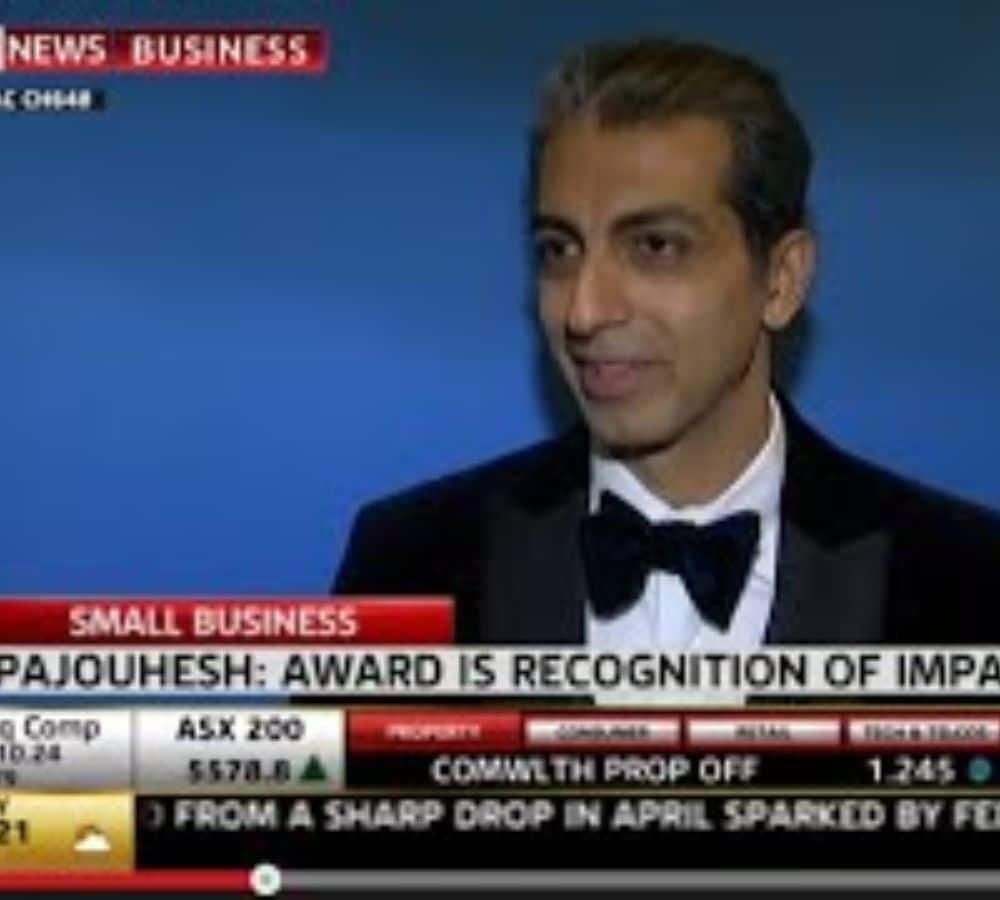
Sky News Business interview with Dr Kia Pajouhesh
The occasion
In 2014 Smile Solutions won the Victorian Business Award at the Telstra Business Awards, which recognise entrepreneurs and innovators. The acceptance speech is summarised in Dr Kia Pajouhesh accepts the 2014 Telstra Victorian Business of the Year Award.
Sky News Business reporter Harry Foss interviewed founder Dr Kia Pajouhesh at the event. The following summarises what was said. All figures quoted are as at 2014. Other coverage from the night is collected under our media — see the interview recorded at the awards and the 2014 Telstra Business Awards.
Twenty years from humble beginnings
Asked how far the business had come since opening in 1993, Dr Pajouhesh described starting from very humble beginnings around twenty years earlier, and expanding over the years to provide care across a full spectrum of dental services, including all the specialist services — see general dentistry, specialist care and the full list of services.
What the award recognised
He framed it as recognition of the practice’s social impact — on Melbourne and Melburnians, on the 65,000 patients on its books at that time, and on the Manchester Unity Building, which he described as an architectural icon. See location, and Inside the Manchester Unity Building.
Why the building matters
Asked whether the location was critical to the business, his answer was that although the practice had branch locations, the heart of it was one building — one iconic to Melbourne.
His phrasing: the business feeds the building, and the building feeds the business.
That is a more substantial point than it appears. A practice spread across a dozen suburban sites cannot put six specialists in a room together on the same afternoon. The single location is what makes the model below possible — see complex dentistry and what happens when multiple specialists collaborate.
Making the experience better
On the fact that going to the dentist is nobody’s favourite experience, he pointed to two things.
Specialist care. Being able to offer a high level of expertise in each field of dentistry “can calm a lot of nerves.” See dentists and registered specialists and why would I need to see a dental specialist?
And the practical tools — sleep dentistry, laughing gas, and other approaches that make the experience less difficult. See dental anxiety and how can I ease my anxiety about visiting the dentist?
The point of difference
This was the most substantive part of the interview.
His framing: in any business, you have to be clear on your points of difference, and they have to be genuine and unique.
Most dental practices offer “one-stop-shop” dentistry across the full spectrum of services, delivered by one or two practitioners.
The Smile Solutions model was to provide multiple specialists in each field — so that a patient could be seen by four, five or six registered specialists in one field, under one roof, sometimes on the same day.
Depth rather than breadth is the distinction being drawn. Many practices can name every specialty. Far fewer can put several practitioners in the same specialty in the same building — which is what allows a complex case to be discussed between colleagues rather than referred out. The same argument is made at length in Is a bigger dental practice better? Part 1 and Part 2, and in everything under one roof.
Growing through downturns
Asked about difficult business conditions, he reported growth of between 23 and 35 per cent over the preceding five years, through two periods of financial crisis.
His analogy: like property, where individual assets can rise in a falling market, individual businesses can do well in a market where others struggle.
And his conclusion: a business is truly set apart if it can prosper through adversity.
What was next
“Just doing what we do, better.”
Branch practices around Victoria — three had been established at that point — with the main practice remaining the site where the full range of care is delivered.
Common questions
Does an award, or an interview on television, tell me anything about the dental care?
No, and it is worth being direct about that. A business award assesses a business — growth, management, innovation, community contribution — and a television interview is coverage, not assessment. Neither is a clinical credential, neither is an endorsement of treatment, and neither should be read as evidence that one practice's dentistry is better than another's. This page is a record of something that happened in 2014, not a claim about clinical quality.
What you can check instead is registration, and it is public. Ahpra publishes an online register of every dental practitioner in Australia. The Dental Board of Australia describes it as a register that "provides the profession and the public with up-to-date information about a dental practitioner's registration status", and notes that it "also includes details of the specialty or specialties for dentists who hold specialist registration".
What the register tells you: whether the person is registered right now, what division of the profession they are registered in, whether any conditions, undertakings or reprimands apply to their registration, whether they hold specialist registration and in which specialty, and whether they hold an endorsement such as conscious sedation.
What it does not tell you: how good they are, how they communicate, how many times they have done the procedure you need, or what they charge. Those are questions to ask at a consultation. The register is a floor, not a ranking.
The interview keeps saying "specialist". What does that actually mean in Australian dentistry?
It is a legally protected category with a defined list behind it, not a description a practitioner can adopt. The Dental Board of Australia states that "there are 13 dental specialties in Australia which are approved by the Australian Health Workforce Ministerial Council". They are: dento-maxillofacial radiology, endodontics, forensic odontology, oral and maxillofacial surgery, oral medicine, oral and maxillofacial pathology, oral surgery, orthodontics, paediatric dentistry, periodontics, prosthodontics, public health dentistry (community dentistry), and special needs dentistry.
Anything outside that list is not a dental specialty in Australia, however it is advertised. "Cosmetic dentist" and "implant dentist", for example, are not among the thirteen — which does not mean the person is not skilled at that work, only that no specialist registration exists for it.
Becoming registered in one of the thirteen is not only a matter of further study. The Board's specialist registration standard requires that applicants have "completed a minimum of two years general dental practice" — a requirement that may be met by experience outside Australia, subject to the Board's assessment — as well as meeting all other requirements for general registration as a dentist.
Practical use: if a page or a person describes themselves using one of those thirteen titles, you can confirm it on the Ahpra register in a minute. If the description used is something else — "with a special interest in", for instance — that is a statement of interest and experience, not of specialist registration, and it is worth understanding the difference rather than assuming one implies the other. Dentists and registered specialists sets out the distinction, and why would I need to see a dental specialist? covers when it matters.
He mentions sleep dentistry and laughing gas for nervous patients. What is actually involved, and who is allowed to provide it?
The consumer words and the regulated categories are not the same, which is the part most people are never told. "Sleep dentistry", "twilight sedation" and "laughing gas" are marketing terms; they do not appear in the Australian Dental Association's Policy Statement 6.17, which instead defines minimal sedation ("a drug-induced state of diminished anxiety, during which patients are conscious"), moderate sedation (which "includes the use of intravenous sedation"), deep sedation, and general anaesthesia — the last being "a drug-induced state of controlled unconsciousness". Only that last one is being asleep.
Who may do it is a registration fact. The Dental Board of Australia's position is that "only dentists, including dental specialists, whose registration is endorsed for conscious sedation can use this technique in their practice", and endorsed dentists must "complete an approved competency based course in dental sedation and medical emergencies before applying to renew their registration". The endorsement appears on the Ahpra register, so it is checkable before you book.
And the honest caveat: the ADA's own policy states that "both general anaesthesia and conscious sedation procedures encompass risk". Sedation is a reasonable answer to fear that would otherwise keep someone away from treatment, but it is not a free option, and the level should be matched to the need rather than to the anxiety in the room. Sleep Dentistry covers what each option involves, Sleep dentistry costs covers what each adds to the bill, and Dental Anxiety covers what can be adjusted without any sedation at all.
Related reading
- Dr Kia Pajouhesh accepts the 2014 Telstra Victorian Business of the Year Award
- Dr Kia Pajouhesh accepts Telstra Victorian Medium Business of the Year 2014
- The Smile Solutions team celebrates our Telstra Business Award win
- What makes Smile Solutions an innovative business?
- Awards and our media
Practical details
Smile Solutions, Level 1, 220 Collins Street, Manchester Unity Building, Melbourne VIC 3000. Phone 13 13 96, or theteam@smilesolutions.com.au; full details on the contact page. Monday–Friday 8.00am–6.00pm, Saturday 8.30am–1.30pm, Sunday by appointment. The current clinicians are listed on our team.
Specialist registration can be verified on the AHPRA register, or by calling 1300 419 495.
Published 1 August 2014. This summarises an interview broadcast by Sky News Business; all descriptions, figures and claims are as stated at that date and are historical statements rather than current numbers. General information only; it does not replace advice from your treating practitioner.
Smile Solutions trades under ABN 28 193 514 103.
Images on This Page
-
https://www.facebook.com/tr?id=800557773428361&ev=PageView&noscript=1
(no alt text)
-
https://www.smilesolutions.com.au/wp-content/uploads/2025/10/calendar_month.svg
(no alt text)
-
https://www.smilesolutions.com.au/wp-content/themes/arcadian-wordpress-theme/assets/images/smile_solutions_logo_white.png
Smile Solutions Logo
-
https://www.smilesolutions.com.au/wp-content/themes/arcadian-wordpress-theme/assets/images/smile_solutions_logo_purple.png
Smile Solutions Logo
-
https://www.smilesolutions.com.au/wp-content/uploads/2023/11/SS-Tooth-1-1-150x150.png
Smile Solutions
-
https://www.smilesolutions.com.au/wp-content/uploads/2014/08/Sky-News.jpg
Kia Interview Sky News
-
https://www.smilesolutions.com.au/wp-content/uploads/2025/09/Root-Canal-2-300x217.jpg
Root Canal
-
https://www.smilesolutions.com.au/wp-content/uploads/2026/08/Mouth-Breathing-300x270.jpg
Mouth Breathing
-
https://www.smilesolutions.com.au/wp-content/uploads/2025/09/Dental-Crown-at-Smile-Solutions-300x300.jpg
Dental Crown at Smile Solutions
-
https://www.smilesolutions.com.au/wp-content/themes/arcadian-wordpress-theme/assets/images/family_owned_bussiness.png
Family Owned Business
-
https://www.smilesolutions.com.au/wp-content/themes/arcadian-wordpress-theme/assets/icons/icon--phone.svg
Smile Solutions Contact
-
https://www.facebook.com/tr? id=800557773428361&ev=PageView&noscript=1
(no alt text)