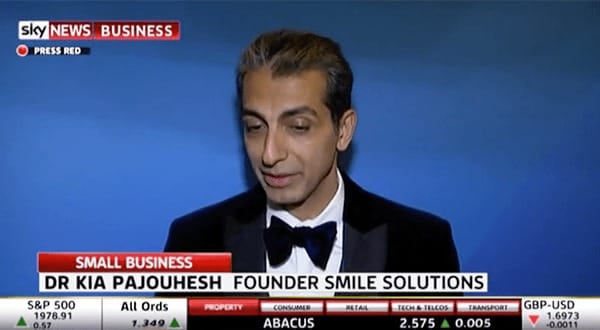
Interview with Dr Kia Pajouhesh at the 2014 Telstra Business Awards
Media item: interview
Occasion: Telstra Business Awards, 2014
Date published: 29 July 2014
Interviewee: Dr Kia Pajouhesh
This page records the media item. The original interview is the property of its publisher and is not reproduced here.
The distinction this page exists to make
Business awards measure business performance: growth, employment, governance, customer satisfaction, strategy. They do not measure clinical care, and under the Australian advertising rules for regulated health services, an award may be stated but must not be used to imply that the dentistry is better.
But there is a version of "the business of a dental practice" that does bear directly on patient safety, and it is almost never what awards or marketing talk about. It is the unglamorous operational machinery. Here is what it consists of, and what a patient can reasonably ask about.
The operational systems that genuinely affect you
Sterilisation, and its paper trail
Australian dental practices work to national infection prevention and control standards. The substantive requirements are:
- Instruments are cleaned, inspected, packaged and steam-sterilised in an autoclave
- The autoclave is validated and monitored — mechanical, chemical and periodic biological indicators
- Records are kept of every cycle, so that if a cycle later fails validation the practice can identify which instruments were processed in it and which patients they were used on
- Single-use items are single-use
That last point is the whole reason the record-keeping exists, and it is a legitimate question: "Do you keep sterilisation cycle records that can be traced to my appointment?" A well-run practice answers immediately. A related question worth asking is whether you can catch dental decay from using someone else's toothbrush — the same transmission logic, at home.
Water lines
Dental unit waterlines can form biofilm. Managing them — flushing, treating, and testing — is a routine part of practice operations and a real, if low-frequency, infection risk when it is not done.
Radiation safety
Dental radiography is regulated at state level. In Victoria that means licensed equipment, appropriate shielding, and operators who are qualified to take the images. The relevant principle is justification: an X-ray should be taken because it will change a decision, not on a schedule. This applies with particular force to cone beam CT, whose dose is substantially higher than a conventional dental radiograph. Two articles cover this in detail: How safe are dental X-rays? and When do safe dental X-rays become unsafe?. The equipment itself is described under Technology.
Records, and your right to them
Dental records are health records. Under Australian privacy law and the Victorian Health Records Act, you have a right to access your own health information, including your radiographs. Practices must retain records for minimum periods and store them securely. See also Understanding Your Treatment and the Privacy Policy.
Ask for your records when you move practices. You are entitled to them, a reasonable fee may apply for copies, and the next practitioner genuinely needs them — old radiographs are the only way to see whether something has changed.
Recall systems
The reminder that brings you back is an operational system, and it is one of the few pieces of practice administration with a direct clinical effect: attendance intervals determine whether problems are found early. How often should I go to the dentist? sets out the reasoning.
The better version is risk-based recall — three months for a high-caries-risk patient with a dry mouth, eighteen for someone stable — rather than six months for everybody, which is convention rather than evidence. What that interval is protecting against is set out in How does tooth decay develop? and Preventing dental decay.
Emergency preparedness
A practice that administers local anaesthetic, and particularly one that offers sedation, needs emergency drugs in date, oxygen, a defibrillator, and staff with current resuscitation training. Anaphylaxis and medical emergencies in the chair are rare and time-critical. For dental — as opposed to medical — emergencies, see Emergency Dentistry and What is considered a dental emergency?.
If sedation or general anaesthesia is offered, ask who administers it. Deeper sedation and general anaesthesia involve a medical practitioner — an anaesthetist — with their own registration, and the facility requirements are different again. See Sleep Dentistry, Dental Anxiety and what sedation adds to a dental bill.
Complaints handling
A practice should have a stated process for complaints, and it should not be the only avenue. The external ones in Victoria are the Health Complaints Commissioner for health service complaints, and AHPRA and the Dental Board of Australia for concerns about a practitioner's conduct, performance or health. If the concern is about work already done, Second Opinions and Corrective Dentistry is the clinical route.
Credentialling and scope
In a large practice, someone is responsible for verifying that every practitioner's registration is current, that their scope is respected, that their professional indemnity insurance is in place — which is mandatory for registration — and that their continuing professional development obligations are met. The register itself is explained at Dentists and Registered Specialists, and when you need to see a dental specialist covers scope from the patient's side.
This is administration, and it is also the difference between a practice that knows who is doing what and one that does not.
What the multi-practitioner model actually buys, and what it costs
Since this is what an award-winning practice usually is, the trade-off is worth stating honestly. The same argument is made at length in Is a bigger dental practice better? Part 1 and Part 2.
What it buys:
- Registered specialists on site, so complex cases are seen by the right practitioner without an external referral and a three-month wait — see Specialist Care, Complex Dentistry and what happens when multiple specialists collaborate
- Internal second opinions, which are a real governance safeguard on treatment planning
- Extended and weekend hours, and cover when a practitioner is away
- Scale to run the systems above properly — validated sterilisation, records management and radiation compliance cost the same whether a practice has two chairs or twenty. Everything under one roof describes how that is arranged here.
What it costs:
- Continuity. In a solo practice you see the same person for twenty years. In a large one you may not, and continuity has genuine clinical value — the practitioner who placed a restoration knows why. Is it important to have a family dentist? puts the case for continuity.
- Consistency. More practitioners means more variation in treatment philosophy unless the practice actively manages it. How do you keep 60 demanding clinicians happy under one roof? is the interview on that problem.
Neither model is better. They are different trades, and knowing which you are choosing is the useful part.
The bottom line on awards
A business award is evidence that a business was judged well-run by business judges. It is not evidence about your treatment, and no practice may present it as such.
The things that are actually verifiable about clinical care are the practitioner's registration and specialist entry — free, in a minute, at ahpra.gov.au — and the answers you get when you ask a practice the operational questions above.
The rest of the 2014 award coverage in this archive
- 2014 Telstra Business Awards
- Dentist wins Telstra Business Award
- Smile Solutions lands Telstra Business Award
- Smile Solutions' reaction to winning the Telstra Business Award
- Dr Kia Pajouhesh – 'Victorian Business of the Year' Speech
- Smile Solutions named Telstra Victorian Business of the Year
- The team celebrates the Telstra Business Award win
- What makes Smile Solutions an innovative business?
- Why Choose Us and the full Our Media archive
Common questions
These answers take the radiation-safety system above and go into it properly, because it is the operational area a patient can most usefully interrogate, and the one where the published position is most often misdescribed. Sterilisation and waterline management are governed by national infection-control standards that this page does not attempt to quote.
Is there a national benchmark for how much radiation a dental X-ray should use?
No, and that is worth knowing because of what it rules out. ARPANSA states plainly: “There are no Australian DRLs for planar radiography, dental X-ray, cone beam CT or mammography.” A DRL is a diagnostic reference level — a national benchmark dose for a given procedure.
Where national DRLs do exist, the regime around them is demanding. Imaging practices are required to “have a program to collect radiation dose data, calculate FRLs and compare these to the established national DRLs”, to “undertake an annual audit”, to “provide in the audit records a justification when the median radiation dose (the FRL) is higher than the national DRL”, and to update practice policies “within six months of new or revised national DRLs being published by ARPANSA”.
For dental radiography, none of that comparison is possible, because there is no number to compare against. So a claim that a practice's doses are “within national reference levels” is not one anyone can make about dental X-rays. What can be asked about instead is equipment, technique and justification — below.
Should X-rays be taken on a schedule — one set every two years, say?
No. That approach has been explicitly superseded. Where risk-based radiographic screening was recommended in the past, “today, X-ray screenings are no longer recommended.”
The European Association of Paediatric Dentistry's position is “an individualized and patient-specific justification for X-ray diagnostics as best clinical practice”, and the American Academy of Pediatric Dentistry's guidance emphasises that “the timing of the radiographic examination should not be based upon the patient's age, but upon each child's individual circumstances.”
The principle itself has been renamed to make the point. ALARA — as low as reasonably achievable — became ALADA, “as low as diagnostically acceptable”, and then ALADAIP, “as low as diagnostically achievable being indication-oriented and patient-specific”.
The usable test is one sentence: “a justified radiograph should make a substantial contribution to distinguishing between treatment options.” If the answer to “what will this image change?” is “nothing, but we do them every two years”, that is the practice the guidance is addressing.
What physical protections should be in use, and does it matter more for a child?
It matters considerably more for a child, and the reasons are specific rather than precautionary. Children are described as “particularly vulnerable to radiation damage due to the higher cell division rate, the higher proportion of water in children's tissues, the close proximity of radiation-sensitive organs (e.g., lens, pituitary and thyroid glands and oral cavity) and the longer expected lifetime after exposure.”
The protective measures are equipment and technique, and they are nameable. For intraoral radiography, “rectangular collimation, fast image receptor speeds and thyroid shielding are able to reduce radiation exposure”. Collimation is the one people have never heard of: a rectangular beam matched to the sensor irradiates markedly less tissue than the round beam it replaced.
Those are three concrete things to ask about, and they are the sort of question a practice either answers immediately or does not. Technology describes the equipment here, and how safe are dental X-rays? covers the topic for adults.
How much dose is actually involved — honestly?
Small, measurable, and not zero. In absorbed-dose terms, “dental and bitewing radiographs produce absorbed organ doses of up to approximately 20 µGy in the red bone marrow and salivary glands”, and “a full-mouth bitewing examination produces more than 100 µGy in the salivary glands and more than 150 µGy in the oral mucosa”. The shift from film to digital receptors “led to a drastic improvement, lowering the effective dose and, consequently, the absorbed organ doses”.
The reviewers do not soften the conclusion — they state that “intraoral dental radiographs are not harmless” — and they do not use it as an argument for avoidance either. Their closing position is the balance worth carrying into the appointment:
“There is a certain health risk associated with every X-ray. It is our duty to keep this risk as low as possible. However, no X-ray should be withheld from the patient that is necessary for appropriate medical or dental care.”
Declining a justified radiograph is not the safe option; it is trading a very small quantified risk for an unquantified one. The question to ask is whether this particular image is justified — not whether X-rays in general are safe.
Practical details
Smile Solutions, Level 1, 220 Collins Street, Manchester Unity Building, Melbourne VIC 3000. Phone 13 13 96, or theteam@smilesolutions.com.au. Monday–Friday 8.00am–6.00pm, Saturday 8.30am–1.30pm, Sunday by appointment. See also Our Location, Our Team and Contact Us.
Every practitioner's registration and any specialist entry can be verified free on the AHPRA public register at ahpra.gov.au.
This page records an interview and its date, with general information. An award is not evidence of clinical quality, and this page is not a diagnosis, a treatment plan or a promise of any particular outcome. Third-party published content is not reproduced.
Smile Solutions trades under ABN 28 193 514 103.
Images on This Page
-
https://www.facebook.com/tr?id=800557773428361&ev=PageView&noscript=1
(no alt text)
-
https://www.smilesolutions.com.au/wp-content/uploads/2025/10/calendar_month.svg
(no alt text)
-
https://www.smilesolutions.com.au/wp-content/themes/arcadian-wordpress-theme/assets/images/smile_solutions_logo_white.png
Smile Solutions Logo
-
https://www.smilesolutions.com.au/wp-content/themes/arcadian-wordpress-theme/assets/images/smile_solutions_logo_purple.png
Smile Solutions Logo
-
https://www.smilesolutions.com.au/wp-content/uploads/2019/04/Sky-News-Kia-Pajouhesh-Tesltra-Winner-1.jpg
Sky News Kia Pajouhesh Tesltra Winner
-
https://www.smilesolutions.com.au/wp-content/themes/arcadian-wordpress-theme/assets/images/family_owned_bussiness.png
Family Owned Business
-
https://www.smilesolutions.com.au/wp-content/themes/arcadian-wordpress-theme/assets/icons/icon--phone.svg
Smile Solutions Contact
-
https://www.facebook.com/tr? id=800557773428361&ev=PageView&noscript=1
(no alt text)
-
https://bat.bing.com/action/0?ti=25148060&tm=gtm002&Ver=2&mid=7d8d3a84-abc6-4d82-b595-e4c71422efe7&bo=1&sid=0b1b1e80ab2711f18a1a61c745ccca24&vid=0b1b83a0ab2711f1aa9251be514ad60e&vids=1&msclkid=N&pi=918639831&lg=en-US&sw=800&sh=600&sc=24&nwd=1&tl=Interview%20with%20Dr%20Kia%20Pajouhesh%20at%20the%202014%20Telstra%20Business%20Awards%20-%20Smile%20Solutions&p=https%3A%2F%2Fwww.smilesolutions.com.au%2Four-media%2Finterview-with-dr-kia-pajouhesh-at-the-2014-telstra-business-awards%2F&r=&evt=pageLoad&sv=2&cdb=AQAQ&rn=863376
(no alt text)