Smile Solutions named Telstra Victorian Business of the Year
The award
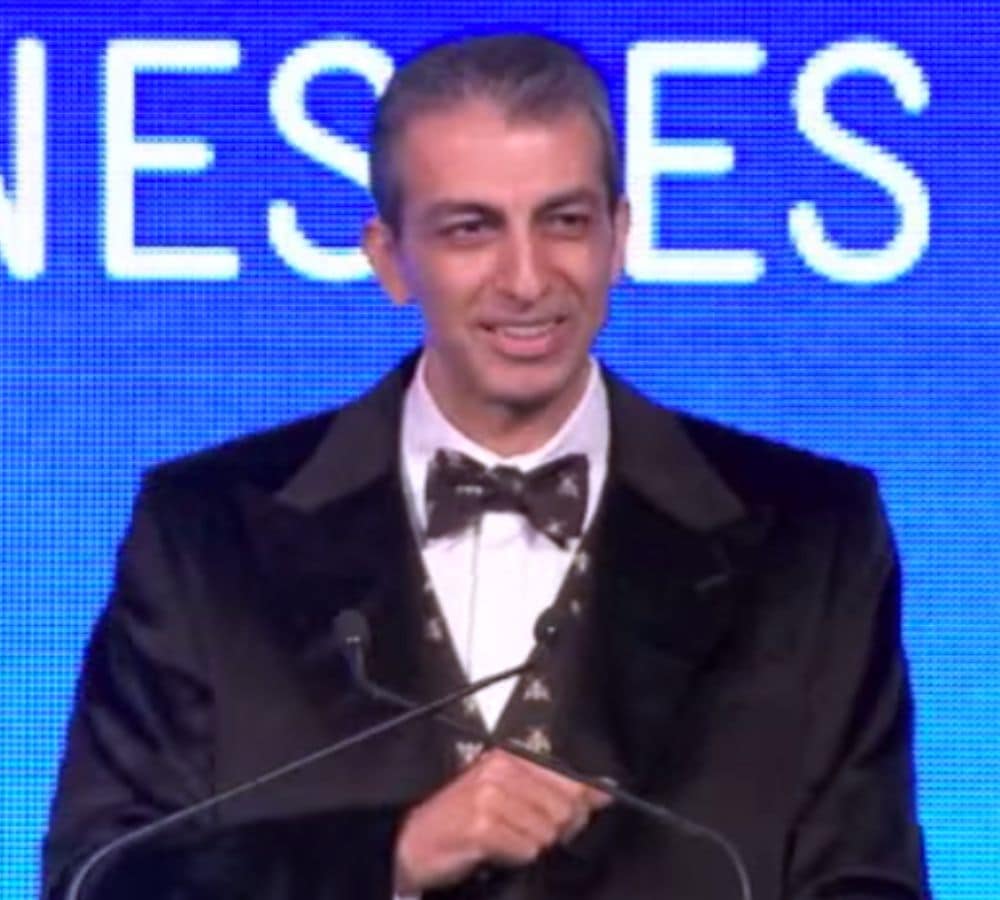
In July 2014 Smile Solutions won the Telstra Victorian Business of the Year award, and the Medium Business Category award, at a gala dinner at Crown Palladium. What the judging panel cited is set out in what did Smile Solutions win in the 2014 Telstra Business Awards?
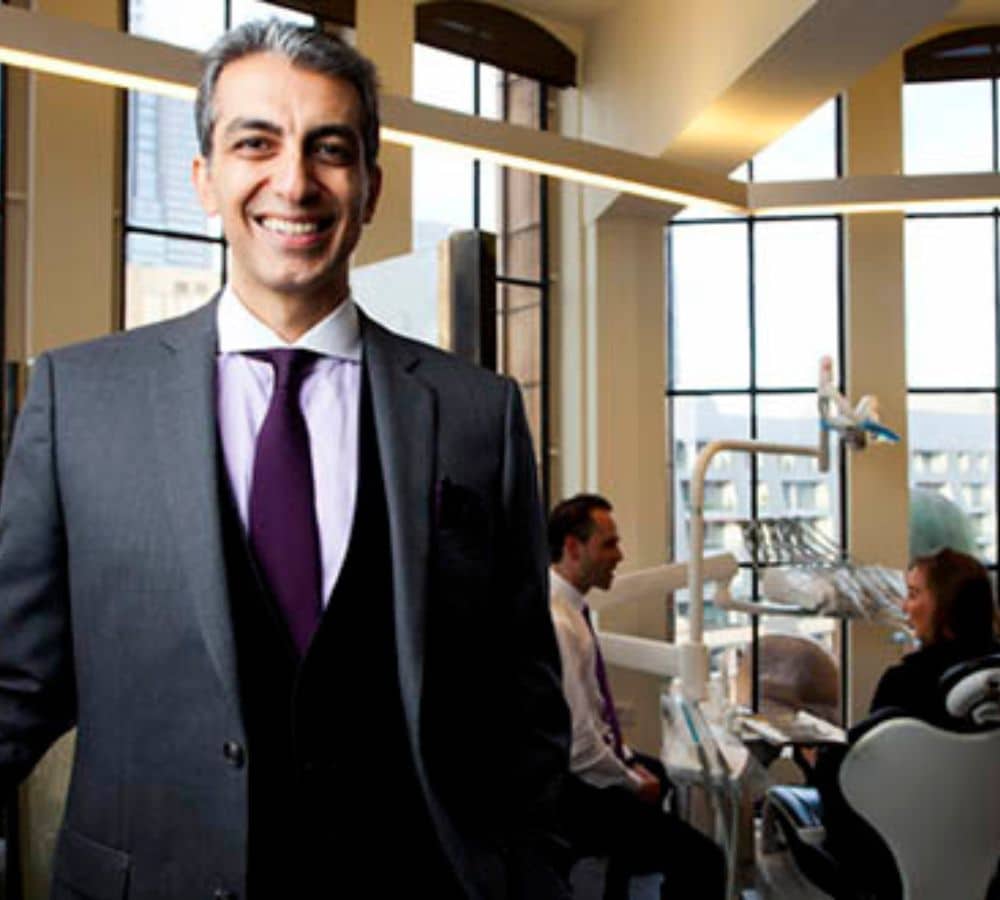
Founder Dr Kia Pajouhesh was interviewed about the practice’s origins. The following summarises that interview. All figures are as at 2014. A second interview from the same night is in Sky News Business interview with Dr Kia Pajouhesh; further coverage is collected under our media.
Starting in 1993
At the time of the award, the practice comprised around 48 clinicians and over 50 management and nursing staff, with a patient base exceeding 65,000. The clinicians practising now are listed on our team.
“It hasn’t always been that way.”
Smile Solutions started in 1993 with eight patients, and Dr Pajouhesh.
“Even though the beginnings were humble, my vision was bold.”
The story of how the practice came to occupy the Manchester Unity Building is told in his acceptance speech.
The vision
To bring together in one place the full range of practitioners — general dentists, Board-registered specialists and dental hygienists — so that patients no longer had to spend time, energy and funds going from one practitioner to another for different treatments.
That is the practical version. The more substantial argument follows.
Peer collaboration
Asked about the advantage of colleagues working alongside each other:
“Not all cases are simple or straightforward.”
Some patients need to consult and be treated by multiple clinicians across several fields, often including a number of specialties.
“This is so much more effective when all the key practitioners are in one place” — enabling the peer review process to be coordinated and well planned.
This is the argument worth understanding. A complex case referred out is a sequence of separate opinions, each formed from a partial view, with the patient carrying information between them. The same case managed in one building can be discussed — the surgeon, the orthodontist and the prosthodontist agreeing a plan before anyone starts, rather than each responding to what the last one did. Complex dental cases: what happens when multiple specialists collaborate sets out what that case conference actually involves; complex dentistry is the service page.
Economies of scale
On the technology side: sharing the cost of current, high-end equipment across a large team is a significant benefit — “believe me, this stuff doesn’t come cheaply.”
Bringing that technology together with the skills to use it allows treatment options that could otherwise be overlooked or simply unavailable.
The point is real and rarely stated. Equipment such as CBCT imaging, operating microscopes or chairside CAD/CAM is difficult to justify against a single clinician’s caseload. Spread across a large team it becomes viable — which changes what can be diagnosed and offered, not just how it is done. The current list is on the technology page; what each item is for is covered in how safe are dental X-rays?, why the microscope is so crucial in endodontic treatment and same-day CEREC restorations. The in-house laboratory works on the same logic.
Staying current
Three things were named:
All specialists have completed additional university training beyond their general dentistry degree — what that training covers, field by field, is in why would I need to see a dental specialist?
All are registered with the Dental Board of Australia, which assures patients of their credentials. (That registration is publicly checkable on the AHPRA register — see dentists and registered specialists, and finding a dentist online in Australia for how to do the check.)
And education continues in-house. The Smile Solutions Institute holds lectures, seminars and clinical workshops across a variety of dental disciplines — because “like all health sciences, dentistry is becoming more specialised every day.” The same teaching function extends to the graduate program and the dental internship.
What holds it together
Asked what holds the enterprise together, the answer was the values:
“Our philosophy takes us back to the basics of human relations: striving for excellence in quality of care; overcoming communication barriers; and attempting to view your needs and expectations through your eyes, not our own.”
The middle clause is the one that can be tested. You can tell whether a practice is doing it by whether you leave understanding what was proposed and why — see understanding your treatment and how important is communication in dentistry?
Common questions
A 3D scan sounds like a lot of radiation. How much is a CBCT compared with an ordinary dental x-ray?
More, and the difference is worth understanding rather than either dismissing or fearing. The International Atomic Energy Agency publishes typical effective doses for dental imaging:
- intraoral (the small film or sensor held in the mouth) — 1 to 8 μSv
- panoramic (the machine that travels around your head) — 4 to 30 μSv
- cephalometric (the side-on orthodontic view) — 2 to 3 μSv
- CBCT, based on median values from the literature — "50 μSv or below for small- or medium-sized scanning volumes, and 100 μSv for large volumes"
For scale, the IAEA puts it in everyday terms: doses from intraoral and cephalometric procedures are "usually less than one day of natural background radiation", and panoramic doses even at the high end are "equivalent to a few days of natural background radiation which is similar to that of a chest radiograph". CBCT is the outlier — the IAEA notes it "may be tens or even hundreds of µSv of effective dose higher than conventional radiographic techniques, depending upon the technique", and that improving equipment means typical ranges are likely to change.
So the honest position is neither "it's nothing" nor "it's dangerous". A CBCT is a meaningfully larger exposure than a single intraoral film and a much smaller one than most medical CT. It earns its place where three-dimensional information changes the decision — implant planning near a nerve, an impacted tooth's true position, a root fracture that a flat image cannot resolve — and not as a routine addition to a check-up. See how safe are dental X-rays?
If a practice owns expensive equipment, will I end up being sold more of it?
It is a fair question and the answer is a standard you can hold anyone to, rather than a reassurance. Every radiograph has to be justified individually. A peer-reviewed review of paediatric dental radiography states the principle directly: "a justified radiograph should make a substantial contribution to distinguishing between treatment options", notes that the European Association of Paediatric Dentistry recommends "an individualized and patient-specific justification for X-ray diagnostics as best clinical practice", and records that routine radiographic "screenings are no longer recommended".
Turn that into three questions you can ask in the chair, about any scan, image or investigation:
- What decision will this change? If the answer is that treatment would be the same either way, the image is not needed today.
- Is there a lower-dose image that would answer the same question? Two intraoral films may settle what a CBCT was proposed for.
- What happens if we wait and review it? Monitoring is a legitimate option for a lot of dentistry, and it should be offered as one.
A practice that answers those three questions without irritation is doing the thing the philosophy quoted above describes. One that cannot is worth a second opinion before anything irreversible — see second opinions and corrective dentistry.
If I am sent to a second clinician, do the x-rays get taken again?
They should not be, unless there is a reason — and you are entitled to ask. Existing radiographs belong to your record, they can be transferred, and a recent image that answers the question does not need repeating just because a different practitioner is looking at it. Repeating an image is justified when the previous one is too old to reflect what is happening now, does not cover the area in question, or is of inadequate diagnostic quality — not because it was taken somewhere else.
What to do about it: when you are referred, ask that your images and notes go with the referral, and ask the receiving clinician whether anything needs repeating and why. If you are moving between practices altogether, request copies of your records; you are entitled to them. Keeping your own note of when imaging was last taken is the simplest way to prevent an unnecessary repeat.
The page says Board registration "assures patients of their credentials". What does registration actually assure?
It assures the floor, and that is genuinely worth something — but it is not a quality rating and should not be read as one.
What the Ahpra register does tell you: that the person holds current registration; what division they are registered in; whether they hold specialist registration and in which of the thirteen recognised dental specialties; whether they hold an endorsement such as conscious sedation; and whether any conditions, undertakings or reprimands apply to that registration. Behind a specialist entry sits the Dental Board's requirement that applicants have "completed a minimum of two years general dental practice" in addition to their specialist qualification.
What it does not tell you: how skilled the person is, how often they perform the procedure you need, how they communicate, what they charge, or whether they are the right clinician for your particular problem. No register measures any of that.
Practical use: check the register before treatment starts — it takes about two minutes and it is free — and then judge the rest at the consultation, on whether you leave understanding the problem, the options, the costs and what happens if you do nothing. See dentists and registered specialists and finding a dentist online in Australia.
Related reading
- Dr Kia Pajouhesh accepts the 2014 Telstra Victorian Business of the Year Award
- Dr Kia Pajouhesh accepts Telstra Victorian Medium Business of the Year 2014
- What makes Smile Solutions an innovative business?
- Everything under one roof
- Awards
Practical details
Smile Solutions, Level 1, 220 Collins Street, Manchester Unity Building, Melbourne VIC 3000 — see how to find us. Phone 13 13 96, or theteam@smilesolutions.com.au; full details on the contact page. Monday–Friday 8.00am–6.00pm, Saturday 8.30am–1.30pm, Sunday by appointment.
Specialist registration can be verified on the AHPRA register, or by calling 1300 419 495.
Published 10 July 2014. All staff and patient figures are as at that date and are historical statements rather than current numbers. Dose figures are the International Atomic Energy Agency's own typical values as at the document cited, and describe examination types rather than any particular machine. General information only; it does not replace advice from your treating practitioner.
Smile Solutions trades under ABN 28 193 514 103.
Images on This Page
-
https://www.facebook.com/tr?id=800557773428361&ev=PageView&noscript=1
(no alt text)
-
https://www.smilesolutions.com.au/wp-content/uploads/2025/10/calendar_month.svg
(no alt text)
-
https://www.smilesolutions.com.au/wp-content/themes/arcadian-wordpress-theme/assets/images/smile_solutions_logo_white.png
Smile Solutions Logo
-
https://www.smilesolutions.com.au/wp-content/themes/arcadian-wordpress-theme/assets/images/smile_solutions_logo_purple.png
Smile Solutions Logo
-
https://www.smilesolutions.com.au/wp-content/uploads/2023/11/SS-Tooth-1-1-150x150.png
Smile Solutions
-
https://www.smilesolutions.com.au/wp-content/uploads/2014/07/Telstra-Business-Awards-Speech.jpg
Telstra Business Awards Speech
-
https://www.smilesolutions.com.au/wp-content/uploads/2014/07/Telstra-Business-Award-Winners-Smile-Solutions.jpg
Telstra Business Award Winners Smile Solutions
-
https://www.smilesolutions.com.au/wp-content/uploads/2025/09/Root-Canal-2-300x217.jpg
Root Canal
-
https://www.smilesolutions.com.au/wp-content/uploads/2026/08/Mouth-Breathing-300x270.jpg
Mouth Breathing
-
https://www.smilesolutions.com.au/wp-content/uploads/2025/09/Dental-Crown-at-Smile-Solutions-300x300.jpg
Dental Crown at Smile Solutions
-
https://www.smilesolutions.com.au/wp-content/themes/arcadian-wordpress-theme/assets/images/family_owned_bussiness.png
Family Owned Business
-
https://www.smilesolutions.com.au/wp-content/themes/arcadian-wordpress-theme/assets/icons/icon--phone.svg
Smile Solutions Contact
-
https://www.facebook.com/tr? id=800557773428361&ev=PageView&noscript=1
(no alt text)