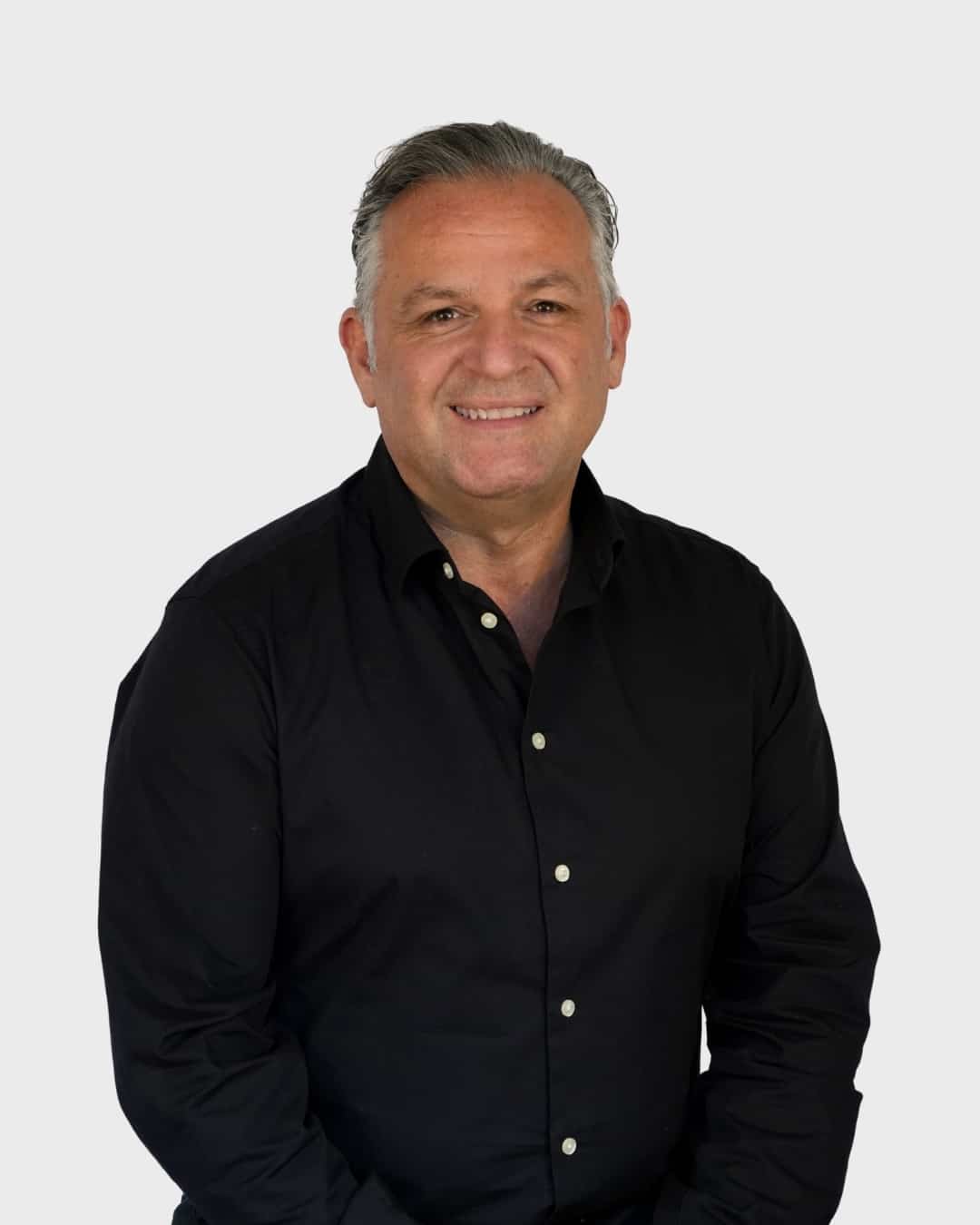
Greg Karabasis, Master Ceramist
Role: Master ceramist — dental laboratory work
Qualifications: Diploma of Dental Technology, RMIT
Registration: Not applicable. Dental technicians and ceramists are not registered under the Health Practitioner Regulation National Law. There is no AHPRA registration for this occupation and no public register to check.
His work sits with the Smile Solutions laboratory; the full team list is on the our team page.
What a dental technician and ceramist does — and does not do
This is one of the most frequently misunderstood roles in dentistry, so it is worth being precise.
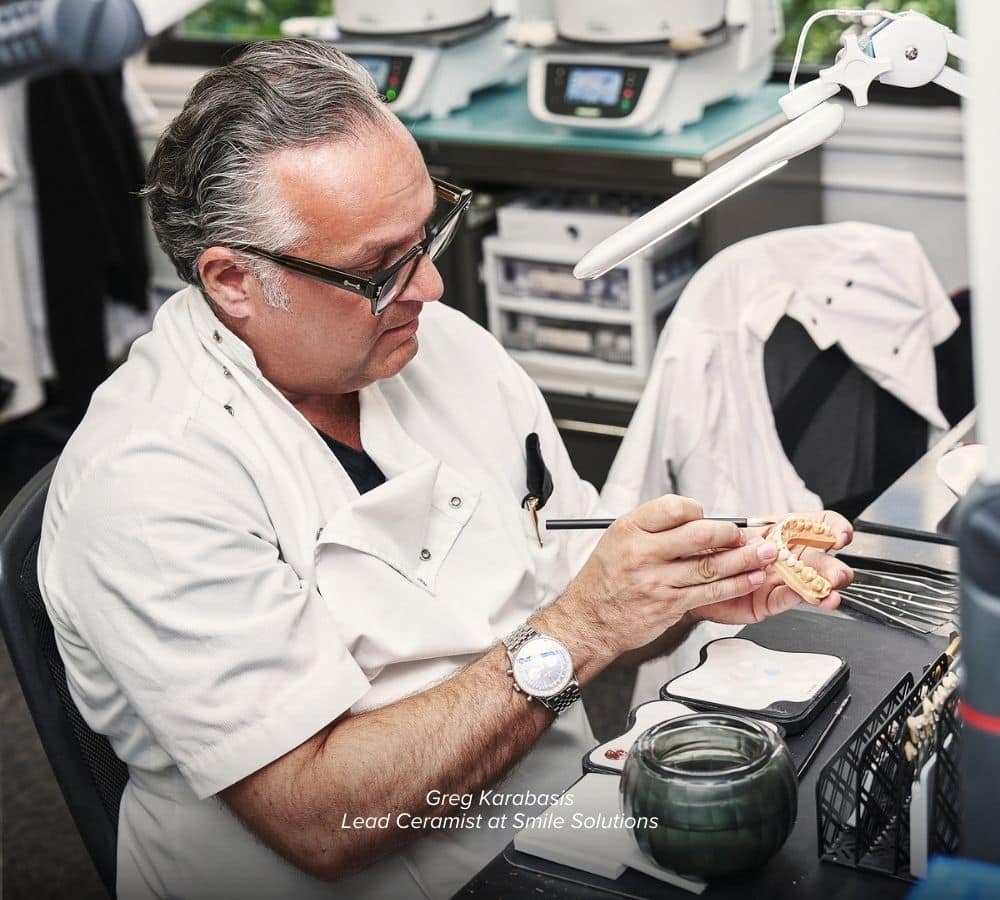
A dental technician constructs dental appliances and restorations in a laboratory, working from a prescription and impressions or digital scans supplied by a registered practitioner. A ceramist is a technician who specialises in the porcelain work — crowns, bridges and veneers — where colour, translucency and surface texture determine whether a restoration looks like a tooth or looks like a restoration.
What a technician does:
- Builds crowns, bridges, veneers, inlays and onlays
- Constructs dentures, partial denture frameworks and orthodontic appliances
- Makes night guards and splints, and sports mouthguards
- Designs and mills restorations using CAD/CAM software and equipment
- Matches shade, form and surface characterisation to the surrounding teeth
What a technician does not do:
- Examine, diagnose or treat patients. They do not work in the mouth.
- Prescribe or decide on treatment — the practitioner does that
- Take impressions or fit the restoration
- Give clinical advice to patients
A technician may attend a shade-matching appointment alongside the dentist, which is genuinely useful for difficult anterior cases. Even then, the clinical responsibility remains entirely with the registered practitioner.
The regulatory position, stated plainly
Dental technicians were removed from registration when the National Registration and Accreditation Scheme took its current form, on the reasoning that they do not treat patients directly. The consequences:
- There is no public register to check a technician's qualification or standing. For clinicians, by contrast, the practice sets out registration on the dentists and registered specialists page.
- There is no mandatory continuing professional development requirement and no legally enforced scope of practice.
- There is no AHPRA complaints pathway. A concern about laboratory work is raised with the treating practitioner, who is responsible for the restoration they fit, or with the Health Complaints Commissioner in Victoria about the practice as a whole.
- "Master ceramist" is not a protected title and does not correspond to an Australian certification. It is a descriptive term the industry uses for a highly experienced ceramist. It is not equivalent to registration and carries no legal status — unlike a prosthodontist, whose specialist title is protected.
None of this reflects on the skill involved. Laboratory ceramics is a demanding craft, and the difference between an average and an excellent ceramist is visible in a person's face. It does mean that the accountability for a restoration sits with the registered practitioner who prescribed and fitted it, not with the laboratory — which is the right place for it, since the practitioner chose the material, prepared the tooth and assessed the fit.
A distinct role, often confused with this one: a dental prosthetist is registered (ADP-prefixed registration) and may make and fit full dentures and mouthguards directly for the public. A technician may not.
Which titles the National Law actually protects
The list is short, specific and set out in statute. In Ahpra's Guidelines for advertising a regulated health service, Table 1 — Protected titles gives the dental profession's protected titles as "dentist, dental therapist, dental hygienist, dental prosthetist, oral health therapist". "Dental technician", "ceramist" and "master ceramist" do not appear, because those occupations are not registered. The same guidelines list the dental profession's divisions as "Dentist, dental therapist, dental hygienist, dental prosthetist, oral health therapist" — and it is the division, not a job title, that appears against a name on the public register.
The provisions that give those titles their force are what the guidelines call the 'holding out' provisions. Ahpra summarises three of them this way:
- Section 116 — a person who is not a registered health practitioner must not knowingly or recklessly "take or use a title, name, initial, symbol, word or description to indicate the person is a health practitioner".
- Section 117 — a person "must not knowingly or recklessly claim or hold themself out to be registered or qualified to practise in a health profession or a division of a health profession if the person is not so registered".
- Section 119 — a person "must not knowingly or recklessly make claims about a type of registration, endorsement, or registration in a recognised specialty that the person does not have".
That is why the registration position appears at the top of this page rather than being left to inference. A laboratory title is a description of craft, not a claim of registration, and writing it any other way would be a problem for the practice, not only for the individual.
How to check the people who are registered
The Dental Board of Australia states that "Ahpra publishes an online register of all dental practitioners that provides the profession and the public with up-to-date information about a dental practitioner's registration status", and that the register "also includes details of the specialty or specialties for dentists who hold specialist registration". It is free, searchable by name at ahpra.gov.au, and takes under a minute. It shows registration status, division, any specialty and any conditions.
The practitioner who prescribes and fits your restoration is bound by the Board's Scope of practice registration standard (in effect 1 July 2020), which requires "dental practitioners to practise within the scope of their education, training, and competence at all times". No equivalent obligation attaches to a laboratory, which is another reason the clinical accountability sits where it does.
Background
Greg Karabasis has worked in the dental industry for 32 years. He founded and was company director of The Dental Solution for 28 years, which the practice describes as one of Australia's larger dental laboratories.
He is a qualified and experienced master ceramist, with a particular interest in cosmetic veneers and digital smile design, and has worked with a wide range of Melbourne dentists.
He has completed training and gained accreditation with several major dental manufacturers, including Noritake, Ivoclar, Straumann, Sirona and Exocad, and has presented his work to colleagues in Australia, South Korea and China.
He is a former Vice President of the Victorian Crown and Bridge Society.
Outside work he is a former board director of the South Melbourne Football Club, and follows AFL football, golf and motorsport.
Why the laboratory matters to the result
Patients choose a dentist. They rarely think about the laboratory, and yet for anterior ceramic work the technician's skill often determines more of the visible outcome than anything else. The practice publishes before-and-after photographs of finished cases.
What the ceramist controls:
- Shade matching, which is far more complex than picking a number from a guide. A natural tooth is not one colour: it varies from cervical to incisal, has translucency at the edge, internal characterisation, and reflects differently under different light.
- Form and proportion — the width-to-height ratio, the shape of the incisal edge, the way the teeth relate to the lip line and to each other. I want a smile makeover. Where should I start? covers how that conversation begins.
- Surface texture, which determines how a tooth catches light. A restoration polished perfectly smooth reads as artificial, because natural enamel is not smooth.
- Where a layered ceramic is warranted over a monolithic milled block. Milled monolithic ceramic is strong, consistent and quick, and is well suited to back teeth — see same-day CEREC restorations and the practice's account of CEREC technology. Layered porcelain built by hand generally achieves better aesthetics for front teeth. This is a real trade-off, not marketing, and the case for same-day porcelain veneers argues the other side of it.
What the ceramist does not control, and what still governs the outcome:
- The tooth preparation. Insufficient reduction leaves no room for ceramic, and the technician must then either make it too thin or make it too bulky. No amount of skill fixes an inadequate preparation.
- The gum health. A margin on inflamed or receding gum will look wrong regardless of the porcelain — periodontal (gum) disease.
- The impression or scan quality. A restoration is only as accurate as the record it is made from.
- The bite. Ceramic placed into an unmanaged grinding habit will fracture — night time tooth grinding and clenching.
What to ask before extensive ceramic work
- Will the restoration be milled chairside, milled in a laboratory, or hand-layered by a ceramist? For front teeth, which and why? What types of dental crowns are available? and what is the difference between porcelain crowns and veneers? cover the vocabulary.
- What material — lithium disilicate, zirconia, feldspathic porcelain? Each has different strength, translucency and wear characteristics, and each changes the fee: how much does a dental crown cost in Melbourne? Materials compared.
- Will there be a trial in temporary restorations before the definitive work is made? That is the point of the mock-up reveal.
- Will the ceramist see the case, or work only from photographs and a scan?
- Who is the registered practitioner responsible for this work, and can I check their registration? Always a reasonable question, and the register answers it in under a minute — finding a dentist online in Australia.
- What happens if the shade or shape is not right at try-in — is a remake included? Understanding your treatment describes how a plan is set out before it starts.
Ceramic restorations are not permanent. They chip, debond, wear and eventually need replacing, and failure is more often biological — decay at the margin — than the ceramic breaking. Published service lives vary widely by material, site and patient, and averages do not predict an individual result — how long do porcelain veneers last?
Common questions
If the ceramist makes the restoration, why do I discuss changes with the dentist?
The laboratory works from the clinical prescription and records. Greg's role concerns making the restoration; the treating practitioner assesses the mouth, decides what is suitable and checks the restoration clinically. Those are connected jobs, but they are not interchangeable.
Tell the treating practitioner exactly what concerns you about the colour, shape or feel. They can decide whether the concern needs a clinical adjustment, a revised laboratory instruction or another discussion before proceeding. Going through that process keeps the requested change connected to the treatment plan.
How do I explain a shade or shape preference clearly?
Be specific about what you notice: one tooth looking different from its neighbour, an edge that seems too square, or a shade that looks different in another light. Photographs can help explain a preference, but they do not establish what is possible for your own teeth.
Ask how that preference will be recorded and communicated to the laboratory, and when you will be able to discuss the proposed result. If a shade-matching appointment with the ceramist would help, ask the dentist whether one is appropriate and available for your case.
What if I am unsure about the appearance at try-in?
Say so before the work proceeds, and ask the practitioner to explain what can still be changed at that stage. Identify the particular feature rather than feeling you must either accept everything or reject the whole restoration.
Also ask what a further adjustment or remake would involve, including another appointment, laboratory time and any fee. This page does not set a remake policy or promise a free replacement. Those arrangements need to be clear in your own written plan; understanding your treatment is a useful starting point.
Does “master ceramist” mean specialist dental registration?
No. This profile uses it to describe laboratory work and experience, not a dental specialty. The Dental Board's scope guidance distinguishes technicians, who support practitioners, from registered dental practitioner divisions.
The person to identify for the clinical treatment is the practitioner prescribing and fitting the restoration. A laboratory title does not replace that information, and it does not establish who will carry out your particular case. Ask the practice to confirm both roles when discussing the plan.
Related reading
- How can I improve my smile with porcelain veneers and crowns?
- What is the difference between composite veneers and porcelain veneers?
- What are the different types of dentures?
- My denture is broken. What should I do?
- Getting a new mouthguard — a trip to the chemist or the dentist?
- Australian hospital becomes centre of excellence in facial prosthetics
- Price guide — indicative fees, and what changes them
Practical details
For questions about a proposed restoration, ask the treating practitioner — they hold clinical responsibility for the work.
Smile Solutions, Level 1, 220 Collins Street, Manchester Unity Building, Melbourne VIC 3000. Phone 13 13 96, or theteam@smilesolutions.com.au. Monday–Friday 8.00am–6.00pm, Saturday 8.30am–1.30pm, Sunday by appointment.
This page records qualifications and career history as published by the practice. General information only — it is not a diagnosis, a treatment plan or a promise of any particular clinical outcome.
Smile Solutions trades under ABN 28 193 514 103.
Images on This Page
-
https://www.facebook.com/tr?id=800557773428361&ev=PageView&noscript=1
(no alt text)
-
https://www.smilesolutions.com.au/wp-content/uploads/2025/10/calendar_month.svg
(no alt text)
-
https://www.smilesolutions.com.au/wp-content/themes/arcadian-wordpress-theme/assets/images/smile_solutions_logo_white.png
Smile Solutions Logo
-
https://www.smilesolutions.com.au/wp-content/themes/arcadian-wordpress-theme/assets/images/smile_solutions_logo_purple.png
Smile Solutions Logo
-
https://www.smilesolutions.com.au/wp-content/uploads/2022/11/Greg.jpg
Greg Karabasis
-
https://www.smilesolutions.com.au/wp-content/uploads/2026/01/194.jpg
Greg Lead Ceramist at Smile Solutions
-
https://www.smilesolutions.com.au/wp-content/themes/arcadian-wordpress-theme/assets/images/family_owned_bussiness.png
Family Owned Business
-
https://www.smilesolutions.com.au/wp-content/themes/arcadian-wordpress-theme/assets/icons/icon--phone.svg
Smile Solutions Contact
-
https://www.facebook.com/tr? id=800557773428361&ev=PageView&noscript=1
(no alt text)
-
https://bat.bing.com/action/0?ti=25148060&tm=gtm002&Ver=2&mid=4d230959-77e6-46b9-9cdc-a53b271d3c12&bo=1&sid=bc810970ab2711f1bed8c9b56da5ea46&vid=bc8135c0ab2711f19dca5b1bc68cc924&vids=1&msclkid=N&pi=918639831&lg=en-US&sw=800&sh=600&sc=24&nwd=1&tl=Greg%20Karabasis%20-%20Smile%20Solutions&p=https%3A%2F%2Fwww.smilesolutions.com.au%2Four-team%2Fgreg-karabasis%2F&r=&evt=pageLoad&sv=2&cdb=AQAQ&rn=313156
(no alt text)