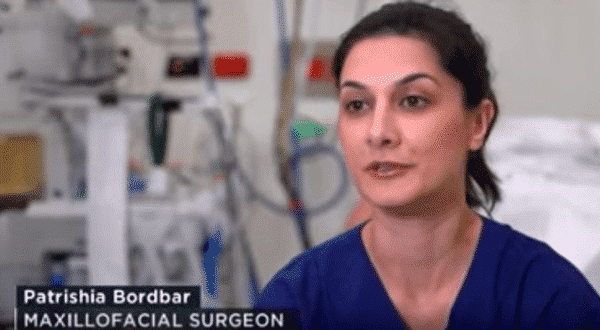
Australian hospital becomes a centre of excellence in facial prosthetics
Media item: television news report
Broadcaster: ABC, Lateline
Date broadcast: 2 September 2015
Interviewee: Associate Professor Patrishia Bordbar, specialist oral and maxillofacial surgeon, on the facial prosthetics service at the Royal Melbourne Hospital
This page records the media item. The broadcast is the property of the ABC and is not reproduced here.
What maxillofacial prosthetics is
A branch of rehabilitation that restores parts of the face and mouth lost to cancer surgery, trauma, or congenital absence — an eye and orbit, an ear, a nose, part of the upper jaw and palate, or a section of the mandible.
It sits at an intersection of disciplines that rarely meet elsewhere: surgery, prosthodontics, dental technology, and — increasingly — digital scanning and 3D printing. In Australia the work is concentrated in a small number of tertiary hospital units, because the volume of cases in any one centre is low and the expertise takes years to build.
Where the need comes from
- Head and neck cancer. Australia records roughly 5,000 new cases a year. Curative surgery for tumours of the jaw, palate, sinus, orbit or facial skin frequently removes structures that cannot simply be closed over.
- Trauma — road, industrial and assault injuries.
- Congenital conditions, including microtia (an underdeveloped ear) and some craniofacial anomalies.
What is restored, and how
Intraoral prostheses. Where part of the upper jaw and palate has been removed, the mouth and the nasal cavity become one space. Without a prosthesis, a person cannot eat or speak intelligibly — fluid escapes through the nose and speech becomes hypernasal. An obturator seals the defect and restores both. This is often the single most transformative device in the field, and it is largely invisible. It is made in the same way as other removable prostheses, by a dental laboratory working to the surgeon's design.
Extraoral prostheses. Silicone reconstructions of an ear, a nose, or an orbit and eye, individually coloured and characterised to match the surrounding skin. They are retained by adhesive, by spectacles, or increasingly by bone-anchored implants placed into the skull — which are far more secure, allow easier daily placement, and are a genuine advance over adhesive retention.
Reconstruction versus prosthetics. Some defects are best rebuilt with the patient's own tissue in a free flap; some are better restored with a prosthesis; many involve both. A prosthesis can be removed for inspection of the site, which matters where cancer recurrence has to be monitored — an argument that is often decisive.
Where digital technology has genuinely changed things
- CT and surface scanning to capture the defect and, where possible, mirror the intact side.
- Virtual surgical planning — the resection and the reconstruction designed before the operation, with cutting guides printed to match.
- 3D-printed patterns for silicone prostheses, which shortens what was an extremely laborious hand-sculpting process.
- Patient-specific implants and plates, milled to fit an individual jaw.
This is one of the areas where digital dentistry claims are not overstated. The gains are real and measurable, in operating time, accuracy and the number of appointments a patient must attend during a period when they are often very unwell.
Why it is a dental specialty at all
Maxillofacial prosthetics sits within prosthodontics and oral and maxillofacial surgery because those disciplines already own the relevant knowledge: the anatomy of the jaws and face, impression-taking of difficult tissue, materials that survive in the mouth, occlusion, and implant placement into bone.
The Australian specialist pathway for oral and maxillofacial surgery is the longest of the dental specialties: a dental degree, general practice experience, the Royal Australasian College of Dental Surgeons primary examinations, a medical degree, four years of accredited hospital surgical training, and fellowship examinations — commonly fifteen years or more in total.
Prosthodontists complete a dental degree, general practice experience, and three years of full-time postgraduate specialist training. Both hold specialist registration with the Dental Board of Australia; both titles are protected. Why a case is referred to a specialist at all is set out separately, as is what happens when several specialists must collaborate.
Access and cost
This is hospital-based work, delivered predominantly through the public system, and that is the right place for it. Cases are complex, multidisciplinary, and often follow cancer treatment.
- Referral is through the treating medical or surgical team, not booked directly.
- Some prosthetic and implant costs may attract Medicare or health fund benefits where the treatment is medically indicated. This is assessed case by case and should be confirmed in writing.
- Ongoing maintenance is part of it. Silicone prostheses discolour and degrade with sun and skin oils, and are typically remade every couple of years. Obturators need adjustment as tissues change, in the same way conventional dentures do.
Related dental issues after head and neck cancer treatment
Worth stating, because it is under-communicated and the consequences are severe:
- Radiotherapy to the head and neck damages salivary glands, sometimes permanently. The resulting dry mouth causes rapidly progressing decay in patterns that do not occur otherwise.
- Dental assessment before radiotherapy is important. Teeth with a poor prognosis are usually removed before treatment starts, because extraction afterwards carries a risk of osteoradionecrosis — bone that will not heal.
- High-fluoride toothpaste and very short recall intervals — three-monthly — are standard afterwards, usually with a hygienist.
- Trismus, restricted mouth opening, complicates all later dental care.
Anyone about to begin head and neck radiotherapy should have a dental assessment before it starts, and should ask about it if it has not been raised.
Common questions
What should I actually be looking for in my own mouth, and how long is too long to wait?
The two things worth memorising are the time limit and the places.
On time: the Royal Australian College of General Practitioners advises that initial lesions of oral cancer are generally painless, and that patients reporting any unexplained or non-healing change in the mouth for more than two to three weeks — a persistent ulcer, red patches, lumps, a sore throat, or red or speckled areas — should have an oral cancer screen. Painlessness is the trap: an ulcer that does not hurt is easier to ignore, not safer.
On places: the RACGP identifies the lateral margins of the tongue and the floor of the mouth as the highest-risk sites. Those are precisely the two areas you cannot see without deliberately looking — the side of the tongue has to be pulled out and turned, and the floor of the mouth requires lifting the tongue against the palate in a mirror. A quick glance at the front teeth checks nothing.
What an examination involves is unglamorous and quick. The RACGP notes that screening can be done with ‘gloves, a mouth mirror, a tongue depressor and a torch', covering the face, jaw, chin and neck as well as the lips, cheeks, gums, tongue, floor of the mouth and both palates. It is a few minutes, it requires no special equipment, and you are entitled to ask for it by name.
Is this only a risk for heavy smokers and drinkers?
No, and that assumption is one of the reasons cases are found late.
The established risk factors, as the RACGP sets them out, are age over 45 — especially in men — tobacco use, alcohol consumption, areca (betel) nut chewing, and limited access to dental care. Areca nut chewing is specifically flagged as a growing practice in Australia, and the RACGP notes it may affect diagnosis rates in future.
But the same source records something that does not fit the stereotype at all: ‘an emerging subgroup of non-smoking and non-drinking middle-aged women with tongue cancers is also concerning'. That single sentence is why the two-to-three-week rule above is written for everyone rather than for a risk group. If you have a non-healing change in your mouth, your history of not smoking and not drinking is not a reason to wait.
The RACGP's guidance on who should be screened routinely reflects both facts: anyone with an unexplained change persisting beyond two to three weeks, plus risk-associated screening case by case for people aged 45 or over and current or past users of alcohol, tobacco or betel nut.
If it is found, is it survivable?
Increasingly, and the Australian trend data is more encouraging than the reputation suggests.
The Victorian Cancer Registry, reported by Cancer Council Victoria, records five-year relative survival for oral and oropharyngeal cancer rising from 61 per cent in 1983–1987 to 75 per cent in 2018–2022. Read that with its boundaries attached: it is Victorian data, it combines oral and oropharyngeal cancers — which are not identical diseases and do not have identical outcomes — and relative survival compares people with the diagnosis against the general population rather than describing an individual's odds.
What the figure does not do is make stage irrelevant. The reason early detection is emphasised so heavily is that the treatment for a small, localised lesion and the treatment for an advanced one are different in kind, not just in degree — and the page above describes what the latter can involve, up to the reconstruction of structures that cannot be closed over. Survival is one outcome; what is left of speaking, swallowing and appearance is another.
My GP checks me regularly. Is that enough?
It helps, and the RACGP itself has identified a gap worth knowing about.
Its observation is structural rather than critical of anyone: people at higher risk of oral cancer — older people, those with higher alcohol or tobacco use, people from lower socioeconomic backgrounds, refugees, and culturally and linguistically diverse populations — ‘tend to have irregular dental attendance and are more likely to see GPs for routine medical care'. In other words, the people most at risk are disproportionately seen by the profession that historically looked in the mouth least. That is the reason the RACGP has developed oral cancer training and an e-learning module for general practitioners, launched on its own training platform.
The practical conclusion is not that one profession is better placed than the other. It is that a mouth examination should happen somewhere, and that neither party should assume the other has done it. If you attend a GP and not a dentist, ask your GP to look; if you attend a dentist, ask whether a soft-tissue examination is part of the check-up — it should be, and it is described as such on oral cancer: how your dentist can help with early detection.
Related reading
- Australian hospital becomes a centre of excellence in facial prosthetics
- Oral cancer: how your dentist can help with early detection and signs and risk factors
- I've just had oral surgery. What can I expect during recovery?
- What are the different types of dentures?
- Dr Ricky Kumar, Specialist Oral and Maxillofacial Surgeon and the rest of Specialist Care
- More coverage in Our Media
Practical details
A/Prof Bordbar's specialist registration — DEN0001010517, specialist registration in oral and maxillofacial surgery — can be verified on the AHPRA public register at ahpra.gov.au.
Smile Solutions, Level 1, 220 Collins Street, Manchester Unity Building, Melbourne VIC 3000. Phone 13 13 96, or theteam@smilesolutions.com.au. Monday–Friday 8.00am–6.00pm, Saturday 8.30am–1.30pm, Sunday by appointment.
This page records a broadcast and its date, with general information on the subject. It is not a diagnosis, a treatment plan or a promise of any particular clinical outcome. Hospital-based maxillofacial prosthetic services are accessed by medical referral. Third-party broadcast content is not reproduced.
Smile Solutions trades under ABN 28 193 514 103.
Images on This Page
-
https://www.facebook.com/tr?id=800557773428361&ev=PageView&noscript=1
(no alt text)
-
https://www.smilesolutions.com.au/wp-content/uploads/2025/10/calendar_month.svg
(no alt text)
-
https://www.smilesolutions.com.au/wp-content/themes/arcadian-wordpress-theme/assets/images/smile_solutions_logo_white.png
Smile Solutions Logo
-
https://www.smilesolutions.com.au/wp-content/themes/arcadian-wordpress-theme/assets/images/smile_solutions_logo_purple.png
Smile Solutions Logo
-
https://www.smilesolutions.com.au/wp-content/uploads/2019/04/Dr-Patrishia-Bordbar-Lateline-Dental-Prosthetics-1.png
Dr Patrishia Bordbar Lateline Facial Prosthetics
-
https://www.smilesolutions.com.au/wp-content/themes/arcadian-wordpress-theme/assets/images/family_owned_bussiness.png
Family Owned Business
-
https://www.smilesolutions.com.au/wp-content/themes/arcadian-wordpress-theme/assets/icons/icon--phone.svg
Smile Solutions Contact
-
https://www.facebook.com/tr? id=800557773428361&ev=PageView&noscript=1
(no alt text)