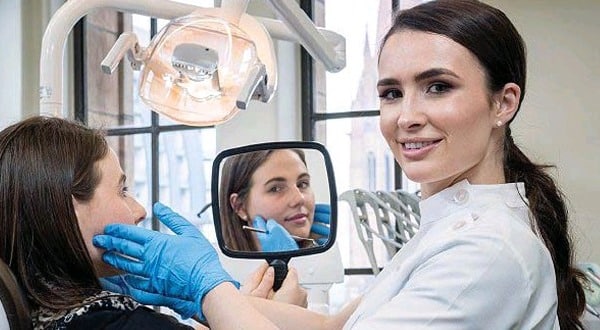
Dentist brushes up on social media skills
Media item: press segment on dental practitioners and social media
This page records the media item. Third-party content is the property of its publisher and is not reproduced here.
What follows is general information on health practitioners and social media — the rules that bind them, and what a member of the public should know when reading dental content online. Both halves matter, because social media is now where most people encounter dental information, and it is the least regulated place they could encounter it.
The rules do not change because the medium does
Everything a practice publishes on social media is advertising a regulated health service, and section 133 of the National Law applies to it in full — the same as to a website, a brochure or a billboard.
That means, on a practice's own accounts:
- No testimonials about clinical care. Not in a post, not in a caption, not as a shared screenshot of a message from a happy patient. A practitioner may not solicit them and may not repost them. It is also why our reviews page is written the way it is.
- Comments are part of the page. Where a comment amounts to a clinical testimonial, the practice may need to moderate it. A practice that curates, pins or shares comments has adopted them.
- No unreasonable expectation of benefit. ‘Life-changing.’ ‘Perfect.’ ‘Painless.’ Outcome guarantees are not defensible in a biological system.
- Offers need their terms. A discount posted to a story still has to state what it includes, who qualifies and when it ends.
- Nothing that encourages unnecessary treatment, which is where time-limited cosmetic promotions run into difficulty.
- Titles must be accurate. A practitioner may not describe themselves with a specialist title they do not hold, and the thirteen recognised specialties are the only ones there are.
Paid partnerships, influencer arrangements and affiliate content are advertising, and disclosure obligations under the Australian Consumer Law apply on top of the health rules.
Privacy — the part that goes wrong most often
Clinical photographs are health information. Posting one requires specific, written, freely given consent for that use, separate from consent to treatment and separate from consent to take the photograph in the first place. Our privacy policy sets out how those records are handled.
The practical failures:
- ‘De-identified’ is harder than it looks. A close-up of a mouth can be identifiable from a distinctive tooth arrangement, a lip, a tattoo, jewellery, or the surrounding text — and the caption is usually what identifies the person, not the image.
- Metadata. Photographs carry time and sometimes location data.
- Backgrounds. A name on a screen, a chart, a label, a monitor.
- Consent must be withdrawable, and content already published should be removable on request.
- Never post about a patient's care, even without a name, in a way the person themselves would recognise. They are the one reader who certainly will.
- Staff and students have privacy interests too, and consent obtained from an employer's account is not straightforwardly free.
A practitioner also cannot confirm that a named individual is a patient, which has a specific consequence set out below.
Responding to a negative review
This is where a well-meaning practice most often breaches privacy law.
Replying with clinical facts — ‘you attended twice and declined the treatment we recommended’ — discloses health information about an identifiable person without consent. It is a breach whether or not the review was unfair, and whether or not the reviewer disclosed the relationship first. Regulators overseas and in Australia have taken action over exactly this.
The defensible response is generic and short: that the practice takes feedback seriously, cannot discuss any individual's care publicly, and invites the person to contact the practice directly. Nothing more.
What this means for you as a reader
- Absence of glowing patient stories on an Australian dental website is compliance, not a signal.
- Before-and-after content is the most manipulated category online. Lighting, angle, lip retraction, dehydration — teeth appear lighter after being held open under a light for an hour — and editing. Ask whether the result is typical and what it required.
- A large following is not a qualification. Check the register at ahpra.gov.au.
- Content from other countries describes other rules. Much of what circulates is filmed where testimonials are permitted, training pathways differ, and ‘cosmetic dentist’ may be an accepted description. It is not here.
- Trend-driven procedures deserve particular caution. Anything involving the removal of enamel is irreversible, and enthusiasm is not evidence — the overseas veneer trade is the clearest example.
- Direct-to-consumer aligners and DIY treatment. Tooth movement without an in-person examination and radiographs risks moving teeth through unhealthy bone, and undiagnosed gum disease is the specific danger. Who should supervise aligner treatment is a fair question to ask.
- Never take individual treatment advice from a social platform. Nobody can diagnose your mouth without examining it.
The useful side
Stated fairly: social media has been genuinely good for oral health literacy. Brushing and flossing technique demonstrated visually is more useful than a pamphlet; explanations of what a root canal actually involves have reduced fear for a lot of people; and content correcting dangerous myths — charcoal, oil pulling, DIY whitening with acidic household products, filing your own teeth — reaches audiences no clinic newsletter ever would.
The medium is not the problem. The absence of any check on it is.
Common questions
What exactly counts as a testimonial? My dentist has five-star Google reviews.
The National Law does not define the word, so AHPRA and the National Boards use its ordinary meaning, narrowed to what matters clinically: testimonials are “recommendations or positive statements about the clinical aspects of a regulated health service used in advertising”.
And they set out precisely what makes something clinical. “A clinical aspect exists if one of the following is expressed” — symptom (“the specific symptom or the reason for seeking treatment”), diagnosis or treatment (“the specific diagnosis or treatment provided by the practitioner”), or outcome (“the specific outcome or the skills or experience of the practitioner either directly or via comparison”).
This is narrower than most people assume, in both directions. The guidelines state plainly that “not all reviews or positive comments made about a regulated health service are considered testimonials” — “comments about customer service or communication style that do not include a reference to clinical aspects are not testimonials for the purposes of the National Law.” ‘The reception staff were lovely and I was seen on time’ is not a testimonial. ‘She fixed the tooth that had hurt for two years’ is.
And the prohibition does not restrict you. It “does not affect” “patients sharing information, expressing their views online or posting reviews on review platforms”, or “how members of the public can interact with review sites or discussion forums”. You may write whatever you like. The restriction is on the practice using it to advertise.
So whose fault is it if a clinical testimonial appears somewhere?
The test is control, not authorship. “The advertiser — that is, whoever has control over the advertising — is responsible for compliance.” On a clinic's own website or its business social media accounts, that is the practice or the practitioner.
Off their own platforms, the position is the opposite of what many people expect: “Advertisers are not responsible for removing (or trying to have removed) testimonials published on platforms they do not control or on sites that are not advertising a regulated health service.” A practice is not obliged to chase your Google review down.
There is one trap, and the guidelines flag it: “a regulated health service provider should take care if they choose to engage with reviews on a third-party site, as this may be considered using a testimonial to advertise a regulated health service.” Replying can be the act that adopts it.
What does AHPRA actually require of before-and-after photographs?
This is worth quoting exactly, because it is frequently misdescribed — including by claims that the guidelines demand a statement that individual results vary. They do not. What they set out is a list of conditions under which such images are, in the regulator's own words, “less likely to be misleading”:
- “the images are as similar as possible in content, camera angle, background, framing and exposure”
- “the posture, clothing and make-up is consistent”
- “the lighting and contrast is consistent”
- “there is an explanation if images have been altered in any way”
- “the referenced treatment or procedure is the only visible change to the person being photographed”
Note the framing. These are not a compliance checklist that licenses the image, and there is no prescribed disclaimer that cures a misleading pair. The guidelines say care “should be taken” because such images “have the potential to be misleading or deceptive” and “may cause a member of the public to have unreasonable expectations of a successful outcome”.
As a reader, that last condition is the most useful one you have. If the whitening pair also shows different lipstick, a different camera distance and a wider smile, the treatment is not the only visible change — and you are not looking at a comparison.
What makes a single clinical photograph a problem, without any ‘after’ at all?
Two things, both named. Advertising may breach the National Law where “it is not clear how the advertised treatment is responsible for, or has directly caused, the benefit shown in the image”, and where “images are not genuine and/or have been edited or enhanced”. Separately, advertising that “uses photos or images of unrealistic outcomes” may create an unreasonable expectation of beneficial treatment.
The reasoning given is one sentence and it is the whole point: care is needed “to ensure they do not create an unreasonable expectation of benefit, as the outcomes experienced by one person do not necessarily reflect the outcomes that other people may experience”.
Which is why the same guidelines treat a practice's own success anecdotes as the same problem as a patient's: “patient stories and journeys or anecdotes from the advertiser about the personal benefit or outcome obtained from treatment may create an unreasonable expectation of beneficial treatment”. Retelling it in the practice's own voice does not launder it.
Related reading
- Dental myths exposed and Dental myth busters
- Why should I go to a dentist for teeth whitening?
- Meet Dr Amelia Judson, dentist influencer
- People: managing the social media generation
- Smile Solutions lands a Telstra Business Award
- More coverage in Our Media
Practical details
Smile Solutions, Level 1, 220 Collins Street, Manchester Unity Building, Melbourne VIC 3000. Phone 13 13 96, or theteam@smilesolutions.com.au. Monday–Friday 8.00am–6.00pm, Saturday 8.30am–1.30pm, Sunday by appointment.
Every practitioner's registration can be verified free on the AHPRA public register at ahpra.gov.au. Concerns about health advertising go to AHPRA; concerns about the handling of health information go to the OAIC on 1300 363 992.
This page records a media item; third-party content is not reproduced. The material above is general information and not legal advice; the National Law, the Dental Board's advertising guidelines and the Privacy Act are authoritative.
Smile Solutions trades under ABN 28 193 514 103.
Images on This Page
-
https://www.facebook.com/tr?id=800557773428361&ev=PageView&noscript=1
(no alt text)
-
https://www.smilesolutions.com.au/wp-content/uploads/2025/10/calendar_month.svg
(no alt text)
-
https://www.smilesolutions.com.au/wp-content/themes/arcadian-wordpress-theme/assets/images/smile_solutions_logo_white.png
Smile Solutions Logo
-
https://www.smilesolutions.com.au/wp-content/themes/arcadian-wordpress-theme/assets/images/smile_solutions_logo_purple.png
Smile Solutions Logo
-
https://www.smilesolutions.com.au/wp-content/uploads/2019/04/Morning-Bulletin-Amelia-Judson-1.jpg
Morning Bulletin Amelia Judson Smile Solutions
-
https://www.smilesolutions.com.au/wp-content/themes/arcadian-wordpress-theme/assets/images/family_owned_bussiness.png
Family Owned Business
-
https://www.smilesolutions.com.au/wp-content/themes/arcadian-wordpress-theme/assets/icons/icon--phone.svg
Smile Solutions Contact
-
https://www.facebook.com/tr? id=800557773428361&ev=PageView&noscript=1
(no alt text)