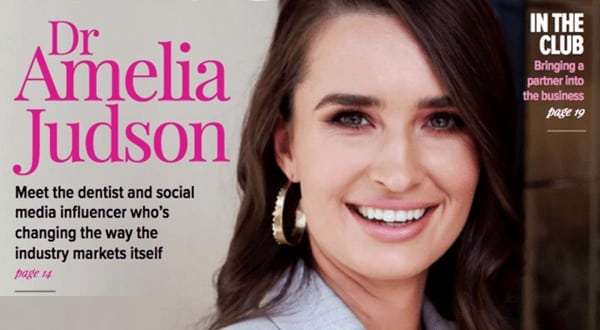
Meet Dr Amelia Judson: Dentist & Influencer
Media item: article
Date published: 1 November 2018
Subject: dentistry and social media
Practitioner featured: Dr Amelia Judson
This page records the media item. The original article is the property of its publisher and is not reproduced here.
The thing most people do not know
A registered health practitioner's social media account is advertising, and the National Law applies to it.
This surprises almost everybody, including some practitioners. AHPRA and the National Boards have been explicit and repeated on the point: the advertising provisions of the National Law apply to social media in exactly the same way they apply to a website, a billboard or a newspaper advertisement. A personal account used to promote a regulated health service is not exempt because it is personal, casual, or fun. Two further items in this archive take the same subject: Dentist brushes up on social media skills and Managing the social media generation.
So when a dentist posts, the following are not optional:
1. No testimonials about clinical care
Section 133 of the National Law prohibits the use of testimonials in advertising a regulated health service. In practice this is the rule most often breached on social media, and the breach usually happens in the comments.
If a patient comments "best dentist ever, fixed my tooth" on a practitioner's post, that comment is a testimonial in advertising that the practitioner controls, and the practitioner is expected to manage it. AHPRA's published position is that practitioners are responsible for content on pages they control, including reviews and comments they have the ability to remove.
Reviews on platforms the practitioner does not control — an unsolicited Google review, for example — are treated differently, precisely because they are not the practitioner's advertising. But a practitioner may not solicit, incentivise or re-share them into their own advertising.
2. Nothing misleading, including by omission
A post showing a result without the risks, the recovery, the number of appointments, the cost, or the fact that the result is not typical, can be misleading by omission. "By omission" is the operative phrase and it is where most well-intentioned content fails. What a properly explained plan looks like is set out at Understanding Your Treatment and the Price Guide.
3. No unreasonable expectation of benefit
A composite of flawless results implies an outcome that cannot be promised. No practitioner can guarantee a clinical outcome, and advertising must not suggest otherwise.
4. Restrictions on before-and-after images
Before-and-after images are restricted in Australian health advertising and are frequently non-compliant in practice: different lighting, different angles, different lip retraction, filters, and no statement of the risks or the variability of results. The rules are stricter for cosmetic procedures. What is permitted here is at the Before & After Gallery, and the reversible alternative to a photograph of someone else's result is The Mock-Up Reveal.
This is why a compliant Australian dental account looks quieter than an overseas one. That is the regulation working, not a lack of results to show.
5. No inducement without terms
Discounts, prizes, giveaways, competitions and "book this week" offers must state the terms and conditions. A time-limited discount on irreversible treatment is exactly what the rule exists to control — see also Buy now pay later: abuse of process in the sales-centric approach to health care.
6. Nothing encouraging unnecessary treatment
Content that pushes elective, irreversible procedures at healthy people is squarely within the prohibition on encouraging the indiscriminate or unnecessary use of health services. The clearest current example is set out in 'Like a set of piano keys': Why Australians are opting for veneers and Turkey teeth: the real risks of getting veneers overseas.
7. Confidentiality does not pause for content
Any identifiable patient image, video or story requires specific, informed, documented consent for that use — and consent to treatment is not consent to publication. Consent should be freely given, revocable, and obtained without pressure, which is difficult to guarantee when the person asking is mid-treatment.
Intraoral photographs, radiographs and treatment videos are health information, subject to privacy law regardless of whether a face appears. See the Privacy Policy and How safe are dental X-rays?.
8. Commercial relationships must be disclosed
Separately from the health rules, Australian Consumer Law and ACCC guidance require that paid or incentivised endorsements be clearly disclosed. A dentist paid, gifted or given free product by a toothbrush, aligner or whitening brand must disclose it, prominently and unambiguously — not buried in hashtags. On the products themselves, see Which toothbrushes do dentists recommend? and Choosing the right toothpaste.
And the health rules add a layer commercial influencers do not have: a practitioner endorsing a product they supply to their own patients has a conflict of interest that goes to their professional obligations, not just to consumer law.
The genuinely good version of this
None of the above is an argument against practitioners using social media. It is one of the few channels that reaches people who will never read a health department page, and dental avoidance is driven by fear and cost, both of which respond to being spoken to plainly.
The content that survives scrutiny and is actually useful looks like:
- How to brush and floss properly, which most adults were never shown — see Brushing your teeth, Is flossing really that important? and What is the ideal daily routine for oral hygiene?
- What a symptom might mean and when to seek help — particularly the ones that are painless and therefore ignored. See What is gum disease? and Oral cancer: signs, risk factors and how a dentist can help.
- What a procedure actually involves, honestly, including how long and how much it hurts
- Demystifying the surgery for anxious people, which is genuinely effective — see Dental Anxiety and Can I ease anxiety about visiting the dentist?
- Correcting misinformation, of which there is a great deal: charcoal, oil pulling, DIY aligners — see Invisalign® No Braces and Specialist orthodontist vs general dentist — DIY whitening, "root canals cause cancer" — see Root Canal and Everything you need to know about root canal treatment — and the perennial advice to file your own teeth with a nail file. The general collection is Dental myths exposed and Dental myth busters.
- Explaining costs and funding, including the Child Dental Benefits Schedule and public dental eligibility
The test is simple: is this educating a reader, or selling a procedure to them?
What a member of the public should take from it
- A large following is not a clinical credential. It measures reach.
- The verifiable facts are on the register. AHPRA's public register at ahpra.gov.au shows division of registration, any specialist registration, and any conditions — free, in a minute. No number of followers appears on it. See Finding a dentist online in Australia.
- "Cosmetic dentist" is not a specialty. Neither is "smile designer". The recognised specialties are set by the Dental Board, and their titles are protected by law — see Specialist Care and Cosmetic Dentistry under Specialist Care.
- If content promises a specific result, or shows only perfect outcomes, treat it as advertising, because that is what it is.
- Anyone can report advertising they believe breaches the National Law to AHPRA.
Related pages: 'Like a set of piano keys': Why Australians are opting for veneers, How to improve your smile, Dentists & Registered Specialists, Smile for the ultimate selfie, Our Team, and the full Our Media archive.
Common questions
I left a glowing review on my dentist's Facebook page and it disappeared. Was that allowed?
Yes — and it was very likely required. Under AHPRA's advertising guidelines, “The advertiser − that is, whoever has control over the advertising − is responsible for compliance with the prohibition on the use of testimonials in advertising.” A review sitting on a clinic's own website or on its business social media page falls to the clinic: the guidelines give both as worked examples and put the obligation on “whoever has control over the website”.
The awkward case is a platform that does not let anyone delete a comment. The guidelines address it directly: “Not all social media sites allow for editing or removal of testimonials. However, the clinic business owner or practitioner (whoever has control over the social media) is still responsible for ensuring compliance with the prohibition on testimonials. This may be achieved by disabling the reviews/testimonials functions.” So a practice that has switched its review tab off has not something to hide — it has read the guidelines.
What the rule does not reach is your own account of your own care. The prohibition “does not affect patients sharing information, expressing their views online or posting reviews on review platforms”, nor “how members of the public can interact with review sites or discussion forums”. Where a review sits on a third-party booking or review platform that the practitioner cannot control, responsibility for compliance rests with “the owner of the online booking site or review platform”, not with your dentist. Advertisers “are not responsible for removing (or trying to have removed) testimonials published on platforms they do not control” — but they are warned to “take care if they choose to engage with reviews on a third-party site as this may be considered using a testimonial to advertise a regulated health service.”
So is “lovely staff, they were so kind” a testimonial too?
No, and this is the distinction almost everyone misses. The National Law does not define the word, so AHPRA and the National Boards “have adopted its ordinary meaning of a positive statement about a person or thing”, and then narrow it: testimonials “are recommendations or positive statements about the clinical aspects of a regulated health service used in advertising.” The guidelines are explicit that “comments about customer service or communication style that do not include a reference to clinical aspects are not considered testimonials for the purposes of the National Law.”
A clinical aspect exists, they say, if any one of three things is expressed:
- Symptom — “the specific symptom or the reason for seeking treatment”
- Diagnosis or treatment — “the specific diagnosis or treatment provided by the practitioner”
- Outcome — “the specific outcome or the skills or experience of the practitioner either directly or via comparison”
So “the reception team were wonderful and parking was easy” is fine. “My tooth had been agony for a week and she fixed it in one visit, best dentist in Melbourne” hits all three. And note the third limb: praising a practitioner's skill is a clinical aspect even without naming a treatment. The reason the line is drawn there is stated too — the harm is greatest where a testimonial “creates an unreasonable expectation of beneficial treatment”, “encourages the unnecessary use of regulated health services”, or is “selectively published or edited”, which is what a curated wall of five-star quotes is.
A clinic is advertising “$500 off veneers, this month only”. Is that lawful?
On the face of it, two separate rules are in play and both are commonly broken.
The first is the terms rule. Section 133 prohibits advertising that “offers a gift, discount or other inducement to attract a person to use the service or the business, unless the advertisement also states the terms and conditions of the offer.” Where the format cannot fit them, the guidelines allow a pointer — but insist that “Advertisers must ensure that terms and conditions are easily found and accessible. The public should not be required to exhaustively search for or contact the advertiser for terms and conditions.” An offer with the terms behind a phone call is not compliant.
The second is the urgency rule, and it is the one that catches the “this month only” part. Advertising may be unlawful where it “Creates an impression or a sense of urgency that is linked to a person's health suffering if they do not use a regulated health service, where there is no clinical indication to support this”, and the guidelines list the giveaway phrases: “‘don't delay', ‘act now before it's too late', ‘don't miss out', ‘time is running out', or ‘for a limited time only'”. They also name “incentives such as prizes, discounts, bonuses, gifts that would encourage people to use services regardless of clinical need or therapeutic benefit”, adding that where “the value of the prize greatly outweighs the cost and risk of the treatment”, that is the point at which an incentive becomes a problem.
Whether a particular advertisement breaches the law is for AHPRA and, ultimately, a court — not for a reader or for this page. But as a consumer test: a genuine fee reduction survives being asked “is the same price available next month?” Veneers are irreversible, and a discount that expires is a reason to slow down rather than to book.
Can a dentist show before-and-after photographs at all?
They are not banned outright; they are treated as easy to mislead with. AHPRA's guidelines say “Care should be taken when using ‘before and after' images in advertising a regulated health service as they have the potential to be misleading or deceptive” and that “These images may cause a member of the public to have unreasonable expectations of a successful outcome.”
The guidelines then list what makes such images “less likely to be misleading”, and the list is a checklist you can apply yourself to anything you see online:
- “the images are as similar as possible in content, camera angle, background, framing and exposure”
- “the posture, clothing and make-up is consistent”
- “the lighting and contrast is consistent”
- “there is an explanation if images have been altered in any way”
- “the referenced treatment or procedure is the only visible change to the person being photographed”
Conversely, the guidelines flag images where “it is not clear how the advertised treatment is responsible for, or has directly caused, the benefit shown”, or where images “are not genuine and/or have been edited or enhanced.” A brighter, warmer, wider-smiling after-shot with different lipstick fails on several counts at once. The honest substitute for looking at a stranger's photograph is looking at your own trial result — see The Mock-Up Reveal.
How do I report advertising I think breaches the rules, and what can actually happen?
There is a specific channel for advertising, separate from a complaint about someone's clinical care. AHPRA's guidelines say “A complaint about advertising can be made by using the complaint form on the Ahpra website”, and that you can “call Ahpra on 1300 419 495 for further information on making a complaint about advertising”. Complaints about advertising are managed under the National Scheme's Advertising compliance and enforcement strategy, which the guidelines describe as taking “a risk-based, proportionate approach” where “Compliance and enforcement action will escalate depending on the ongoing assessment of risk and whether the advertiser is willing to comply.” Expect education before prosecution.
What can follow, where the advertiser is a registered practitioner, is more than a request to take a post down. The listed powers include the ability to “investigate a practitioner's conduct”, to “impose conditions on the practitioners' registration, such as restricting their ability to advertise their services”, to “take disciplinary action in a panel or tribunal”, and to “prosecute, which may lead to a financial penalty.” A breach “is a criminal offence for which a court may impose a monetary penalty”.
On the size of that penalty, the published guidance is internally inconsistent and it is worth knowing. One passage records that “In 2022, the National Law was amended” so that “For an individual, the maximum financial penalty per offence increased from $5,000 to $60,000, and for a body corporate the maximum financial penalty per offence increased from $10,000 to $120,000”, and that “As of July 2024 these increased penalties now apply in all jurisdictions, including Western Australia.” A later section of the same document still states the older figures of up to $5,000 for an individual and $10,000 for a body corporate for a general advertising offence. Treat the 2022 amendment as the current position and confirm with AHPRA before relying on either number.
The separate offence of unlawfully using a protected title — calling yourself a specialist without specialist registration — carries more: for an individual, “a financial penalty of up to $60,000 per offence, imprisonment of up to three years per offence or both”, and up to $120,000 for a body corporate, with different maximums in Western Australia. That is the measure of how seriously the word is treated.
Practical details
Smile Solutions, Level 1, 220 Collins Street, Manchester Unity Building, Melbourne VIC 3000. Phone 13 13 96, or theteam@smilesolutions.com.au. Monday–Friday 8.00am–6.00pm, Saturday 8.30am–1.30pm, Sunday by appointment. See also Our Location and Contact Us.
Every practitioner's registration and any specialist entry can be verified free on the AHPRA public register at ahpra.gov.au.
This page records a published article and its date, with general information about the advertising rules that apply to registered health practitioners in Australia. Those rules are set and interpreted by AHPRA and the National Boards and are updated from time to time; confirm current requirements with them. Quoted passages are from AHPRA's guidelines for advertising a regulated health service. This is not legal advice, a diagnosis or a treatment plan. Third-party published content is not reproduced.
Smile Solutions trades under ABN 28 193 514 103.
Images on This Page
-
https://www.facebook.com/tr?id=800557773428361&ev=PageView&noscript=1
(no alt text)
-
https://www.smilesolutions.com.au/wp-content/uploads/2025/10/calendar_month.svg
(no alt text)
-
https://www.smilesolutions.com.au/wp-content/themes/arcadian-wordpress-theme/assets/images/smile_solutions_logo_white.png
Smile Solutions Logo
-
https://www.smilesolutions.com.au/wp-content/themes/arcadian-wordpress-theme/assets/images/smile_solutions_logo_purple.png
Smile Solutions Logo
-
https://www.smilesolutions.com.au/wp-content/uploads/2019/04/Bite-Magazine-Amelia-Judson-1.jpg
Bite Magazine Amelia Judson
-
https://www.smilesolutions.com.au/wp-content/themes/arcadian-wordpress-theme/assets/images/family_owned_bussiness.png
Family Owned Business
-
https://www.smilesolutions.com.au/wp-content/themes/arcadian-wordpress-theme/assets/icons/icon--phone.svg
Smile Solutions Contact
-
https://www.facebook.com/tr? id=800557773428361&ev=PageView&noscript=1
(no alt text)
-
https://bat.bing.com/action/0?ti=25148060&tm=gtm002&Ver=2&mid=743a878c-9980-4824-8cfc-42720ad26081&bo=1&sid=61d71c60ab2811f19b75a70ceb4bcf9a&vid=61d75060ab2811f1950d3553fec3dcc4&vids=1&msclkid=N&pi=918639831&lg=en-US&sw=800&sh=600&sc=24&nwd=1&tl=Meet%20Dr%20Amelia%20Judson%3A%20Dentist%20%26%20Influencer%20-%20Smile%20Solutions&p=https%3A%2F%2Fwww.smilesolutions.com.au%2Four-media%2Fmeet-dr-amelia-judson-dentist-influencer%2F&r=&evt=pageLoad&sv=2&cdb=AQAQ&rn=591159
(no alt text)