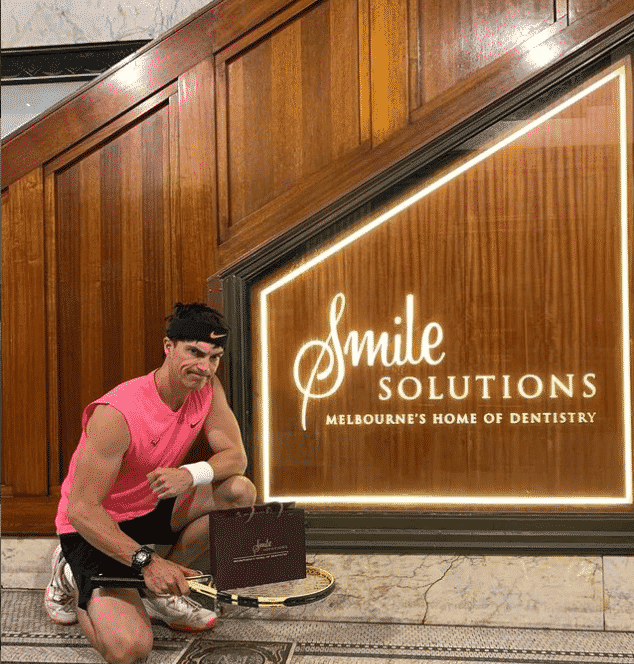
Rafa's dental day at Smile Solutions
Media item: archived item, published September 2021
This page records the media item. Third-party content is the property of its publisher and is not reproduced here, and no individual's treatment is described.
The date is the interesting part. September 2021 was the middle of Melbourne's longest lockdown, and dentistry was one of the health services most directly restricted. What follows is general information on how the pandemic changed dental practice, and what has stayed changed — because much of it has.
Why dentistry was singled out
Almost everything a dentist does generates aerosol. High-speed handpieces, ultrasonic scalers and triple syringes atomise saliva and blood into particles that remain suspended in a small room for a considerable time. Dentists also work centimetres from the airway of an unmasked person, for extended periods, and cannot avoid it.
That combination made dental practice a recognised transmission risk very early, and it is why restrictions on dentistry were imposed sooner and lifted later than for many other services.
What restricted practice actually meant
Australian dentistry operated under tiered restriction levels, adjusted repeatedly as conditions changed. Broadly:
- At the most restrictive level, only urgent care was permitted, and aerosol-generating procedures were largely suspended. What is considered a dental emergency? is the line that was being drawn.
- Intermediate levels allowed routine care with additional precautions, with aerosol-generating procedures permitted only with specified PPE and controls.
- At the least restrictive level, normal practice resumed with standard precautions.
The clinical consequence of the restricted levels was a shift to techniques that generate no aerosol — hand instrumentation instead of ultrasonic scaling (dental cleans and hygienists, when do you need deeper cleaning?), atraumatic restorative techniques, silver diamine fluoride to arrest decay without drilling (can you reverse tooth decay?), and temporary dressings to stabilise a tooth until definitive treatment became possible (tooth fillings).
Several of those techniques were already good dentistry and were simply underused. They remain in the repertoire.
What changed in the surgery, and stayed changed
- Air management. Air exchange rates, HEPA filtration and fallow time between patients — the interval allowed for aerosol to settle or be cleared — entered routine planning and largely stayed. Our Technology describes the current set-up.
- High-volume suction discipline, which dramatically reduces aerosol escape and is now used more consistently.
- Pre-procedural rinses, still debated in terms of measurable benefit, but widely adopted — see The truth and myths about mouthwashes.
- PPE. P2/N95 respirators with fit-testing, eye protection and face shields for aerosol-generating work became standard rather than exceptional.
- Screening and spacing. Health screening at booking, fewer people in waiting rooms, and appointment schedules built around room turnover rather than only chair time.
- Teledentistry, which arrived out of necessity. It cannot diagnose — there is no substitute for examination and radiographs — but it triages effectively, answers post-operative questions, and saves people a journey.
The backlog, and its cost
The part that is easy to overlook.
Deferred dental care does not stay deferred; it gets worse. A watched lesion becomes a filling; a filling becomes a root canal; a root canal becomes an extraction. The stages of dental decay is that sequence in clinical terms. Public dental waiting lists, already long, lengthened substantially, and the effects were felt most by the people who already had the least access.
Other pandemic-era effects on oral health were documented widely: increased bruxism and jaw pain attributed to stress, more snacking and grazing at home (how does sugar affect your dental health?), disrupted routines in children, and delayed presentation of oral lesions — the last of which matters most, because delayed diagnosis of oral cancer changes outcomes. See Oral cancer: how your dentist can help with early detection and What are the causes, symptoms and treatment of mouth cancer?
What to do if you deferred care
Still relevant, because a meaningful number of people have not been back since.
- Book an examination, even if nothing hurts. Pain is a late symptom in dentistry, not an early one — how often should I go to the dentist?
- Say plainly that you have not attended for some years. It is extremely common and no reasonable practitioner will make anything of it.
- Ask for a staged plan by priority rather than one large quote — what is urgent, what can wait, what is being watched. Understanding Your Treatment and the price guide show how a plan is set out here.
- Raise cost openly if that is part of why you stopped. Public dental services, the Child Dental Benefits Schedule and staged treatment all exist, and the National Debt Helpline (1800 007 007) is free if dental cost is part of something wider.
- If you are anxious about attending, say so when booking. It changes how the appointment is run — see Dental Anxiety and How can I ease my anxiety about visiting the dentist?
What the period demonstrated
Two things worth recording.
First, that infection control in dentistry was already strong. Standard precautions in Australian dental practice — sterilisation, single-use items, barrier technique — were built for bloodborne viruses and largely held. The additions were about aerosol, not about hygiene.
Second, that access is fragile. A service delivered almost entirely through private small business, sitting outside Medicare, has limited capacity to absorb a shock — and the people who lost care first were the people who had least of it to begin with.
Related pages: General Dentistry, Our Technology, Emergency Dentistry, Why choose Smile Solutions in a dental emergency?, RN Breakfast with Fran Kelly, Children’s Dentistry, and the rest of the media record.
Common questions
I have not been for more than two years. How much more work is that likely to mean?
Measurably more, and the extraction figure is the one that should move you. In a large Australian survey, perceived treatment need was compared between people whose last visit was more than two years ago and those seen within two years. The gaps: a filling needed, 39.4% versus 23.7%; an extraction needed, 18.6% versus 7.3%; gum treatment, 12.6% versus 7.9% — each difference statistically significant. The requirement for an extraction roughly doubles. One honest caveat: the study is cross-sectional, so the authors are explicit that causality cannot be inferred from it — but nothing in the clinical sequence above suggests waiting helps.
I am anxious about going back after this long. Is that unusual?
No. A meta-analysis of 31 studies covering 72,577 adults put the global prevalence of dental fear and anxiety at 15.3% (95% CI 10.2–21.2), high dental fear at 12.4% (9.5–15.6), and severe fear at about 3% (0.9–7.1). Two caveats belong with those numbers: only three of the 31 studies were rated low risk of bias, and the measuring instrument shifts the answer more than the population does — which is why "about one adult in six" is defensible and a single decimal figure is not. In Australian data, 43.9% of people describing themselves as very afraid had last attended more than two years earlier, against 29.1% of those with no fear.
Is the "vicious cycle" of dental fear a real finding or just a phrase?
It is a measured association, and its authors are unusually careful about its limits. In the Australian survey, 29.2% of people who were very afraid fitted the profile of delayed visiting, dental problems and symptom-driven treatment seeking, against 11.6% of those with no fear — an adjusted odds ratio of 3.33 (95% CI 2.67–4.15). But the same authors state that "it is certainly not the case that having high dental fear is a necessary and sufficient precondition for poor oral health outcomes", and note that almost 70% of the very afraid did not fit the profile. They also flag why avoidance is self-reinforcing: it "prevents people from 'extinguishing' the anxious or fearful state as a result of non-traumatic dental experiences". The 11.6% with no fear who fitted it anyway were attributed to cost, time and lack of interest.
If a tooth has been left too long, what actually decides whether it can be kept?
Four things, and none of them is how much it hurts. In a long-term study of root-filled teeth, a pre-operative periapical radiolucency on the film roughly doubled the chance the tooth was eventually extracted (odds ratio 1.87), and pocket depths over 5 mm were the strongest predictor of loss — at 30 years, about 30% of teeth with deep pockets remained in function against 80% of those at 5 mm or less. How much tooth is left matters too: molars with less than about 30% of the tooth substance remaining were extracted at 12.5% against 3.5% for those with more. And the restoration cannot wait: posterior root-filled teeth crowned four months after treatment were extracted at three times the rate of those crowned within four months. Deferral changes the options, not just the price.
Should I be using a mouthwash now, given how much rinsing the pandemic introduced?
As an extra, not as a substitute — and the Australian Dental Association's current oral hygiene policy draws the line precisely. Its list of main oral hygiene strategies is brushing two minutes twice a day, an age-appropriate fluoride toothpaste, cleaning between the teeth once a day, and regular professional check-ups and cleaning. Mouthrinse is not in that list. It appears in a separate list of "proven aids to oral hygiene", in the company of sugar-free chewing gum. Independent sources line up behind that reading: Australian Prescriber calls mouthwash "an adjunct to, not a substitute for, regular brushing and flossing" that "should never be the sole means of oral hygiene", and the Cochrane review of chlorhexidine rinse tested it only "as an adjunct to mechanical oral hygiene procedures".
Is there any reason to be cautious about a chlorhexidine rinse?
One, and it matters mainly for what you tell a hospital rather than your dentist. ASCIA states that allergic reactions to chlorhexidine "are rare, but are increasing in frequency, possibly due to increased use of chlorhexidine containing products". A review of chlorhexidine mouthrinse specifically found that anaphylaxis "does not appear to have occurred as a result of using chlorhexidine mouthrinse to maintain periodontal health" — so this is not a reason to avoid a rinse your dentist has prescribed. The practical problem ASCIA identifies is identification: the presence of chlorhexidine "is often not obvious, and labelling can be inconsistent", there is "no universal symbol" for it, and people with a known allergy "often have more than one reaction due to misdiagnosis or accidental re-exposure". If you have reacted to an antiseptic before, say so before any procedure.
Practical details
Smile Solutions, Level 1, 220 Collins Street, Manchester Unity Building, Melbourne VIC 3000. Phone 13 13 96, or theteam@smilesolutions.com.au. Monday–Friday 8.00am–6.00pm, Saturday 8.30am–1.30pm, Sunday by appointment. Directions are on Location; enquiries go through Contact Us.
Every practitioner's registration can be verified free on the AHPRA public register at ahpra.gov.au, and the registrations held here are listed on Dentists and Registered Specialists.
This page records a media item; third-party content is not reproduced and no individual is identified or described. The material above is general historical and public health information, not clinical advice. Infection control requirements and any restrictions on practice are set by health authorities and change — the Victorian Department of Health, the Dental Board of Australia and the Australian Dental Association are authoritative. Research figures quoted describe study populations, with the limitations their authors state, and do not predict an individual outcome.
Smile Solutions trades under ABN 28 193 514 103.
Images on This Page
-
https://www.facebook.com/tr?id=800557773428361&ev=PageView&noscript=1
(no alt text)
-
https://www.smilesolutions.com.au/wp-content/uploads/2025/10/calendar_month.svg
(no alt text)
-
https://www.smilesolutions.com.au/wp-content/themes/arcadian-wordpress-theme/assets/images/smile_solutions_logo_white.png
Smile Solutions Logo
-
https://www.smilesolutions.com.au/wp-content/themes/arcadian-wordpress-theme/assets/images/smile_solutions_logo_purple.png
Smile Solutions Logo
-
https://www.smilesolutions.com.au/wp-content/uploads/2021/09/Screenshot-2021-09-02-140302-1.png
Rafa Smile Solutions
-
https://www.smilesolutions.com.au/wp-content/themes/arcadian-wordpress-theme/assets/images/family_owned_bussiness.png
Family Owned Business
-
https://www.smilesolutions.com.au/wp-content/themes/arcadian-wordpress-theme/assets/icons/icon--phone.svg
Smile Solutions Contact
-
https://www.facebook.com/tr? id=800557773428361&ev=PageView&noscript=1
(no alt text)
-
https://bat.bing.com/action/0?ti=25148060&tm=gtm002&Ver=2&mid=1b274037-4631-45b9-abdf-57e48a31f6be&bo=1&sid=d792b6d0ab2611f1bb281f85cff9183b&vid=d792d260ab2611f1b008598a1b6ebd87&vids=1&msclkid=N&pi=918639831&lg=en-US&sw=800&sh=600&sc=24&nwd=1&tl=Rafa's%20Dental%20Day%20at%20Smile%20Solutions%20-%20Smile%20Solutions&p=https%3A%2F%2Fwww.smilesolutions.com.au%2Four-media%2Frafas-dental-day-at-smile-solutions%2F&r=&evt=pageLoad&sv=2&cdb=AQAQ&rn=931643
(no alt text)