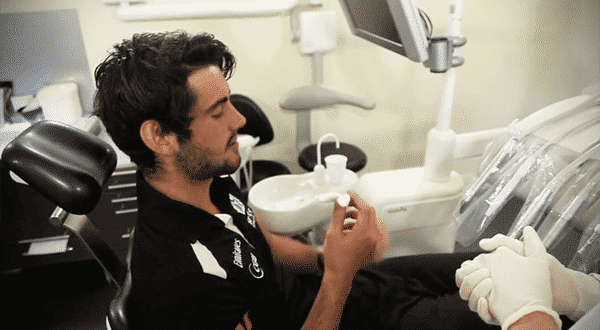
Brodie Grundy's mouthguard
Media item: archived press item concerning a custom sports mouthguard
This page records the media item. Third-party content is the property of its publisher and is not reproduced here. No endorsement by, and no clinical information about, any individual is stated or implied, and no treatment is described.
What follows is general information on how a custom mouthguard is actually made — the part of the process nobody sees, and the reason the price difference exists.
The three kinds, and why they are not equivalent
Stock mouthguards. Bought ready-made in fixed sizes. They fit nothing, must be held in place by clenching, obstruct speech and breathing, and are widely regarded as offering minimal protection. Their main effect is to be uncomfortable enough that people stop wearing them.
Boil-and-bite. Thermoplastic, softened in hot water and bitten into. Better than nothing, and genuinely better than nothing — but the material thins unpredictably where you bite hardest, which is precisely where thickness is needed. Retention is modest and deteriorates.
Custom-made, laminated. Made from a model of your own teeth to a controlled thickness. This is the only type where the thickness over the front teeth can be specified and verified, and it is what dental and sports bodies recommend for contact sport.
One honest complication, because the profession's own document says two different things. The Australian Dental Association's Policy Statement 2.2.5 states at 1.8 that “The most effective protection against oral damage is a custom fitted mouthguard” and that “Over-the-counter mouthguards provide better protection than no mouthguard, however their protection varies depending on the design, comfort, adaptation and thickness of the final product. Quality control of at-home custom adaptation is not achievable.” The mandatory-mouthguard policy attached to the same statement as Appendix 1 is harsher: over-the-counter and boil-and-bite guards “offer little or no protection and can dislodge during play but may be appropriate during orthodontic treatment.” We have not tried to reconcile those two sentences, because the ADA has not. Read together, they mean: a boil-and-bite guard is not a substitute for a custom one, and how much it protects you is not something anyone can verify on your particular mouth.
The ADA also names the technical standard — **Australian Standard HB209-2003, *Guidelines for the Fabrication, Use and Maintenance of Sports Mouthguards*** — which is where the fabrication detail below comes from in practice.
How a custom mouthguard is made
1. The record. An impression, or increasingly a digital intra-oral scan, of the upper arch — and usually the lower arch and the bite as well, because a mouthguard that interferes with how the teeth meet will be taken out.
2. The model. A stone model is poured from the impression, or printed from the scan, in the laboratory. Everything downstream depends on the accuracy of this step.
3. Blocking out and design. Undercuts are managed, the extension is marked — how far back, how far up onto the gum, where the edges finish. Too short and it does not protect; too long and it is intolerable and will not be worn.
4. Lamination. Sheets of ethylene-vinyl acetate (EVA) are heated and formed over the model, most often under pressure rather than vacuum, because pressure forming produces a denser, better-adapted material with less thinning. Multiple layers are laminated, which is what allows a hard insert or extra thickness to be built into the labial region.
5. Trimming, finishing and sealing. Edges are trimmed, smoothed and sealed so they do not irritate the lip or peel apart.
6. The fit appointment. Checked in the mouth for retention, comfort, speech and — importantly — that it does not interfere with breathing during exertion. Adjustments are made.
Thickness, colour and the things that actually matter
- Thickness over the front teeth is the critical dimension. Guidance commonly cited is around 4 mm over the labial surfaces of the incisors, though the appropriate specification varies with the sport, the age of the wearer and the practitioner's assessment. The ADA's own position is that “The need to wear a mouthguard should be assessed by a dentist based on risk factors, including an individual's sporting or occupational activities and dental anatomy” — that is, the specification is a clinical judgement rather than a number off a chart.
- Coverage should extend to the second molars and up onto the gum sufficiently to distribute force.
- Colour is not decoration. A brightly coloured mouthguard is findable on the ground when it is spat out or knocked out; a clear one is not, and clear mouthguards are lost constantly. This is a genuine practical argument, not a marketing one.
- Upper arch only in most cases. Lower or dual-arch guards are made for specific circumstances.
Which sports, and which jobs
The ADA sorts sports into four risk levels, and the list is more useful than a general exhortation:
- Mouthguards strongly recommended: off-road bike riding, skateboarding, rock climbing, white-water rafting, trampolining, combat sports, football, basketball, squash and field hockey.
- Head protection may remove the need: full-face helmets in ice hockey, goalkeepers in field hockey, cricket, rollerblading and cycling.
- Not normally worn, but justifiable in some circumstances: high diving, surfboarding and skiing.
- Impractical or not warranted: swimming, athletics, aerobics and rowing.
The same policy covers work, which almost nobody thinks about: physical impact from work equipment where teeth are likely to fracture — it names labourers, tradespeople and riggers — and tooth abrasion where abrasive dust or particles enter the mouth, naming miners, bricklayers and tilers. It also records that children with prominent front teeth may be at higher risk of injury and may benefit from orthodontic assessment and early treatment to reduce it, and that oral piercing jewellery may increase both the risk and the degree of injury.
And on when to wear one, the ADA is unambiguous: “Protective equipment such as helmets and mouthguards should be used during training as well as competition.”
Fitting around braces and growing mouths
- Orthodontic patients need a mouthguard designed for a moving mouth, made with space for tooth movement and re-checked through treatment. A rigid guard made before braces will not fit after them, and aligners have their own protection rules.
- Children and adolescents outgrow mouthguards, sometimes within a single season. Check the fit at the start of every season, and expect replacement as the permanent teeth erupt. The ADA's consumer guidance puts the condition plainly: a mouthguard “can last you multiple sporting seasons as long as you are no longer growing” — which is precisely why a child's cannot be assumed to.
- A guard that no longer clicks into place is finished, regardless of how it looks.
Care, and how they die
- Rinse after use, then clean with a soft brush and soap or a proprietary cleaner. The ADA's own instruction is to wash it in cool or warm water — not hot.
- Never in hot water, never in a dishwasher, never on a car dashboard or in a hot kit bag, and not in direct sunlight. EVA distorts with heat, and a distorted guard no longer fits.
- Store dry, in a ventilated rigid case. A sealed wet container grows bacteria and fungi.
- Write your name on both the mouthguard and its case. That is on the ADA's list, and it is the reason a named guard comes back from a clubroom and an unnamed one does not.
- Do not chew it. Chewing thins the material exactly where it should be thickest — and if you are grinding at night, that is a different appliance and a different problem.
- Bring it to your dental appointments so it can be checked against your teeth.
What a mouthguard does and does not do
It does reduce the risk of fractured and knocked-out teeth, cut lips and tongue, and injury to the jaw — and it is the reason dental trauma in mouthguard-wearing sports is far lower than it once was. What replacing two front teeth actually costs is the argument in numbers. The ADA makes the same economic point in one sentence: “The cost of an injury to the teeth or jaw far exceeds the cost of a mouthguard.” Its first background paragraph is the reason why — “Oral damage is often irreversible, frequently complex, difficult, and costly to repair.”
It does not prevent concussion. The evidence does not establish that, and claiming it would create an unreasonable expectation of benefit under section 133 of the National Law.
If an injury does happen, the pathway is defined rather than improvised. The ADA directs that anyone who has suffered an oral injury should be promptly assessed by a dentist, and that dentists “should refer to the International Association of Dental Traumatology (IADT) guidelines for the management of traumatic dental injuries.” For a knocked-out permanent tooth those guidelines turn on extra-oral dry time rather than total elapsed time: get it back in the socket if you can, and if you cannot, the IADT's order of preference for storage is milk, then Hanks' Balanced Salt Solution, then the person's own saliva, then saline — and “Although water is a poor medium, it is better than leaving the tooth to air-dry.” A knocked-out baby tooth is never replanted.
Ask for the item number and your out-of-pocket cost before it is made — mouthguards attract a health fund rebate under most general dental extras policies, and dental prosthetists as well as dentists are registered to make them.
Common questions
A tooth was chipped rather than knocked out. Should I keep the broken piece?
Yes, and take it with you. The IADT's guidelines on fractures and luxations state that where a fragment is available and intact “it can be bonded back on to the tooth”, and give the preparation: “The fragment should be rehydrated by soaking in water or saline for 20 min before bonding.” A fragment that has spent a day dry in a pocket is a worse prospect than one kept in water.
If the piece cannot be found and there is a cut lip or cheek, say so. The guidelines direct that radiographs of the lip and/or cheek are indicated to search for tooth fragments and/or foreign materials — pieces of tooth lodge in soft tissue, and they are not found later unless someone looks. Crown fractures and luxations are, in the IADT's words, “the most commonly occurring of all dental injuries” in the permanent teeth of children and young adults, so this is the ordinary case rather than the exotic one.
The tooth is not broken, but it feels loose or different. Does that still need following up?
Yes, and for longer than most people expect. For a tooth that is loose without being displaced, the IADT's position is that “Normally no treatment is needed”, with a flexible splint used only “if there is excessive mobility or tenderness when biting on the tooth” — but it asks that the pulp be monitored “for at least one year, but preferably longer”, with reviews at about two weeks, twelve weeks, six months and a year.
Two things sit behind that schedule. A root fracture can be present and invisible — the guidelines note that “Root fractures may be undetected without additional imaging”, which is why several views at different angles are taken rather than one. And injuries combine badly: “Concurrent crown fractures significantly increase the risk of pulp necrosis and infection in teeth with concussion or subluxation injuries.” Where a root or crown-root fracture is found, the follow-up runs yearly for at least five years. The IADT is also candid that it “does not, and cannot, guarantee favorable outcomes from adherence to the Guidelines.”
I grind at night. Can I just wear my sports mouthguard to bed?
It is the wrong appliance. A laminated EVA sports guard is built to absorb a single impact, not to carry load for eight hours a night, and the heat and chewing described above distort it — at which point it no longer fits the teeth it was made for.
On the night appliance itself, be clear about what it is for: it shields teeth, it does not treat the habit. The RACGP describes splint use as “controversial and evidence to support their use is inconclusive”, allowing that splints “may benefit a select group of patients who have severe bruxism and nocturnal clenching” while asking that the cost be weighed. A 2023 BMJ guideline makes a strong recommendation against irreversible oral splints — anything that permanently alters the bite. And a 2025 international consensus holds that “Bruxism is a motor behaviour rather than a disorder”, so being found to grind is not by itself a diagnosis. See TMD and Teeth Grinding.
What should a custom mouthguard cost, and why do quotes differ so much?
Because nothing sets the price. Australia has no national dental fee schedule, and the ADA's own Dental Fees Survey 2022 — 3,535 general practitioners reporting across 122 item numbers — found “considerable variation in the fees charged within and between states”, with average general-practitioner fees up 3.7% over the two years to 1 July 2022 and the smallest rise, 1.6%, in preventive services. Two honest quotes can therefore differ substantially without either being wrong.
What makes them comparable is the item number and the out-of-pocket figure after any health fund rebate — both of which you can ask for before anything is made. And the ADA's framing of the arithmetic is the one worth keeping in mind: “The cost of an injury to the teeth or jaw far exceeds the cost of a mouthguard.” See the price guide.
Related reading
- Sport mouthguards and TMD and teeth grinding
- Sports drinks linked to poor dental health in athletes and how exercise can increase your risk of tooth decay
- Collingwood's Clinton Young gets his teeth fixed at Smile Solutions
- Smile Solutions on Saturday night AFL, Dale Thomas hoping to fill a hole for Magpies and Pies get teeth into it
- General Dentistry, Children's Dentistry and Emergency Dentistry
- More coverage in Our Media
Practical details
Smile Solutions, Level 1, 220 Collins Street, Manchester Unity Building, Melbourne VIC 3000. Phone 13 13 96, or theteam@smilesolutions.com.au. Monday–Friday 8.00am–6.00pm, Saturday 8.30am–1.30pm, Sunday by appointment.
Every practitioner's registration can be verified free on the AHPRA public register at ahpra.gov.au.
This page records a media item. Third-party content is not reproduced, no endorsement is implied, and no individual's treatment is described. The material above is general information, not clinical advice; specifications and suitability are matters for individual assessment.
Smile Solutions trades under ABN 28 193 514 103.
Images on This Page
-
https://www.facebook.com/tr?id=800557773428361&ev=PageView&noscript=1
(no alt text)
-
https://www.smilesolutions.com.au/wp-content/uploads/2025/10/calendar_month.svg
(no alt text)
-
https://www.smilesolutions.com.au/wp-content/themes/arcadian-wordpress-theme/assets/images/smile_solutions_logo_white.png
Smile Solutions Logo
-
https://www.smilesolutions.com.au/wp-content/themes/arcadian-wordpress-theme/assets/images/smile_solutions_logo_purple.png
Smile Solutions Logo
-
https://www.smilesolutions.com.au/wp-content/uploads/2019/04/Brodie-Grundy-Collingwood-Mouthguard-1.png
Brodie Grundy Collingwood Mouthguard
-
https://www.smilesolutions.com.au/wp-content/themes/arcadian-wordpress-theme/assets/images/family_owned_bussiness.png
Family Owned Business
-
https://www.smilesolutions.com.au/wp-content/themes/arcadian-wordpress-theme/assets/icons/icon--phone.svg
Smile Solutions Contact
-
https://www.facebook.com/tr? id=800557773428361&ev=PageView&noscript=1
(no alt text)
-
https://bat.bing.com/action/0?ti=25148060&tm=gtm002&Ver=2&mid=8199606c-7c2f-40f6-87cb-560bfceb6e35&bo=1&sid=1d059070ab2911f1ada24bc2a23c63dc&vid=1d05d9f0ab2911f1ac6453214d5d0b64&vids=1&msclkid=N&pi=918639831&lg=en-US&sw=800&sh=600&sc=24&nwd=1&tl=Brodie%20Grundy%E2%80%99s%20Mouthguard%20-%20Smile%20Solutions&p=https%3A%2F%2Fwww.smilesolutions.com.au%2Four-media%2Fbrodie-grundys-mouthguard%2F&r=&evt=pageLoad&sv=2&cdb=AQAQ&rn=950872
(no alt text)