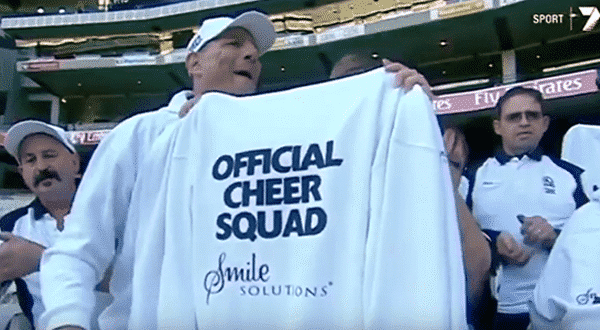
Smile Solutions on Saturday night AFL
Media item: broadcast appearance during AFL coverage
This page records the media item. The broadcast is the property of its publisher and is not reproduced here.
What follows is general information on the role of dentistry in sport — which is larger and less obvious than the mouthguard most people picture. The service page is Sports Mouthguards.
Why sport and dentistry intersect at all
Three separate reasons, and only one of them is trauma.
1. Impact. Contact and collision sports cause dental injury: fractured, displaced and knocked-out teeth, and soft-tissue injury to lips and tongue. See Chipped or Cracked Teeth and Emergency Dentistry.
2. Erosion and decay. This is the larger problem and the least recognised. Sports drinks, gels, energy chews and carbohydrate-loading regimes bathe teeth in acid and fermentable sugar repeatedly during training — What are sports drinks really doing to your teeth? and I've heard a lot about acid wear. Endurance athletes also breathe through the mouth for hours, which dries the mouth and removes saliva — the body's own buffer (What causes dry mouth during running?). Studies of elite athletes have repeatedly found poorer oral health than in the general population, which surprises people who assume elite fitness extends to teeth — Sports drinks linked to poor dental health in athletes and How exercise can increase your risk of tooth decay.
3. Performance and availability. An infected tooth is a systemic inflammatory load, a sleepless night, and a missed session. Dental pain is a recognised cause of lost training days — see Can a dental abscess affect your general health?
What a sports dental programme actually does
- Pre-season screening. A baseline examination and radiographs before the season, so that problems are dealt with in the off-season rather than mid-finals — how often should I go to the dentist?
- A dental record on file, including radiographs — which also serves an identification and comparison purpose after an injury. See How safe are dental x-rays.
- Custom mouthguard provision and replacement, checked for fit as the season progresses — Should I wear a mouthguard while playing sports?
- An on-call arrangement for acute injury, because dental trauma is time-critical — What is considered a dental emergency?
- Dietary counselling on the timing of sports drinks and gels rather than simple prohibition — athletes need the carbohydrate; the fix is how and when, plus rinsing with water and not brushing immediately afterwards. How does your diet affect your teeth?
- Wisdom-tooth planning, so that a predictable removal happens in November rather than in August — Wisdom Teeth and How long does it take to recover from wisdom teeth surgery?
- Bruxism management, common in athletes under load — TMD and teeth grinding and What is bruxism and how is it managed?
On-field dental trauma — the part everyone should know
This applies to a junior football ground as much as to a stadium, and what is done at the ground, before anyone reaches a dentist, largely sets the outcome. The International Association of Dental Traumatology calls an avulsed permanent tooth one of the few real emergency situations in dentistry. The fuller version is What should I do when a tooth is knocked out?
A knocked-out (avulsed) permanent tooth:
- Find the tooth. Hold it by the crown — the chewing part — never the root.
- Do not scrub it. The cells on the root surface are what allow it to reattach, and scrubbing destroys them. If it is dirty, rinse it gently in milk, saline or the patient's own saliva.
- Replant it immediately into the socket if you can, the right way round, and have the person bite gently on a clean cloth to hold it.
- If you cannot replant it, keep it moist. The IADT gives the storage media in descending order of preference as milk, then HBSS or a tooth-preservation solution, then the person's own saliva, then saline. Water only as a last resort — the IADT is explicit that "although water is a poor medium, it is better than leaving the tooth to air-dry". Never let the tooth dry out: the guideline notes that dehydration of the root surface starts to happen in a matter of a few minutes.
- Get to a dentist immediately. Dry time out of the socket is what decides whether the root-surface cells survive — the IADT records that after an extra-alveolar dry time of 30 minutes, most PDL cells are non-viable.
Do not replant a baby tooth — replanting a primary tooth risks damaging the developing permanent tooth beneath. See My child has a knocked out baby tooth: what do I do? and Children's dental emergencies.
A fractured tooth: find the fragment and bring it in moist — fragments can often be bonded back (What should I do if I have a chipped tooth?). A displaced or loosened tooth should be seen the same day. Any facial injury with a suspected jaw fracture, or an altered bite, needs emergency medical assessment, and dental injury frequently accompanies head injury — concussion protocols take priority over the tooth.
Mouthguards, briefly
Covered in more depth elsewhere on this site, but the essential point: a custom-made mouthguard is fitted from a model of your own teeth; a boil-and-bite is not — Getting a new mouthguard: a trip to the chemist or the dentist? and What kind of mouth guard should I use? The Australian Dental Association's position is that protective equipment such as helmets and mouthguards should be used during training as well as competition, and for anyone in orthodontic treatment a mouthguard needs to be re-checked as teeth move — Should my child wear a mouthguard?
What sports dentistry is not
Worth stating, because sport and cosmetic dentistry are marketed together.
- There is no recognised dental specialty of ‘sports dentistry’ in Australia. The Dental Board recognises thirteen specialties, and this is not one of them. Practitioners with a genuine interest in the field work under general or an existing specialist registration — see Specialist Care and Dentists & Registered Specialists.
- A mouthguard is not concussion protection. The function described in the published guidance is mechanical and local: a mouthguard works by absorbing and spreading the impact of a knock to the face, protecting the teeth, mouth and jaw. Nothing in that guidance extends the claim to the brain, and section 133 of the National Law prohibits creating an unreasonable expectation of benefit.
- No treatment on this page improves athletic performance. Preventing pain and infection protects availability. That is the honest claim.
For community and junior sport
The elite end gets the coverage; the injuries happen overwhelmingly at community level, where there is no team dentist and often no first-aid officer who knows what to do with a tooth.
The single most useful thing a club can do is put a small container of milk, or a proprietary tooth-preservation solution, in the first-aid kit, and print the avulsion steps above on the inside of the lid.
Related pages: Brodie Grundy's mouthguard, Pies get teeth into it, Molar Power, Children’s Dentistry, General Dentistry, Oral Health, Wellness and Longevity, and the rest of the media record.
Common questions
Which sports actually need a mouthguard?
The Australian Dental Association sorts them by risk rather than by profile, and publishes the lists. Sports for which the use of mouthguards is strongly recommended include off-road bike riding, skateboarding, rock climbing, white-water rafting, trampolining, combat sports, football, basketball, squash, and field hockey — a list that catches several activities parents do not think of as contact sports. At the other end are sports where a mouthguard would be impractical or not warranted due to low risk of injury, named as swimming, athletics, aerobics, and rowing.
The ADA also treats the decision as individual rather than list-driven: the need to wear a mouthguard should be assessed by a dentist based on risk factors, including an individual's sporting or occupational activities and dental anatomy. Two specific risk multipliers are named — children with prominent front teeth may be a higher risk of injury and may benefit from orthodontic assessment and early treatment to reduce this risk, and oral piercing jewellery may also increase the risk and degree of oral injury. Source: ADA, Policy Statement 2.2.5 — Prevention and Management of Oral Injuries.
Is a chemist mouthguard better than nothing?
The ADA's own policy statement answers that twice, and not identically — which is worth showing rather than smoothing over. The body of the statement says that the most effective protection against oral damage is a custom fitted mouthguard, and that over-the-counter mouthguards provide better protection than no mouthguard, however their protection varies depending on the design, comfort, adaptation and thickness of the final product, adding that quality control of at-home custom adaptation is not achievable.
The appendix to the same document is blunter: over-the-counter and boil-and-bite guards offer little or no protection and can dislodge during play, though they may be appropriate during orthodontic treatment. Teeth.org.au adds the practical failure mode: store-bought guards often fit poorly which can make them loose inside your mouth, making talking and breathing difficult. Take the shared ground — a custom guard is the protective one, and a poorly fitting guard is the one that comes out on impact. Sources: ADA Policy Statement 2.2.5 and its Appendix 1; Teeth.org.au, Sports Mouthguards.
How long does a mouthguard last, and what triggers a new one?
Growth, more than wear. Teeth.org.au states that a mouthguard, if it is used, stored, and fit checked by your dentist, can last you multiple sporting seasons as long as you are no longer growing — so for an adult a guard is a multi-season item, while for a child it is not, however undamaged it looks.
Two attached points are easy to skip. The ADA's position is that protective equipment such as helmets and mouthguards should be used during training as well as competition, not games only. And the sequence matters at the start: Teeth.org.au advises that it is best to have a check-up to make sure no other dental treatment is needed before your mouthguard is made, because a guard moulded over a tooth that is about to be treated will not fit afterwards. Sources: Teeth.org.au, Sports Mouthguards; ADA, Policy Statement 2.2.5.
How long does a knocked-out tooth actually have?
The International Association of Dental Traumatology sets three brackets, and they are about dry time rather than elapsed time. The cells on the root are most likely viable where the tooth has been replanted immediately or within a very short time (about 15 minutes) at the place of accident. They may be viable but compromised where the tooth has been kept in a storage medium and the total extra-oral dry time has been <60 minutes. They are likely to be non-viable where the total extra-oral dry time has been more than 60 minutes, regardless of the tooth having been stored in a medium or not. In between sits the number to remember: after an extra-alveolar dry time of 30 minutes, most PDL cells are non-viable.
The guideline is also honest about what replanting buys. It notes that some of the replanted teeth have low probability of long-term survival and may be lost or condemned to extraction at a later stage — and then gives the reason to do it anyway: not replanting a tooth is an irreversible decision and therefore saving it should be attempted. Avulsion accounts for 0.5%–16% of all dental injuries. Source: IADT guidelines for the management of avulsed permanent teeth.
Practical details
Smile Solutions, Level 1, 220 Collins Street, Manchester Unity Building, Melbourne VIC 3000. Phone 13 13 96, or theteam@smilesolutions.com.au. Monday–Friday 8.00am–6.00pm, Saturday 8.30am–1.30pm, Sunday by appointment. Directions are on Location; enquiries go through Contact Us.
Every practitioner's registration can be verified free on the AHPRA public register at ahpra.gov.au.
This page records a media item; third-party broadcast content is not reproduced and no individual is identified. The material above is general information, not clinical advice. Passages in quotation are drawn from the Australian Dental Association's published policy statement, Teeth.org.au and the IADT guidelines for avulsed permanent teeth as cited; guidelines are revised from time to time and those bodies are the authoritative sources. In a dental emergency seek immediate care; in a medical emergency call 000.
Smile Solutions trades under ABN 28 193 514 103.
Images on This Page
-
https://www.facebook.com/tr?id=800557773428361&ev=PageView&noscript=1
(no alt text)
-
https://www.smilesolutions.com.au/wp-content/uploads/2025/10/calendar_month.svg
(no alt text)
-
https://www.smilesolutions.com.au/wp-content/themes/arcadian-wordpress-theme/assets/images/smile_solutions_logo_white.png
Smile Solutions Logo
-
https://www.smilesolutions.com.au/wp-content/themes/arcadian-wordpress-theme/assets/images/smile_solutions_logo_purple.png
Smile Solutions Logo
-
https://www.smilesolutions.com.au/wp-content/uploads/2019/04/Smile-Solutions-Collingwood-Cheer-Squad-1.png
Smile Solutions Collingwood Cheer Squad
-
https://www.smilesolutions.com.au/wp-content/themes/arcadian-wordpress-theme/assets/images/family_owned_bussiness.png
Family Owned Business
-
https://www.smilesolutions.com.au/wp-content/themes/arcadian-wordpress-theme/assets/icons/icon--phone.svg
Smile Solutions Contact
-
https://www.facebook.com/tr? id=800557773428361&ev=PageView&noscript=1
(no alt text)
-
https://bat.bing.com/action/0?ti=25148060&tm=gtm002&Ver=2&mid=71058d0b-f879-4051-9f5e-9b1e00ece1dd&bo=1&sid=f25ba7d0ab2711f19869f9f0f6b778e9&vid=f25cdea0ab2711f1957e9bea18b29def&vids=1&msclkid=N&pi=918639831&lg=en-US&sw=800&sh=600&sc=24&nwd=1&tl=Smile%20Solutions%20on%20Saturday%20Night%20AFL%20-%20Smile%20Solutions&p=https%3A%2F%2Fwww.smilesolutions.com.au%2Four-media%2Fsmile-solutions-on-saturday-night-afl%2F&r=<=2256&evt=pageLoad&sv=2&cdb=AQAQ&rn=248446
(no alt text)