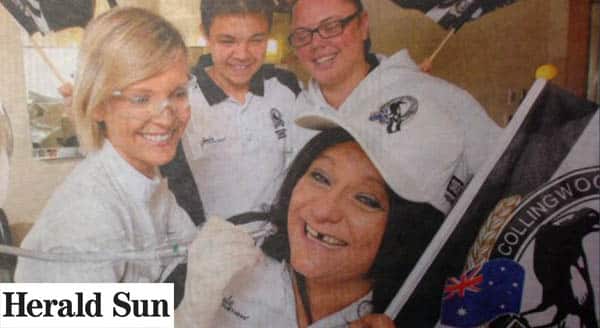
Pies get Teeth into it
Media item: article
Date published: 3 April 2013
Subject: dentistry and Australian rules football
This page records the media item. The original article is the property of its publisher and is not reproduced here.
What this page deliberately does not do
No individual athlete's dental treatment or health information is published here. Elite athletes are identifiable people whose health information is protected exactly like anyone else's, and appearing in the media does not change that.
Section 133 of the National Law prohibits testimonials about clinical care in advertising a regulated health service, and a well-known person describing their treatment is precisely the kind of material the prohibition covers.
What follows is general information about the field.
Sports dentistry: what it actually consists of
Dental and orofacial injuries are among the most common injuries in contact sport, and Australian rules football, rugby codes, hockey, basketball, boxing and combat sports, skateboarding and cycling account for a large share of them.
The injuries are consequential in a way that is easy to underestimate: a permanent front tooth lost at seventeen is a lifetime of restorations, each replacement removing a little more tooth, and eventually an implant or bridge with its own maintenance and replacement cycle. The real cost of replacing two front teeth follows that arithmetic through.
Mouthguards
Mouthguards reduce dental and orofacial injury in contact sport, and this is one of the clearer preventive findings in sports medicine. Australian dental bodies have recommended them for contact sport for decades. Should I wear a mouthguard while playing sports? sets out the case.
The type matters:
- Custom-fitted mouthguards, made from an impression or scan of the athlete's teeth, fit accurately, stay in place, allow speech and breathing, and are the type recommended by the profession.
- Boil-and-bite guards are better than nothing and considerably worse than custom. They fit poorly, are frequently too thin over the front teeth where the protection is needed, are commonly bitten out of shape, and are often not worn because they are uncomfortable. Getting a new mouthguard — a trip to the chemist or the dentist? compares the two directly, and What kind of mouth guard should I use? covers the different designs, including the night guards used for grinding rather than sport.
- A guard that is not worn protects nothing, which is the practical case for the more expensive option: comfort determines compliance.
Children in braces need a mouthguard designed for orthodontic appliances, and it needs remaking as the teeth move — see Braces and Should my child wear a mouthguard?.
Growing children need remaking regularly — a guard made at twelve will not fit at fourteen.
Mouthguards do not prevent concussion. This claim is made in marketing and the evidence does not support it. They protect teeth, lips and jaws.
Dental prosthetists are independently registered practitioners who make mouthguards directly for the public, as do dentists and oral health therapists.
Dental trauma first aid — the part worth memorising
This is the most useful information on this page and it is time-critical. Emergency Dentistry and What should I do in a dental emergency? cover the same ground for injuries off the field.
A permanent tooth knocked completely out
Replant it as soon as you can, and do not let it dry out. What should I do when a tooth is knocked out? is the longer version of the steps below.
- Find the tooth. Hold it by the crown — never the root. The cells on the root surface are what determine whether it survives.
- If it is dirty, rinse it briefly in milk or saline. Do not scrub it.
- Put it back in the socket the right way round, immediately, and have the person bite gently on a cloth to hold it.
- If you cannot replant it, keep it moist. The International Association of Dental Traumatology (IADT) gives the suitable storage media "in descending order of preference" as milk, then HBSS or an emergency tooth preservation solution, then the person's own saliva — spat into a glass, or held inside their own cheek if they are conscious and old enough not to swallow it — then saline. If you have none of those, use water. Plain water is a poor medium, but the IADT is explicit that "although water is a poor medium, it is better than leaving the tooth to air-dry". The absolute that matters is never to let the tooth dry out: a dry tissue, a bag or an empty container is the worst option of all.
- Get to a dentist immediately. This is an emergency.
A knocked-out baby tooth
Do not replant it. Replanting a baby tooth can damage the permanent tooth developing beneath. Still see a dentist to check for other injuries — My child has a knocked out baby tooth: what do I do? and Children's dental emergencies explain why.
A broken or chipped tooth
Find the fragment and keep it in milk — it can often be bonded back on. See a dentist promptly, particularly if the tooth is sensitive or bleeding from the centre, which means the pulp is exposed. See Chipped or Cracked Teeth, What should I do if I have a chipped tooth? and Do I have to get a chipped tooth fixed?.
A tooth pushed out of position or loosened
Do not force it. See a dentist urgently; it may need repositioning and splinting.
Any facial injury
Rule out the bigger problem first. Head injury, loss of consciousness, jaw fracture and airway compromise all take precedence over teeth. If there is any concern about a head injury, follow the relevant concussion protocol and seek medical assessment.
Have this information in the first aid kit, and make sure whoever runs the team knows it. Most dental trauma at community level is managed by a parent or a volunteer coach, not a clinician.
The other sports dentistry issue: elite athletes have poor oral health
This is genuinely counter-intuitive and well documented.
Studies of elite athletes across multiple sports have repeatedly found high rates of untreated decay, dental erosion and gum disease — in a population that is otherwise among the fittest anywhere. How exercise can increase your risk of tooth decay covers the same paradox.
The reasons are specific:
- Sports drinks and gels — acidic and sugary, consumed frequently during training and competition. Frequency of exposure is what causes decay and erosion, not quantity, and an athlete sipping through a three-hour session is running a near-continuous acid attack. What are sports drinks really doing to your teeth? and How does acidic food affect your teeth? go further into the chemistry.
- High-carbohydrate diets, eaten little and often.
- Dry mouth from prolonged exertion, mouth breathing and dehydration — removing the saliva that would otherwise buffer the acid. See What causes dry mouth during running? and My mouth is always dry — why is this and does it affect my teeth?.
- Training schedules that make routine appointments hard.
And it affects performance. Dental pain disrupts sleep and training, and the research literature on athlete oral health specifically identifies impact on training and competition.
The practical advice, which applies to any athlete: rinse with water after sports drinks, do not brush immediately after acid exposure, use fluoride toothpaste and spit rather than rinse, consider high-fluoride toothpaste if erosion is present, and get examined at a shorter interval than the standard six months. I've heard a lot about acid wear explains what that wear looks like before it becomes obvious.
And on sponsorship
Health service sponsorship of sporting clubs is legitimate and common. The advertising provisions of the National Law still apply to it: no testimonials about clinical care, nothing misleading, no unreasonable expectation of benefit, and no implication that an association with a club says anything about clinical quality.
It does not. The verifiable facts remain registration, division and any specialist entry — free, on the AHPRA public register at ahpra.gov.au, and set out for this practice on Dentists and Registered Specialists.
Related pages: Sports Mouthguards, Emergency Dentistry, Chipped or Cracked Teeth, General Dentistry, Molar Power, Brodie Grundy's mouthguard, Dale Thomas hoping to fill a hole for Magpies, Smile Solutions on Saturday Night AFL, and the rest of the media record.
Common questions
Which sports actually need a mouthguard?
More than most people assume, and football is only one of them. The Australian Dental Association's policy on oral injuries sorts sport into four risk levels. Mouthguards are strongly recommended for "off-road bike riding, skateboarding, rock climbing, white-water rafting, trampolining, combat sports, football, basketball, squash, and field hockey". A second group wears head protection that "may thus obviate the need" — full-face helmets in ice hockey, goalkeepers in field hockey, cricket, rollerblading and cycling. A third group is where use "could be justified under certain circumstances": high diving, surfboarding and skiing. Only the fourth group — swimming, athletics, aerobics and rowing — is treated as low enough risk not to warrant one. Trampolining and skateboarding surprise most parents.
Who is most likely to lose a tooth, and can anything reduce the odds beforehand?
The ADA identifies young children and teenagers as high-risk groups, "particularly when learning to walk and when new and/or high-risk activities are involved". Two things change an individual's risk in advance. First, tooth position: "children with prominent front teeth may be at higher risk of injury and may benefit from orthodontic assessment and early treatment to reduce this risk" — a reason to raise it at an orthodontic consultation rather than after the accident. Second, jewellery: the ADA notes that "oral piercing jewellery may also increase the risk and degree of oral injury". The ADA's position is that the need for a mouthguard "should be assessed by a dentist based on risk factors, including an individual's sporting or occupational activities and dental anatomy".
Does it have to be worn at training, or just on game day?
Both. The ADA's position is explicit that "protective equipment such as helmets and mouthguards should be used during training as well as competition", and the ADA's own consumer guidance repeats it: you need to wear the guard at training and on game day. Most community-level dental injuries do not happen in front of a crowd. Where a club wants to formalise this, the ADA and Sports Medicine Australia publish a model "No Mouthguard, No Play" policy that clubs are encouraged — not legally required — to adopt, making guards mandatory at training and games, with coaches and managers directed to check compliance. If your child's club has no policy, that model is the thing to hand the committee.
How long should a mouthguard last, and how do I look after it?
Longer than a season, if the wearer has stopped growing. The ADA's consumer guidance is that a guard which is "used, stored, and fit checked by your dentist" can last multiple sporting seasons "as long as you are no longer growing" — so the annual question is a fit check, not automatically a new guard. The care rules are mundane and mostly ignored: do not store it in direct sunlight, wash it in cool or warm water rather than hot, store it dry in a protective case, and write the wearer's name on both the guard and the case. The named case is why guards come home from school; heat is why they stop fitting.
Is my job a risk to my teeth as well?
For some trades, yes, and it is rarely discussed. The ADA identifies two distinct occupational hazards: "physical impact from work equipment where fracturing of teeth is likely, including labourers, tradespeople, and riggers", and "tooth abrasion where abrasive dust or particles may enter the mouth, including miners, bricklayers, and tilers". The controls differ accordingly — impact calls for protection worn in the mouth, while abrasion calls for workplace engineering, which is why the ADA's position asks for "dust extraction or filtration when generating abrasive particles". If you work in either group, say so at your next examination; the wear pattern it produces is not the same as grinding and is often misread as it.
Practical details
Smile Solutions, Level 1, 220 Collins Street, Manchester Unity Building, Melbourne VIC 3000. Phone 13 13 96, or theteam@smilesolutions.com.au. Monday–Friday 8.00am–6.00pm, Saturday 8.30am–1.30pm, Sunday by appointment. Directions are on Location; enquiries go through Contact Us.
Every practitioner's registration can be verified free on the AHPRA public register at ahpra.gov.au.
This page records a published article and its date, with general information. It is not a diagnosis or a treatment plan, and first aid information does not replace assessment by a practitioner. Mouthguard and oral injury positions are quoted as published by the Australian Dental Association. No individual's clinical information is published here. Third-party published content is not reproduced.
Smile Solutions trades under ABN 28 193 514 103.
Images on This Page
-
https://www.facebook.com/tr?id=800557773428361&ev=PageView&noscript=1
(no alt text)
-
https://www.smilesolutions.com.au/wp-content/uploads/2025/10/calendar_month.svg
(no alt text)
-
https://www.smilesolutions.com.au/wp-content/themes/arcadian-wordpress-theme/assets/images/smile_solutions_logo_white.png
Smile Solutions Logo
-
https://www.smilesolutions.com.au/wp-content/themes/arcadian-wordpress-theme/assets/images/smile_solutions_logo_purple.png
Smile Solutions Logo
-
https://www.smilesolutions.com.au/wp-content/uploads/2019/04/Pies-get-teeth-into-it-1.jpg
Pies get teeth into it
-
https://www.smilesolutions.com.au/wp-content/themes/arcadian-wordpress-theme/assets/images/family_owned_bussiness.png
Family Owned Business
-
https://www.smilesolutions.com.au/wp-content/themes/arcadian-wordpress-theme/assets/icons/icon--phone.svg
Smile Solutions Contact
-
https://www.facebook.com/tr? id=800557773428361&ev=PageView&noscript=1
(no alt text)