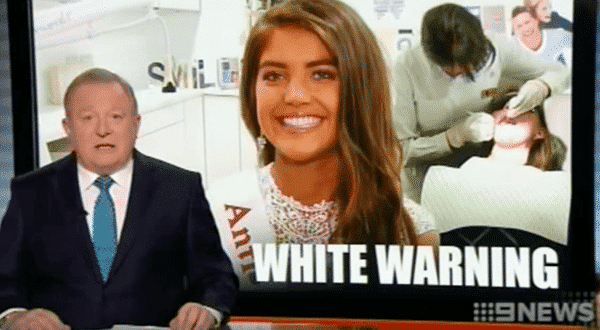
Dr Kat Marhfour of Smile Solutions – Teeth Whitening Interview
Media item: interview
Date published: 10 May 2014
Subject: tooth whitening
Interviewee: Dr Kat Marhfour
This page records the media item. The original interview is the property of its publisher and is not reproduced here.
How tooth whitening actually works
Whitening is a chemical oxidation reaction, not an abrasive or a coating.
The active agent is hydrogen peroxide, either applied directly or released from carbamide peroxide, which breaks down into hydrogen peroxide and urea. As a rough guide, carbamide peroxide is about one third as potent as the same percentage of hydrogen peroxide — 10% carbamide peroxide yields roughly 3.5% hydrogen peroxide. That ratio is the Australian Dental Association's: its policy statement on whitening records that “Many bleaching products contain carbamide (urea) peroxide, one-third of its concentration being equivalent to hydrogen peroxide, e.g., 18% carbamide peroxide approximates 6% hydrogen peroxide”, and puts the range in practice at “as low as 3-6% for some products supplied to patients for home use to 35% in some office-based bleaching products.”
The peroxide diffuses through enamel into dentine. Enamel is permeable at the molecular level; this is why whitening works at all, and also why it can cause sensitivity. Inside the tooth, the peroxide breaks the double bonds of large pigmented organic molecules into smaller, less light-absorbing fragments. The tooth appears lighter because those molecules no longer absorb visible light as strongly.
The colour change is chemical, not mechanical. Nothing is scraped off and nothing is added on.
The two delivery methods
In-chair whitening uses a high concentration of hydrogen peroxide under gingival isolation, in a controlled appointment. It produces a fast, visible change.
Take-home whitening uses a custom tray and a much lower concentration worn over days or weeks.
On the evidence, take-home whitening with custom trays produces results at least as good as in-chair whitening, and often more stable ones — the difference is speed, not endpoint. The common clinical approach combines them: in-chair for immediate change, take-home for the finish and for periodic top-ups. The options available here are set out separately.
Whichever route is taken, the ADA's overall position on supervised whitening is worth having in its own words: “Teeth bleaching products are safe and effective when used by or under the supervision of a dentist and according to the professional directions for use. The most common side-effects are transient tooth sensitivity and soft tissue irritation during or immediately following treatment.”
Lights and lasers
Many whitening systems add a light or laser. The evidence for light activation is weak. Systematic reviews have generally found no clinically meaningful improvement in the final result from adding a light, while some studies find more sensitivity. The heat can also dehydrate the tooth, producing a temporary brightening that reverses over the following days — which can make the immediate post-appointment result look better than the settled one.
What the Australian profession does say about light, in writing, is about safety rather than benefit — and it is worth reading before choosing where to have it done. The ADA warns that “The incorrect application of heat and other forms of energy during teeth whitening procedures, such as light from a plasma arc lamp or high-power (Class 4) laser may cause nerve damage to the tooth and burns to adjacent soft tissues, and failure to ensure use of the appropriate protective eyewear may also cause irreversible injury.” There is a standard governing it — AS/NZS 4173:2018, *Safe use of lasers and intense light sources in health care***, which sets requirements for both dental practices and the cosmetics industry, including required standards of training. And there is a licensing layer most patients never hear about: all registered dental practitioners with appropriate training may use Class 4 lasers, but **Western Australian, Queensland, Victorian and Tasmanian legislation requires practitioners in those states to obtain a licence from the relevant state regulatory authority first.
This matters when comparing prices: a light is not evidence of a better outcome. What lasers are genuinely used for in dentistry is a separate question.
What whitening cannot change
This is where most disappointment comes from, and it is entirely predictable at the assessment stage.
Whitening does not change the colour of any restoration. Composite fillings, crowns, veneers, bridges and implant crowns are inert to peroxide. If you whiten your natural teeth around an existing front crown, the crown stays exactly the colour it was and will then look darker by contrast. Sometimes the restoration has to be replaced afterwards to match, which is a real and often substantial cost that belongs in the decision before treatment starts, not after.
Whitening treats staining, not structure. Enamel is translucent; dentine underneath it is yellow. As enamel thins with age and wear, more dentine shows through, and no amount of peroxide changes the thickness of enamel.
Some discolouration is intrinsic and responds poorly or not at all. Tetracycline staining from childhood antibiotic exposure, severe fluorosis, dentinogenesis imperfecta and trauma-related discolouration behave differently from ordinary surface and dietary staining. A single dark tooth after trauma is a different problem again — often a non-vital tooth that needs internal assessment rather than external bleaching.
Whitening is not a substitute for cleaning. Extrinsic build-up and calculus are removed mechanically. Peroxide does not remove them.
Sensitivity, and what actually helps
Sensitivity is the most common side effect of whitening and it is common — a large share of people get some. It is typically short, sharp, cold-triggered, and settles within a day or two of stopping. That matches the ADA's own account, which names transient tooth sensitivity and soft tissue irritation as the two commonest side effects and places them “during or immediately following treatment.”
What reliably reduces it:
- Lower concentration for longer, rather than high concentration fast
- Potassium nitrate and fluoride — pre-treating with a desensitising toothpaste for a week or two beforehand has good evidence behind it
- Spacing sessions out rather than pushing through
Existing sensitivity, exposed root surfaces, cracks and untreated decay all make it worse — which is why an examination before whitening is not a formality.
Gingival irritation happens when gel contacts gum tissue; it is usually transient. Custom trays exist largely to prevent it, which is one of the real drawbacks of ill-fitting boil-and-bite or one-size trays. There is a second reason a tray that leaks matters: the ADA notes that swallowing peroxide gel “may cause irritation to the oesophagus and stomach resulting in bleeding or sudden distension.”
The Australian rules on peroxide
This is a genuine point of difference that consumers rarely know about, and it is settled in legislation rather than by professional opinion.
In Australia, tooth whitening products are regulated on the basis of peroxide concentration, through the Poisons Standard, with the restrictions “enshrined in all state and territory poisons legislation.” Two thresholds do the work:
- Schedule 5 — sellable to the public with warnings. The ADA records that the Poisons Standard “recognises hydrogen peroxide 3-6% and carbamide peroxide 9-18% as Schedule 5 substances requiring ‘Caution', meaning that teeth whitening products containing up to these concentrations can be sold direct to consumers if they are labelled with stipulated safety warnings.”
- Schedule 10 — dental practitioners only. Schedule 10 covers substances “of such danger to health as to warrant prohibition of their sale, supply and use other than in specified exempt circumstances”, and “Schedule 10 specifically states that teeth whitening products containing more than 6% hydrogen peroxide or 18% carbamide peroxide may only be sold, supplied and used by registered dental practitioners as part of their dental practise.” The Dental Board of Australia states the same rule in a single line: “Australian laws mean only registered dental practitioners can use or supply high-concentration teeth whitening products (over 18% carbamide peroxide or 6% hydrogen peroxide).”
The ADA's reasoning for the second threshold is explicitly about safety rather than professional territory: “On the grounds of public safety, only registered dental practitioners who are educated, trained and competent in teeth whitening (bleaching) procedures should use or supply teeth bleaching products; containing more than 6% hydrogen peroxide or equivalent.”
The practical consequences:
- A supermarket or pharmacy whitening kit is not the same product as an in-practice one. It is a genuinely weaker formulation, not simply the same thing cheaper — capped at 6% hydrogen peroxide or 18% carbamide peroxide against office concentrations the ADA puts as high as 35%.
- Products bought online from overseas may contain concentrations that cannot lawfully be sold to the public in Australia, with no examination, no custom tray and no supervision.
- Whitening offered by a non-registered operator at a kiosk or salon is subject to those retail limits, and the operator is not qualified to examine the teeth first or manage a complication. Why a dentist is the safer route is set out separately.
The things sold as whitening that are not
Charcoal toothpastes whiten, when they do, by abrasion. Abrasion removes surface stain and, with it, enamel — which does not grow back and whose loss exposes more yellow dentine. Long-term use makes teeth darker, not lighter.
"Enamel-safe" acidic rinses and DIY lemon or bicarbonate remedies erode enamel. Acid erosion is irreversible.
Whitening strips are a legitimate low-concentration product; their limitation is fit, and they do not reach interproximal surfaces well.
Before whitening: what an examination is for
Whitening over untreated disease is the substantive risk, and this is the point where the ADA's wording is more specific than most consumer material: “Percolation of hydrogen peroxide into the nerve tissues - often accelerated by exposed dentine and enamel fractures - can lead to nerve inflammation. For this reason, it is necessary to take great care when handling and using hydrogen peroxide bleaching agents, especially the higher concentrations.” Peroxide entering a tooth through a crack or an untreated cavity reaches the pulp far more readily — that is the mechanism, and it is why the examination is the treatment's main safeguard rather than its paperwork.
Before treatment, the practitioner should establish that there is no untreated decay, no active gum disease, no exposed dentine or defective restoration margins, and that the discolouration is the type that responds. They should also record the starting shade — without it, the change is disputed later by everyone involved.
Whitening is not recommended during pregnancy or breastfeeding, not because harm is established but because it has not been studied and the treatment is entirely elective and can wait.
Whitening in children and adolescents is generally deferred; the pulp is larger relative to the tooth, and the mixed dentition changes shade naturally as it develops.
Longevity and honest expectations
Whitening is not permanent. Teeth re-stain from coffee, tea, red wine, dark cola and tobacco, and darken with age regardless.
Most people need periodic top-ups, which is one of the arguments for keeping custom trays: a top-up with an existing tray costs a fraction of a repeat course.
An honest description of the outcome is several shades lighter than the starting point, not a fixed final colour. Under Australian advertising rules a practice cannot promise a specific outcome, and no practitioner can predict exactly how any individual tooth will respond. Section 133 of the National Law puts it as a prohibition on advertising that “creates an unreasonable expectation of beneficial treatment”, and where any offer or discount is attached to whitening, the same section requires that “the advertisement also states the terms and conditions of the offer.”
Common questions
Why can only a dentist supply the stronger whitening products?
Because the Poisons Standard says so, and state and territory legislation enforces it. Hydrogen peroxide at 3–6% and carbamide peroxide at 9–18% sit in Schedule 5 and can be sold to consumers with prescribed warnings; above 6% hydrogen peroxide or 18% carbamide peroxide the products fall under Schedule 10 and “may only be sold, supplied and used by registered dental practitioners as part of their dental practise.” In-practice concentrations run as high as 35% hydrogen peroxide, which is why the examination, the isolation of the gums and the custom tray are part of the product rather than extras attached to it.
Does whitening toothpaste actually whiten teeth?
Not in the sense the word is used everywhere else on this page, and the ADA's own definition draws the line. It defines teeth whitening as products “designed to penetrate the teeth and bleach intrinsic and/or extrinsic tooth discolourations, as opposed to products such as whitening toothpastes that are intended to remove surface staining.”
So a whitening toothpaste works on what is on the tooth. Peroxide works on what is in it. Removing surface stain is a real and useful effect — it is just not a colour change, and it will not go beyond the tooth's own underlying shade. The relevant caution is abrasiveness: anything that lifts stain by scrubbing can also take enamel, which does not grow back and whose loss exposes more of the yellow dentine underneath.
How often can I top up, and is doing this for years safe?
Here the ADA's own document is more candid than most product marketing, and the sentence is worth quoting in full. It observes that “The marketing of some teeth whitening products directly available to Australian consumers encourages unrealistic expectations about whitening results and promotes regular ongoing use to maintain desired effects”, and then says why that troubles it: “This is a concern given the lack of clinical data supporting frequent home use of such products over long periods.”
That is the honest answer. Supervised whitening is described by the ADA as safe and effective when used under a dentist's supervision and according to the professional directions; what has not been established is the safety of using retail products frequently, indefinitely, without supervision. So a top-up schedule is a clinical judgement to agree with the practitioner who assessed you, not a subscription — and if anyone is encouraging continuous use, that is the practice the ADA has named as a concern.
My gums burned after a whitening treatment somewhere. Who do I tell?
Get it looked at first, then report it — and there is somewhere to report it to. The ADA's position statement asks that “Regulatory authorities must take appropriate action to educate the public about the risks of teeth whitening procedures undertaken by persons other than dental practitioners and encourage them to report any concerns they have about teeth whitening products or services to the appropriate authorities.” It names the body: the Australian Competition and Consumer Commission, which it says “should continually monitor the advertising and supply of teeth whitening products and services” against the Competition and Consumer Act 2010, including “mandatory reporting of adverse events causing consumer harm.”
The burn itself is a recognised hazard rather than bad luck. WorkSafe Australia designates hydrogen peroxide above 5% as a hazardous substance, and the ADA records that “Direct exposure of the skin, eyes and mucous membranes to hydrogen peroxide may cause severe irritation or burns.” That is precisely what gingival isolation and a fitted tray exist to prevent — which is why a leaking one-size tray is not a minor shortcoming.
Related reading
- Professional teeth whitening and how can I improve the whiteness of my teeth?
- Home teeth whitening vs having your teeth whitened at the dentist
- Five-way fix: bright whites and White fright: burns and multicoloured teeth
- Dental Myth Busters
- Cosmetic Dentistry and Our Team
- More coverage in Our Media
Practical details
Smile Solutions, Level 1, 220 Collins Street, Manchester Unity Building, Melbourne VIC 3000. Phone 13 13 96, or theteam@smilesolutions.com.au. Monday–Friday 8.00am–6.00pm, Saturday 8.30am–1.30pm, Sunday by appointment.
Every practitioner's registration can be verified free on the AHPRA public register at ahpra.gov.au.
This page records a published interview and its date, with general information. It is not a diagnosis, a treatment plan or a promise of any particular result. Individual outcomes vary and depend on the cause of the discolouration. Third-party published content is not reproduced.
Smile Solutions trades under ABN 28 193 514 103.
Images on This Page
-
https://www.facebook.com/tr?id=800557773428361&ev=PageView&noscript=1
(no alt text)
-
https://www.smilesolutions.com.au/wp-content/uploads/2025/10/calendar_month.svg
(no alt text)
-
https://www.smilesolutions.com.au/wp-content/themes/arcadian-wordpress-theme/assets/images/smile_solutions_logo_white.png
Smile Solutions Logo
-
https://www.smilesolutions.com.au/wp-content/themes/arcadian-wordpress-theme/assets/images/smile_solutions_logo_purple.png
Smile Solutions Logo
-
https://www.smilesolutions.com.au/wp-content/uploads/2019/04/Dr-Kat-Mahfour-Teeth-Whitening-Channel-9-News-1.png
Dr Kat Marhfour Teeth Whitening Channel 9 News
-
https://www.smilesolutions.com.au/wp-content/themes/arcadian-wordpress-theme/assets/images/family_owned_bussiness.png
Family Owned Business
-
https://www.smilesolutions.com.au/wp-content/themes/arcadian-wordpress-theme/assets/icons/icon--phone.svg
Smile Solutions Contact
-
https://www.facebook.com/tr? id=800557773428361&ev=PageView&noscript=1
(no alt text)
-
https://bat.bing.com/action/0?ti=25148060&tm=gtm002&Ver=2&mid=3fd7b366-856c-4aaf-81dc-b71f014f4edf&bo=1&sid=00bd5300ab2811f18ad76df52f43188f&vid=00bd7050ab2811f199a2251aa2fe5459&vids=1&msclkid=N&pi=918639831&lg=en-US&sw=800&sh=600&sc=24&nwd=1&tl=Dr%20Kat%20Marhfour%20of%20Smile%20Solutions%20-%20Teeth%20Whitening%20Interview%20-%20Smile%20Solutions&p=https%3A%2F%2Fwww.smilesolutions.com.au%2Four-media%2Fdr-kat-marhfour-of-smile-solutions-teeth-whitening-interview%2F&r=&evt=pageLoad&sv=2&cdb=AQAQ&rn=460384
(no alt text)