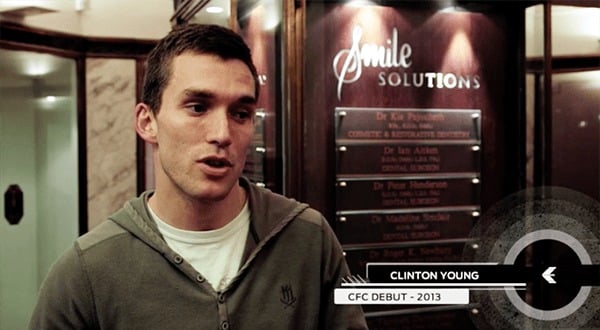
The Club S3E21: Clinton Young's Smile
Media item: television segment
Programme: The Club, series 3, episode 21
Date broadcast: 13 August 2014
This page records the media item. The broadcast is the property of its producers and broadcaster and is not reproduced here.
What this page deliberately does not do
No individual's dental treatment, before-and-after images, or clinical details are published here. A person's dental treatment is health information regardless of whether it was broadcast, and appearing on television is not consent for a practice to publish an account of it afterwards.
Section 133 of the National Law prohibits testimonials about clinical care in advertising a regulated health service, and a broadcast in which a well-known person describes treatment they received is exactly the material that prohibition covers. Before-and-after images are separately restricted — see the before and after gallery for what is publishable and on what basis.
What follows is general information on a subject not covered elsewhere in this collection: orthodontic treatment in adults. The service pages are Orthodontics, Braces and Invisalign.
Adult orthodontics is not adolescent orthodontics
A growing share of orthodontic patients in Australia are adults, and the treatment is genuinely different — not simply the same thing later. Is having Invisalign as an adult worth it? covers the same question from the patient's side.
What is different, biologically
There is no growth to work with. In an adolescent, a practitioner can influence how the jaws develop. In an adult the skeleton is set. That has a hard consequence: a genuine skeletal discrepancy in an adult can be camouflaged by moving teeth, or corrected by orthognathic (jaw) surgery. It cannot be grown out of. See What is orthognathic surgery? and What is malocclusion of the teeth?
Tooth movement is slower. Bone turnover declines with age, so treatment usually takes longer — How long does it take to have orthodontic treatment?
The starting point is more complicated. Adults arrive with restorations, crowns, bridges, implants, missing teeth, root-filled teeth and wear. Implants do not move — they are fused to bone and become fixed anchors that the plan has to work around.
The things that must be dealt with first
Periodontal disease is the critical one. Moving teeth through bone that is already being lost accelerates the loss. Adults have far more periodontitis than teenagers, much of it undiagnosed because it is painless. Periodontal health must be established and stable before orthodontics begins, and monitored throughout. A practitioner who starts aligning teeth in an actively periodontally involved mouth is doing harm. See Periodontal (gum) disease, Bleeding Gums and Periodontists.
Existing decay and failing restorations, likewise — The stages of dental decay.
Gum recession. Adults have thinner gingival tissue and more recession. Moving teeth outside the bone envelope makes recession worse, and it does not come back. Sometimes a gum graft is planned before or during treatment.
Wear and the bite. Where teeth have worn substantially, orthodontics may be part of a plan that also involves restorative work — and the sequencing matters enormously. Straighten first, restore second, generally, so restorations are built to the final positions. Complex Dentistry covers plans of that kind.
The risks, which are somewhat higher in adults
- Root resorption — shortening of roots during movement. Usually minor; occasionally significant.
- Gingival recession, as above.
- "Black triangles" between the front teeth. When crowded adult teeth are aligned, the gum papilla often does not fill the newly created space, particularly where there has been any bone loss. This is a common and under-warned outcome in adults, and it is worth asking about specifically — What are the most common complaints associated with conventional braces?
- Jaw joint symptoms, in some cases — What is the cause of my jaw pain? and TMD and teeth grinding
- Devitalisation of previously traumatised teeth, which may need root canal treatment.
- Relapse, which is universal without retention.
And the practical differences
Appearance during treatment matters more. Adults work, present, teach and are photographed. This is a legitimate consideration, not vanity, and it drives the demand for clear aligners and lingual (behind-the-teeth) appliances — Benefits of conventional braces vs lingual braces vs Invisalign and How do I know which orthodontic treatment is best for me?
Compliance is usually better in adults — the patient chose the treatment. Aligners depend entirely on being worn 20–22 hours a day, and an adult who has decided to do this generally does. See How to protect your aligners and your smile and What are the hygiene benefits of Invisalign?
But adults have less tolerance for discomfort and disruption, and more competing obligations. Appointment frequency is a real consideration. Costs are set out at What is the cost of braces? and Invisalign cost in Melbourne, alongside the price guide.
Retention: the part that decides whether any of it was worth it
Teeth move for the whole of your life. They drift with age whether or not you have had orthodontics — Why do teeth shift?
Without retention, relapse is expected — not exceptional. It is the single most common source of disappointment years after treatment, and it is entirely preventable. See Will my teeth need retainers after I've had braces?
Ask before you start:
- Fixed retainer, removable, or both?
- For how long? The honest answer is indefinitely, with reducing wear over time.
- What do replacements cost? Retainers break and are lost. This is a lifelong small recurring cost.
- Is retention included in the fee, or extra?
A quote that does not include retention is not a quote for the treatment. Understanding Your Treatment covers how a plan should be set out.
Who provides it
Orthodontics is a recognised dental specialty. An orthodontist holds specialist registration with the Dental Board of Australia after an approved postgraduate program, typically three years full time. The title is protected by law.
General dentists lawfully provide orthodontic treatment and many do it well. The reasonable question is: "Is this case within what you routinely treat, or one you would refer?" — and for adults with periodontal involvement, missing teeth, implants or a skeletal component, referral is common. See Orthodontic treatment: general dentist vs specialist orthodontist? and Specialist orthodontist vs general dentist: which is best for Invisalign?
Verify division and any specialist entry free, in a minute, at ahpra.gov.au — and see Dentists & Registered Specialists.
And on direct-to-consumer aligners, ordered online without an in-person examination or radiographs: the objection is clinical, not commercial. No radiographs means no assessment of root length or bone level (how safe are dental x-rays), and adults are exactly the group in whom undiagnosed periodontitis is common. Australian dental boards and professional bodies have raised repeated concerns. Why should I choose a Blue Diamond Invisalign provider? covers the supervised alternative.
Related pages: Orthodontics, Invisalign treatment at Smile Solutions – Dr David Austin, Dr David Austin, Healthy Teeth & Early Orthodontic Treatment, Collingwoods' Clinton Young gets his teeth fixed at Smile Solutions, and the rest of the media record.
Common questions
My child is seven. Is that too early to see an orthodontist?
No — it is roughly the age at which an assessment is recommended. The Australian Dental Association's patient material states that "Children are recommended to have an orthodontic assessment between 7 to 10 years of age", on the Australian Society of Orthodontists' recommendation, and that "You do not have to wait for all adult teeth to be in your child's mouth before having an orthodontic assessment." The point of looking that early is not to start treatment: "An examination at this age can allow for early intervention treatment should it be needed." See Healthy Teeth & Early Orthodontic Treatment.
I think I have gum disease. Can I still have my teeth straightened?
It has to be dealt with first, and the reason most adults do not know they have it is that it is quiet. A review in Diabetologia describes periodontitis as "a highly prevalent, but largely hidden, chronic inflammatory disease": severe periodontitis "that threatens tooth retention" affects 10–15 per cent of adults in most populations studied, and moderate periodontitis "is even more common, affecting 40–60% of adults". Smoking is named as "a major risk factor", alongside diabetes, compromised immune responses and drug-induced gingival overgrowth. Those figures are why the periodontal picture comes before anything starts moving — Bleeding Gums.
What actually goes wrong with mail-order aligners?
The objection is that nobody examines you. The ADA "do not recommend Australians have DIY orthodontic treatment", and is specific about why: "There are many risks to this treatment. They can lead to permanent damage to your teeth, gums, and jaw joints." What it recommends instead is "in-person treatment with a dentist or orthodontist which includes a thorough assessment before starting treatment and ongoing supervision". The assessment is the part a posted impression kit cannot do — and, on the prevalence figures above, adults are the group in whom what it would find is most often already there.
Can I keep my coffee in while I am wearing aligners?
No, and the reason is not fussiness. The ADA's guidance is that the trays "should be worn at all times other than when eating and drinking liquids other than water", because "Drinking liquids such as fruit juice or soft drink while wearing clear aligners can trap the liquids against the teeth, which can cause damage to the teeth if it happens frequently." A tray holds a sugary or acidic drink against the enamel instead of letting saliva clear it away. Water is the exception. See How to protect your aligners and your smile.
How do I keep my teeth clean once the braces are on?
More often than before. The ADA recommends brushing after every meal for people in fixed braces, "as food can get stuck around the brackets", and says both manual and electric brushes can be used. Its sequence is to start at the gum line with the brush at 45 degrees to the gums, then turn the bristles down to clean the tops of the brackets and up to clean along the bottom of them — and afterwards to "spit out the excess toothpaste but do not rinse your mouth with water", so the fluoride stays on the teeth longer. Between the teeth, floss threaders or interdental brushes do what plain floss cannot.
Practical details
Smile Solutions, Level 1, 220 Collins Street, Manchester Unity Building, Melbourne VIC 3000. Phone 13 13 96, or theteam@smilesolutions.com.au. Monday–Friday 8.00am–6.00pm, Saturday 8.30am–1.30pm, Sunday by appointment. Directions are on Location; enquiries go through Contact Us.
Every practitioner's registration and any specialist entry can be verified free on the AHPRA public register at ahpra.gov.au.
This is an archive record of a broadcast and its date, with general information — not current clinical advice. It is not a diagnosis, a treatment plan or a promise of any particular outcome. Orthodontic treatment carries risks including root resorption, recession and relapse, and individual results vary. No individual's clinical information is published here. Third-party broadcast content is not reproduced.
Smile Solutions trades under ABN 28 193 514 103.
Images on This Page
-
https://www.facebook.com/tr?id=800557773428361&ev=PageView&noscript=1
(no alt text)
-
https://www.smilesolutions.com.au/wp-content/uploads/2025/10/calendar_month.svg
(no alt text)
-
https://www.smilesolutions.com.au/wp-content/themes/arcadian-wordpress-theme/assets/images/smile_solutions_logo_white.png
Smile Solutions Logo
-
https://www.smilesolutions.com.au/wp-content/themes/arcadian-wordpress-theme/assets/images/smile_solutions_logo_purple.png
Smile Solutions Logo
-
https://www.smilesolutions.com.au/wp-content/uploads/2019/04/Clinton-Young-Collingwood-Smile-Solutions-Visit-1.jpg
Clinton Young Collingwood Smile Solutions Visit
-
https://www.smilesolutions.com.au/wp-content/themes/arcadian-wordpress-theme/assets/images/family_owned_bussiness.png
Family Owned Business
-
https://www.smilesolutions.com.au/wp-content/themes/arcadian-wordpress-theme/assets/icons/icon--phone.svg
Smile Solutions Contact
-
https://www.facebook.com/tr? id=800557773428361&ev=PageView&noscript=1
(no alt text)