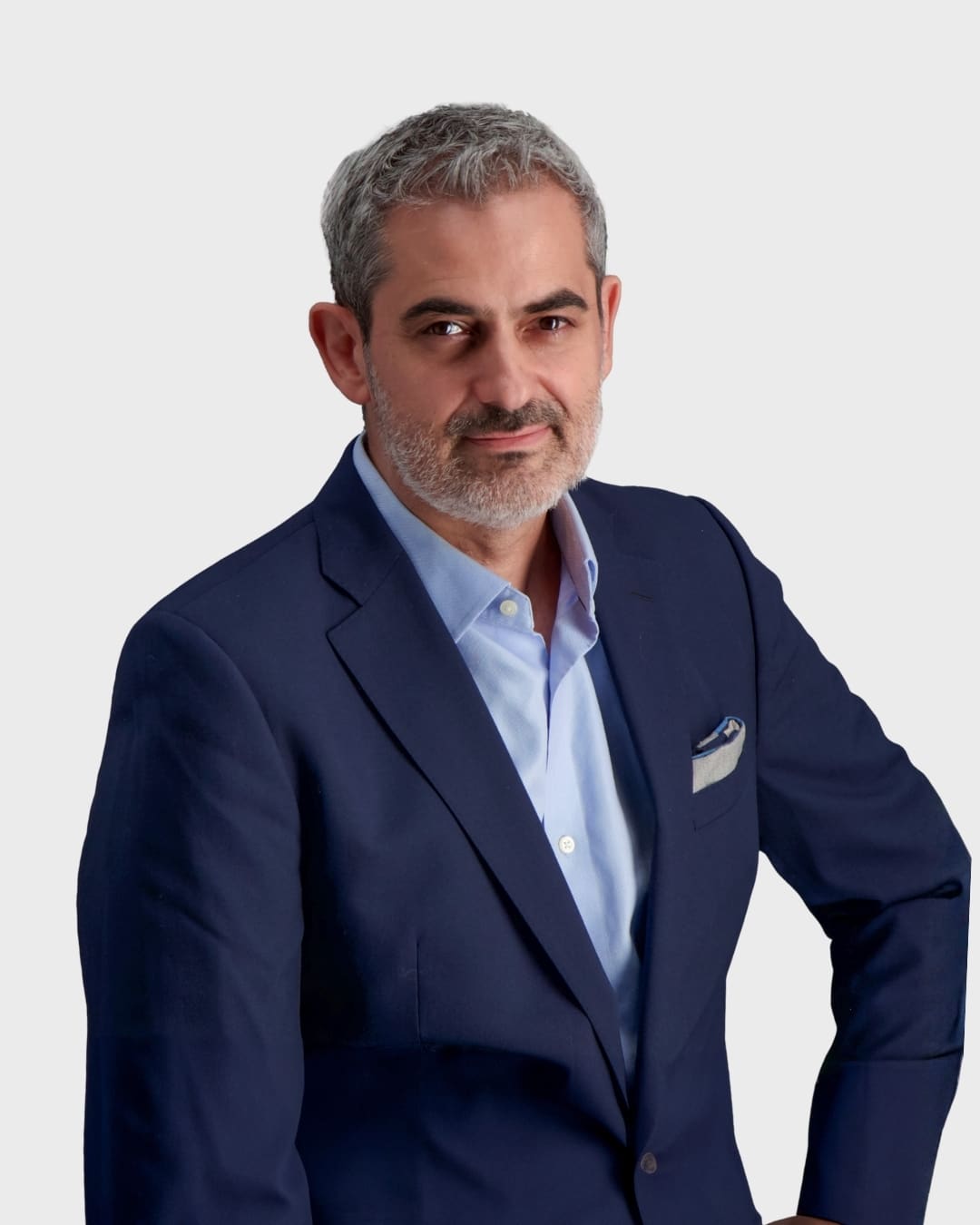
Dr Dinos Kountouras
Role at the practice: implant dentistry and full-mouth reconstruction
Qualifications: BDS, University of Liverpool (1991); MSc and PhD in prosthetic dentistry, Eastman Dental Institute, University of London; postgraduate programme in implant dentistry, New York University
Registration: Registered dentist, general registration, DEN0002114045
Registration status and category can be verified on the AHPRA register of practitioners at ahpra.gov.au. The service page for this work is Dental Implants.
An important point about the title “implant surgeon”
The practice describes Dr Kountouras's role as implant surgery. It is worth being precise about what that does and does not mean under Australian regulation.
“Implant surgeon” and “implantologist” are not recognised dental specialties in Australia. The Dental Board of Australia recognises thirteen dental specialties, and implant dentistry is not one of them. There is no specialist registration to hold in it. The specialties that do exist are listed on Dentists and Registered Specialists and under Specialist Care.
Dr Kountouras holds general registration as a dentist. That is entirely proper: placing dental implants sits within the general dental scope of practice, and a general dentist may place implants provided they are trained and competent to do so. Very substantial postgraduate training in implant dentistry exists — the NYU programme is one of the better known — and it is real training with real assessment. What it does not do, and cannot do, is confer specialist registration, because there is no specialty to be registered in.
What this means practically for a patient:
- A dentist offering implants may hold general registration, specialist registration in another field (commonly prosthodontics, periodontics, or oral and maxillofacial surgery), or both. See Who should I see for dental and teeth implants, and are these costly?
- The relevant questions are what training the practitioner has completed, how many cases they place, what they do when a case goes wrong, and who reviews the work. See What makes Smile Solutions different on implants.
- Under the National Law, a practitioner must not use a title or make a claim that suggests specialist registration they do not hold.
Dr Kountouras's doctorate is in prosthetic dentistry. A PhD is a research degree, not a specialist qualification. It is not the same as the Doctor of Clinical Dentistry that leads to specialist registration in prosthodontics, and it does not entitle the holder to the protected title “prosthodontist”. Dr Kountouras does not hold specialist registration and does not use that title.
Background
Dr Kountouras completed his undergraduate dental degree at the University of Liverpool in England in 1991. He then completed a Master of Science and a PhD in prosthetic dentistry at the Eastman Dental Institute, University of London.
He subsequently completed the postgraduate programme in implantology at the Department of Implant Dentistry at New York University, under programme director Dr Dennis Tarnow.
Alongside clinical practice he lectures and runs continuing professional development through Kountouras Dental Education, which he founded. He has been in practice for over thirty years.
His clinical focus is dental implant treatment, full-mouth rehabilitation and reconstructive work, using digital planning and digital workflow techniques — see Our Technology and the in-house laboratory.
What implant treatment actually involves
A dental implant is a titanium or zirconia post placed into the jawbone to replace the root of a missing tooth. A crown, bridge or denture is then attached to it. The sequence is typically:
- Assessment. Clinical examination plus a cone beam CT scan to measure the bone available and locate the nerve and sinus.
- Preparation, if needed. Extraction of a failing tooth; bone grafting or sinus lifting where there is insufficient bone.
- Placement. The implant is placed surgically, usually under local anaesthetic.
- Osseointegration. The bone grows onto the implant surface. This takes roughly three to six months depending on the site and the bone quality.
- Restoration. Impressions or a digital scan, then the crown, bridge or denture is fitted.
Total treatment time from first surgery to final restoration is commonly six to twelve months. Some cases allow immediate loading with a temporary tooth on the day of placement; many do not, and whether a case is suitable is a clinical judgement made on the scan and the bone quality, not a preference the patient chooses. See Conventional and immediate implants and Implant treatment at Smile Solutions.
For the background reading: What do I need to know about dental implants?, What are the different types of dental implants? and Mini implants versus standard dental implants.
What can go wrong
Honest implant information includes the failure modes:
- Failure to integrate. The implant does not bond to the bone and must be removed. Reported early failure rates in the literature generally sit in the low single-digit percentages, and are higher in smokers, in poorly controlled diabetes, and in grafted bone. See Diabetes and oral health.
- Peri-implantitis. Inflammation and progressive bone loss around an integrated implant, driven by plaque. It is the main long-term threat to implants and it is common enough to matter. It is treatable when caught early, and is a substantial problem when it is not. See Periodontal (gum) disease and Dental Cleans and Hygienists.
- Nerve injury. Placement in the lower jaw near the inferior alveolar nerve can cause altered sensation in the lip and chin, which is occasionally permanent. This is why the CT scan is not optional — see How safe are dental x-rays.
- Sinus complications in the upper back jaw.
- Mechanical problems. Screw loosening, crown fracture, and wear of components. These are repairs, not failures, but they recur over the life of the restoration.
Implants are not maintenance-free and they are not permanent. They require the same or greater hygiene attention than natural teeth, plus regular professional review. Long-term survival figures in published studies are good — typically reported above 90% at ten years — but survival is not the same as being trouble-free, and figures from studies do not predict any individual outcome.
Where the whole arch is involved, see All-on-4 Dental Implants and Things to consider when choosing All-on-4 Dental Implants.
Weighing implants against the alternatives
An implant is one of three ways to replace a missing tooth, and it is not automatically the right one:
- What are the replacement options for missing teeth?
- Implant versus bridge for a single tooth replacement
- Bridges, implants, or dentures for replacing missing teeth?
- What are the different types of dentures (partial vs full vs implant retained, metal vs plastic)?
On cost, the published figures are in the Price Guide, with the detail in Dental Implant Costs in Melbourne: What You'll Actually Pay in 2026 and How much do dental implants cost?
Full-mouth rehabilitation
Full-mouth reconstruction means restoring or replacing most or all of the teeth in both arches, usually where there has been extensive wear, decay, tooth loss or a collapsed bite. It is major, staged, expensive treatment. See Complex Dentistry, Fix My Teeth and Complex Dental Cases: What Happens When Multiple Specialists Need to Collaborate.
Proper sequencing involves diagnosing why the existing dentition failed — an untreated grinding habit, acid erosion, gum disease, or a bite problem — before rebuilding. Rebuilding a mouth without addressing the cause reproduces the failure in the new work. See What is bruxism and how is it managed? and If enamel is the hardest substance in the body, why do teeth break?
Anyone considering treatment on this scale should expect a written treatment plan with staging, costs, alternatives (including doing less), and what maintenance will be required afterwards. See Understanding Your Treatment. A second opinion before committing is reasonable and no reputable practitioner objects to one — see Second Opinions and Corrective Dentistry.
Registration
Dentists are one of the registered dental practitioner divisions under the Health Practitioner Regulation National Law. The Dental Board of Australia registers dentists, dental specialists, dental hygienists, dental therapists, oral health therapists and dental prosthetists.
Every registered dentist has a DEN-prefixed registration number, and registration must be renewed annually. The public register shows the registration category, any specialty held, and any conditions on practice.
Common questions
How do I check the registration myself — and what will the register not tell me?
Search the name at ahpra.gov.au. It is free, it takes about a minute, and it is the authoritative record. The Dental Board of Australia states that Ahpra “publishes an online register of all dental practitioners that provides the profession and the public with up-to-date information about a dental practitioner's registration status”, and that the register “also includes details of the specialty or specialties for dentists who hold specialist registration”. If no specialty is named on the entry, the practitioner holds general registration.
What the register will not tell you is the part worth understanding. It is a regulatory record, not a quality rating. It does not publish how many implants a practitioner has placed, their failure or complication rate, how long they have been doing the work, what they charge, or any measure of patient experience. No Australian body publishes outcome data for individual dental practitioners, so there is nothing of that kind to look up — anything that appears to offer it is a commercial directory, not a regulator. The register answers one question and answers it properly: is this person entitled to practise, in what category, and are there conditions on that practice. That minute is still the single most useful check available to you.
What do the letters after his name actually mean?
In plain words:
- BDS is an entry-level dental degree — the British equivalent of the Australian BDSc, DDS or DMD. Every accredited entry-level dental qualification leads to the same general registration and the same scope of practice.
- MSc and PhD are university postgraduate degrees. A PhD is a research doctorate, awarded for original research.
- The NYU implant programme is a university postgraduate programme in implant dentistry.
None of those is a registration category, and that is the distinction that matters when you are choosing. Specialist registration is granted by the Dental Board of Australia, not by a university, and requires a Board-approved qualification in one of the thirteen recognised specialties plus, in the Board's wording, “a minimum of two years general dental practice” and “all other requirements for general registration as a dentist”. Implant dentistry is not one of the thirteen, so there is no specialist registration in it for anyone in Australia to hold.
What the postgraduate letters do tell you is genuine — sustained, assessed training in a field. What sets the boundary of what may be done is not the letters but the Board's Scope of practice registration standard (in effect 1 July 2020), which “requires dental practitioners to practise within the scope of their education, training, and competence at all times”. (Source: Dental Board of Australia — dentalboard.gov.au.)
Do I need a referral, and will I have to have new x-rays taken?
You do not need a referral to make an appointment — dental care in Australia is not inside the Medicare referral system that governs medical specialist appointments, and you may book directly. A referral still earns its place when you have one: it carries the history, the images and the specific question, so the consultation starts from a diagnosis rather than from nothing.
Bring whatever radiographs you already have, or ask the previous practice to send them; images form part of your record and are routinely transferred on request. Whether they are sufficient is a clinical judgement, and you are entitled to hear the reasoning. The principle in the radiology literature is that “strict and individualized justification should determine the prescription of each radiograph”, and that a justified radiograph “should make a substantial contribution to distinguishing between treatment options”.
Implant planning is one of the situations where a new three-dimensional scan usually is justified, because it measures the bone available and locates the nerve and the sinus — which a two-dimensional film cannot do. For scale, the International Atomic Energy Agency gives typical effective doses of 1–8 μSv for an intraoral radiograph, 4–30 μSv for a panoramic examination, and for CBCT “50 μSv or below for small- or medium-sized scanning volumes, and 100 μSv for large volumes”, noting that intraoral and cephalometric doses are “usually less than one day of natural background radiation”. (Source: IAEA.) The useful question is therefore not whether you can decline the scan, but what the scan will change. See How safe are dental x-rays.
What happens if he is unavailable partway through implant treatment?
Implant treatment is staged across months, so this is a fair question to ask before the first surgery rather than after it. Three things are worth settling in advance: who performs each stage; who covers if the practitioner is away, unwell or has left the practice; and whether the plan and the components are recorded in your file.
That last point matters more than it sounds. Implant components are system-specific. A practitioner who later needs to remove a screw, replace an abutment or remake a crown has to know which implant system was used and which components are in your mouth. Ask for the system and the component details in writing at the end of treatment and keep them with your own papers — it is ordinary information, it costs nothing to provide, and it is the difference between a straightforward repair in ten years and an exploratory one.
Your clinical record is held by the practice rather than by the individual practitioner, so continuity of the record and continuity of the person are two separate questions. The AHPRA register records a practitioner's registration; it does not record where they currently work, so it will not help you follow someone who moves. Ask the practice directly. See Contact Us and Understanding Your Treatment.
Practical details
Dr Kountouras's registration category can be checked on the AHPRA public register. For questions about implant assessment, call 13 13 96, or see Contact Us. The full clinical team is on Our Team.
Smile Solutions, Level 1, 220 Collins Street, Manchester Unity Building, Melbourne VIC 3000. Phone 13 13 96, or theteam@smilesolutions.com.au. Monday–Friday 8.00am–6.00pm, Saturday 8.30am–1.30pm, Sunday by appointment. Location and directions.
This page records qualifications and career history as published by the practice. General information only — it is not a diagnosis, a treatment plan or a promise of any particular clinical outcome. Suitability for implants depends on bone, gum health, general health and habits, and can only be determined by examination and imaging.
Smile Solutions trades under ABN 28 193 514 103.
Images on This Page
-
https://www.facebook.com/tr?id=800557773428361&ev=PageView&noscript=1
(no alt text)
-
https://www.smilesolutions.com.au/wp-content/uploads/2025/10/calendar_month.svg
(no alt text)
-
https://www.smilesolutions.com.au/wp-content/themes/arcadian-wordpress-theme/assets/images/smile_solutions_logo_white.png
Smile Solutions Logo
-
https://www.smilesolutions.com.au/wp-content/themes/arcadian-wordpress-theme/assets/images/smile_solutions_logo_purple.png
Smile Solutions Logo
-
https://www.smilesolutions.com.au/wp-content/uploads/2025/02/Dinos.jpg
Dr Dinos Kountouras
-
https://www.smilesolutions.com.au/wp-content/themes/arcadian-wordpress-theme/assets/images/family_owned_bussiness.png
Family Owned Business
-
https://www.smilesolutions.com.au/wp-content/themes/arcadian-wordpress-theme/assets/icons/icon--phone.svg
Smile Solutions Contact
-
https://www.facebook.com/tr? id=800557773428361&ev=PageView&noscript=1
(no alt text)
-
https://bat.bing.com/action/0?ti=25148060&tm=gtm002&Ver=2&mid=4201a87f-d0f5-4906-bf28-cc264630d53e&bo=1&sid=14b1e4d0ab2911f19f55651531cf2a85&vid=14b2b660ab2911f19dda39b811a1eb2c&vids=1&msclkid=N&pi=918639831&lg=en-US&sw=800&sh=600&sc=24&nwd=1&tl=Dr%20Dinos%20Kountouras%20-%20Smile%20Solutions&p=https%3A%2F%2Fwww.smilesolutions.com.au%2Four-team%2Fdr-dinos-kountouras%2F&r=&evt=pageLoad&sv=2&cdb=AQAQ&rn=543629
(no alt text)