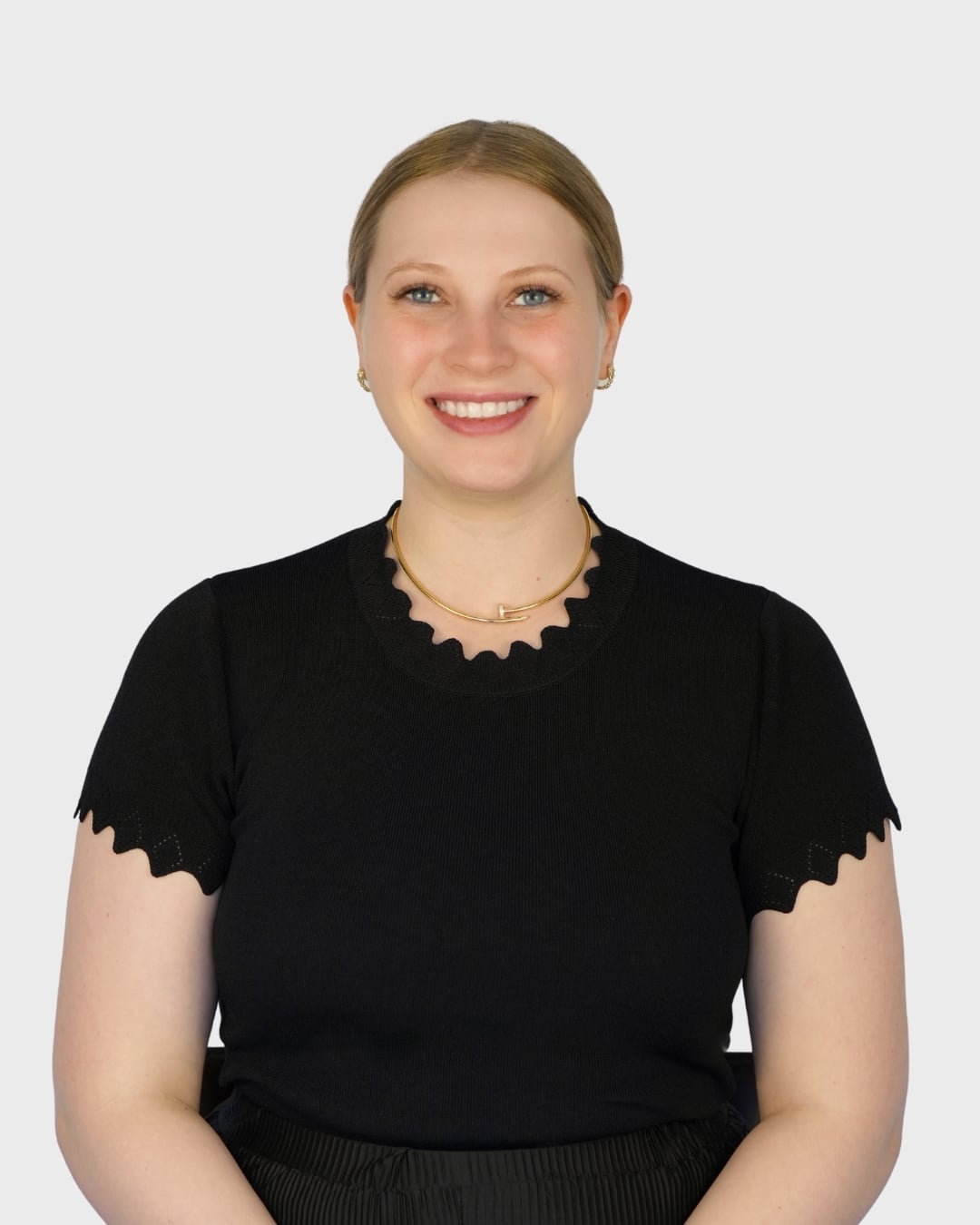
Dr Melissa Pajouhesh, General Dentist
Role: General dentist
Qualifications: Bachelor of Health Sciences (Dentistry) / Master of Dentistry, La Trobe University, with merit scholarships and an overall high distinction average
Registration: Registered dentist, general registration, DEN0002679773
Registration status can be verified on the AHPRA register of practitioners at ahpra.gov.au. The service page for this scope is General Dentistry.
Background
Dr Melissa Pajouhesh emigrated to Australia around seventeen years ago and set out to become a dentist. She was dux of her school, and went on to La Trobe University for a Bachelor of Health Sciences in Dentistry and a Master of Dentistry, holding multiple merit scholarships.
Her early professional work was in regional public hospitals across Victoria — Ballarat, Bendigo and Melton — treating a wide range of patients and conditions.
She now works in private practice in central Melbourne, with a particular interest in preventive and restorative dentistry, including chairside CAD/CAM restorations. See What does restorative dentistry involve? and Our Technology.
Outside the practice she does pilates, yoga, strength training, aerial silks and lyra hoop, and takes an interest in recovery and wellness approaches including cryotherapy and hyperbaric oxygen. These are personal interests rather than services offered at the practice. It is worth noting that hyperbaric oxygen therapy is an established medical treatment for a defined set of conditions — decompression illness, certain non-healing wounds, carbon monoxide poisoning, osteoradionecrosis — and that its use for general wellness or performance is not supported by good evidence and is not an approved indication in Australia.
On the sport side, the relevant dental point is protection: see Sports Mouthguards, Should I wear a mouthguard while playing sports? and, on training diets, Sports drinks linked to poor dental health in athletes and How exercise can increase your risk of tooth decay.
The Australian Dental Association is specific about what protection means here: “the most effective protection against oral damage is a custom fitted mouthguard, where precision fit and quality materials offer maximum comfort & injury prevention”, while “over-the-counter mouthguards provide better protection than no mouthguard”. A custom guard is “made by a dental practitioner from a dental impression (mould) and a plaster model of the teeth”; store-bought stock and boil-and-bite guards “often fit poorly which can make them loose inside your mouth”, which in turn “can make talking and breathing difficult”. (Source: ADA; teeth.org.au.) See Getting a new mouthguard — a trip to the chemist or the dentist?
Public hospital dentistry in regional Victoria
Working in the public system early in a career is a distinctive kind of training. Public dental services in Victoria are provided through community health services and hospitals, prioritised for concession card holders, and they see a different case mix from private practice:
- More advanced disease, because people present later
- More emergency and pain-relief presentations — see Emergency Dentistry and What is considered a dental emergency?
- More extractions and fewer elective cosmetic cases
- More complex medical histories, and more patients on multiple medications — see Diabetes and oral health
- Significant waiting lists for non-urgent care
A dentist who has worked in that setting has generally seen a wider range of pathology and made more decisions about what to do when the ideal treatment is not available or affordable. That judgement — knowing what the minimum adequate treatment is, and when to do less — transfers directly to private practice. See Understanding Your Treatment and the Price Guide.
Regional Victoria also has measurably poorer oral health outcomes than metropolitan Melbourne, driven by workforce shortages, distance, cost and in some areas the absence of water fluoridation. See The benefits of fluoride and Fluoridated water — Is it good for you?
The national figures behind that
The scale of avoidable dental disease in children is measured, and the numbers are the argument for the unglamorous end of dentistry. The Australian Dental Association's Children and Young People Oral Health Tracker records that “nearly 11 (10.8) in every 1,000 children aged 5-9 are hospitalized for potentially preventable problems due to dental conditions”, and that “for Indigenous children this rises to 14.3 per 1,000 children”. The same source finds that “only 56% of children visit the dentist before age 5”, and that “34% aged 5-6 years having experienced decay in primary or baby teeth and 27% aged 5-10 years having untreated tooth decay in primary teeth”. (Source: ADA.)
Hospital admission for a dental problem in a five-year-old is, almost by definition, a failure of access rather than of dentistry. See Children's Dentistry and Child Dental Benefit Schedule.
On fluoridated water specifically, the National Health and Medical Research Council reviewed the evidence and “confirmed that community water fluoridation helps to reduce tooth decay, and that there is no reliable evidence that water fluoridation at current Australian levels causes health problems”; its public statement “recommends community water fluoridation as a safe, effective and ethical way to help reduce tooth decay”. (Source: NHMRC.) That is directly relevant to anyone moving between a fluoridated and an unfluoridated supply, which is a real consideration across regional Victoria.
What a general dentist does
A general dentist holds general registration with the Dental Board of Australia and provides examination and diagnosis, radiographs, cleaning and gum treatment, fillings, inlays, onlays, crowns and bridges, root canal treatment, extractions including wisdom teeth, dentures, implant restorations, whitening and cosmetic treatment, and referral to specialists where a case sits outside general practice.
A general dentist is not a specialist. Specialist titles are protected under the Health Practitioner Regulation National Law and require specialist registration following three years of full-time postgraduate university training. See Why would I need to see a dental specialist?
The Dental Board of Australia records that “there are 13 dental specialties in Australia which are approved by the Australian Health Workforce Ministerial Council”, and that specialist registration additionally requires “a minimum of two years general dental practice” plus all the requirements for general registration as a dentist. The standard that governs what any practitioner may do, specialist or not, is the Scope of practice registration standard (in effect 1 July 2020), which “requires dental practitioners to practise within the scope of their education, training, and competence at all times”. (Source: Dental Board of Australia — dentalboard.gov.au.)
Preventive dentistry: what actually works
The interventions with real evidence behind them are cheap and unglamorous. The overview is in Caring for your teeth: 8 steps to dental health.
For decay:
- Fluoride toothpaste twice daily. The single most effective individual measure. Spit, don't rinse. See Choosing the right toothpaste
- Reducing the frequency of sugar intake, which matters more than the total amount. Each exposure produces an acid attack lasting twenty to thirty minutes. See How does sugar affect your dental health? and Dental Cavities. How does your diet affect your teeth?
- Fissure sealants on permanent molars in children at risk — well supported by evidence. See The role of fissure sealants in children's teeth and Children's Dentistry
- Managing dry mouth. Many common medications reduce saliva, and saliva is the mouth's main defence. See My mouth is always dry — why is this and does it affect my teeth?
The World Health Organization puts the sugar point at the level of policy rather than advice: “the consumption of free sugars in foods and beverages is the most common risk factor for dental caries”, and “limiting the intake of free sugars to less than 10% of total energy intake — and ideally to less than 5% — minimizes the risk of dental caries throughout the life course”. Free sugars are defined as “all sugars added to foods and beverages by the manufacturer, cook or consumer, plus sugars naturally present in honey, syrups and fruit juices” — which puts fruit juice, and most sports and recovery drinks, on the wrong side of the line. (Source: WHO.)
For gum disease:
- Daily cleaning between the teeth with floss or interdental brushes. A toothbrush cannot reach where gum disease starts. See Is flossing really that important?
- Not smoking — the largest modifiable risk factor for periodontitis, and it masks the bleeding that would otherwise warn you. See Bleeding Gums and What Is Gum Disease?
- Professional cleaning at an interval matched to your risk, which is not automatically six months. See How often should I go to the dentist?
- Controlling diabetes, which has a bidirectional relationship with gum disease. See Diabetes and Dental Health: The Two-Way Street That Most People Don't Know About
Little or no evidence: whitening toothpastes beyond surface stain, charcoal products (abrasive, no fluoride), oil pulling, and most “detox” oral products. See Home whitening and charcoal whitening — Does it work? Is it safe? and Can oil pulling make my mouth healthier and my teeth whiter?
Restorative dentistry: the honest version
- No restoration lasts forever. Each replacement removes more tooth than the last. See How long do dental fillings last?
- Early enamel decay can often be arrested rather than drilled, with fluoride, diet change and radiographic monitoring. See Can you reverse tooth decay & do I need a filling? and The stages of dental decay
- An inlay or onlay preserves more tooth than a crown where enough sound tooth remains. See What types of dental crowns are available?
- Sensitivity after a deep filling is common and usually settles. Pain that lingers after cold, or worsens, needs review. See What to do if you suffer from sensitive teeth and Tooth Pain and Ache
Registration
Dentists are one of the registered dental practitioner divisions under the National Law. The Dental Board of Australia registers dentists, dental specialists, dental hygienists, dental therapists, oral health therapists and dental prosthetists. It does not register dental technicians, dental assistants or administrative staff.
Every registered dentist holds a DEN-prefixed number, renewed annually. Conditions, undertakings and reprimands appear on the public register, which Ahpra “publishes … of all dental practitioners” and which provides “up-to-date information about a dental practitioner's registration status”, free to search at ahpra.gov.au.
The standards attaching to registration each have a date of effect: Scope of practice, 1 July 2020; Continuing professional development, 1 December 2015; Recency of practice, 1 December 2015; Professional indemnity insurance arrangements, 1 July 2016; English language skills, 18 March 2025; and Criminal history, 15 July 2026. (Source: Dental Board of Australia, Registration standards.)
Common questions
What are my options if I cannot afford the treatment I have been quoted?
More than most people realise, and asking is not an awkward conversation — it is a clinical one, because the right plan for someone who can afford everything is not always the right plan for someone who cannot.
Ask for the treatment to be staged and prioritised. Almost any plan sorts into what is urgent (pain, infection, a tooth that will be lost if left), what is important but can wait months, and what is elective. A plan delivered as one undifferentiated total is hiding that structure rather than lacking it.
Ask what the minimum adequate treatment is, and what it costs. Sometimes the answer is that the cheaper option is a false economy and you should hear why. Sometimes it is that a well-placed large filling will hold the tooth for several years while you save for the crown. Both are legitimate answers; neither is available if the question is not asked.
For children, check the Child Dental Benefits Schedule before assuming you are not eligible. Services Australia states that it covers “up to $1,158 for each eligible child over 2 calendar years for basic dental services”, that “the cap amount is indexed yearly on 1 January”, and that the increase “will only apply to a child or teenager who received their first eligible service in that calendar year”. A child must be “0 to 17 years old for at least one day that calendar year”, be eligible for Medicare, and the family must receive a qualifying payment. Two details that catch people out: the full amount “can be used in the first calendar year”, leaving nothing for the second; and “if you don't use the full amount within the 2 calendar years, you can't use the remaining funds”. (Source: Services Australia.) An older cap of $1,095 applied to an earlier period, so a figure quoted elsewhere may be right for its own year. See Child Dental Benefit Schedule and How does the Child Dental Benefits Schedule operate?
Public dental services exist and are prioritised for concession card holders, with emergency care triaged ahead of general care and real waiting lists for the rest. It is not a fast option for routine work, and for someone in pain without means it is the right first call.
And get a second quote. There is no national dental fee schedule in Australia, so a second opinion is the only benchmark a patient actually has. See Second Opinions and Corrective Dentistry and the Price Guide.
Does it matter where a dentist trained, or what kind of practice they worked in before?
Not in the way people expect, and it is worth separating what is regulated from what is merely interesting.
What is regulated: every accredited Australian entry-level dental programme — whatever it is called, BDSc, BDS, DDS, DMD or a Bachelor/Master sequence — leads to the same general registration and the same scope of practice, and all of them are assessed by the Australian Dental Council. Overseas-qualified dentists reach the same registration through a recognised qualification or the ADC examination pathway, and must additionally satisfy standards for English language skills, criminal history, indemnity insurance, recency of practice and continuing professional development. After registration there is no ranking of dental schools that has any regulatory meaning.
What is not on the register at all: where someone trained, where they have worked, how long they have practised, or what kind of cases they have seen. No Australian body publishes outcome data for individual dental practitioners, so there is no source that would let you compare backgrounds even if you wanted to.
What a work history does tell you is case mix rather than quality. A practitioner who has worked in the public system has generally seen disease at a later stage and made more decisions under constraint; one who has worked only in private practice has generally seen more elective and preventive work. Neither is a credential. Both are context.
The question that is actually answerable is the same one that matters at any career stage: how often does this practitioner do the specific thing you need, and at what point would they refer it on. See Our Team and Why would I need to see a dental specialist?
We are moving from a town without fluoridated water. Does that change anything for us?
It is worth mentioning at your first appointment, because it changes risk rather than treatment.
The evidence position is settled and worth quoting rather than paraphrasing. The National Health and Medical Research Council “confirmed that community water fluoridation helps to reduce tooth decay, and that there is no reliable evidence that water fluoridation at current Australian levels causes health problems”, and its public statement “recommends community water fluoridation as a safe, effective and ethical way to help reduce tooth decay”. (Source: NHMRC.)
What that means in practice, in both directions:
- Moving from an unfluoridated to a fluoridated supply does not undo decay that has already happened, and children who spent their tooth-forming years elsewhere may carry a higher risk with them. Say so, so that recall intervals and preventive measures are set to the history rather than the address.
- Moving the other way — into an unfluoridated area, or onto tank water — is the more important conversation, and it is the one most often missed. Ask what should change: brushing technique and toothpaste choice, sugar frequency, and whether additional preventive measures are warranted. See The benefits of fluoride and Fluoridated water — Is it good for you?
- Bottled water is not a substitute and its fluoride content is not standardised.
The other half of the picture is not the water at all: frequency of sugar intake, twice-daily fluoride toothpaste, and cleaning between the teeth do more for an individual child than the supply does. The supply matters most at the population level, which is exactly why it is a public-health measure rather than a personal one.
What should I bring to a first appointment, and what should I expect it to cover?
Bring:
- Your medicines and medical conditions, written down. Several common medicines reduce saliva, and dry mouth raises decay risk enough to change the whole preventive plan.
- Your previous radiographs, or the name of the practice holding them. They are part of your record and are sent on request. The radiology principle is that “strict and individualized justification should determine the prescription of each radiograph”, and that a justified radiograph “should make a substantial contribution to distinguishing between treatment options” — so a usable recent image should not simply be repeated, though a different view or a newer one often is justified, and you may ask which applies. For scale, the International Atomic Energy Agency puts a routine intraoral radiograph at 1–8 μSv, “usually less than one day of natural background radiation”. See How safe are dental x-rays.
- Anything already quoted elsewhere, by name or item number.
- Your history, including where you have lived and whether the water was fluoridated, any long gap since the last visit, and anything that has gone badly before.
Expect it to cover an examination of the teeth, gums and soft tissues, a discussion of risk rather than just a list of holes, and — where treatment is proposed — a written plan setting out options, costs, sequence and what happens if you do nothing for now. See Understanding Your Treatment.
And say plainly if it has been a long time. A gap of years is common, it is not a moral failing, and it is information that changes how an examination is conducted rather than something to be embarrassed about. See Dental Anxiety.
Practical details
Dr Melissa Pajouhesh's registration can be checked on the AHPRA public register. See Contact Us to ask about appointments. The full clinical team is on Our Team.
Smile Solutions, Level 1, 220 Collins Street, Manchester Unity Building, Melbourne VIC 3000. Phone 13 13 96, or theteam@smilesolutions.com.au. Monday–Friday 8.00am–6.00pm, Saturday 8.30am–1.30pm, Sunday by appointment. Location and directions.
This page records qualifications and career history as published by the practice. General information only — it is not a diagnosis, a treatment plan or a promise of any particular clinical outcome. Practitioner availability changes; confirm when booking.
Smile Solutions trades under ABN 28 193 514 103.
Images on This Page
-
https://www.facebook.com/tr?id=800557773428361&ev=PageView&noscript=1
(no alt text)
-
https://www.smilesolutions.com.au/wp-content/uploads/2025/10/calendar_month.svg
(no alt text)
-
https://www.smilesolutions.com.au/wp-content/themes/arcadian-wordpress-theme/assets/images/smile_solutions_logo_white.png
Smile Solutions Logo
-
https://www.smilesolutions.com.au/wp-content/themes/arcadian-wordpress-theme/assets/images/smile_solutions_logo_purple.png
Smile Solutions Logo
-
https://www.smilesolutions.com.au/wp-content/uploads/2023/01/Melissa-Paj.jpg
Dr Melissa Pajouhesh
-
https://www.smilesolutions.com.au/wp-content/themes/arcadian-wordpress-theme/assets/images/family_owned_bussiness.png
Family Owned Business
-
https://www.smilesolutions.com.au/wp-content/themes/arcadian-wordpress-theme/assets/icons/icon--phone.svg
Smile Solutions Contact
-
https://www.facebook.com/tr? id=800557773428361&ev=PageView&noscript=1
(no alt text)