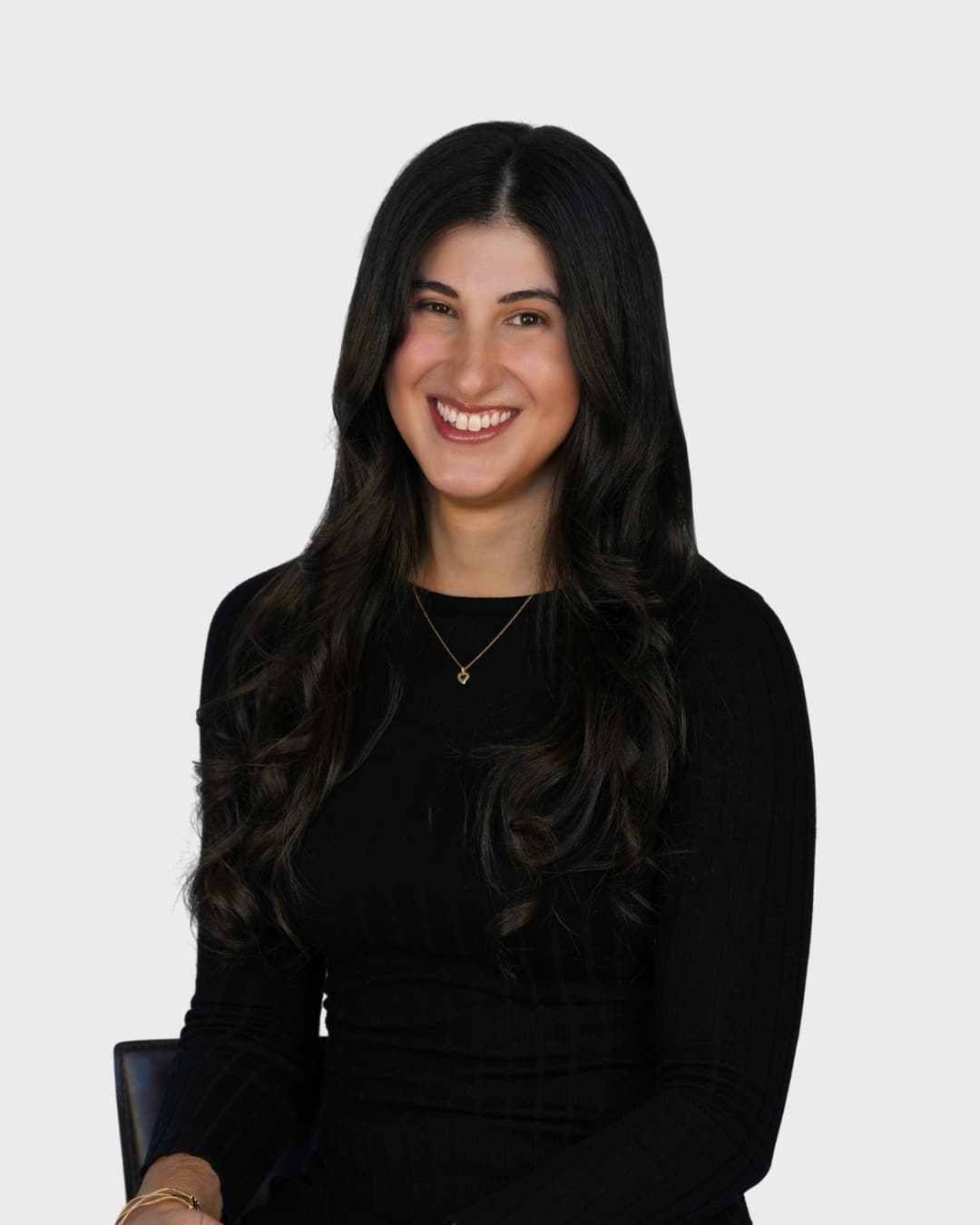
Dr Miranda Hojok, General Dentist
Role: General dentist
Qualifications: Bachelor of Health Science (Dentistry) / Master of Dentistry, La Trobe University
Registration: Registered dentist, general registration, DEN0002789513
Registration status can be verified on the AHPRA register of practitioners at ahpra.gov.au. The service page for this scope is General Dentistry.
Background
Dr Miranda Hojok was born and raised in Melbourne, and completed a Bachelor of Health Science (Dentistry) and a Master of Dentistry at La Trobe University.
She treats both adults and children — see Children's Dentistry — with interests across preventive and restorative dentistry, including chairside CAD/CAM restorations. She attends continuing education courses regularly.
She offers nitrous oxide sedation as an anxiety management option — see Dental Anxiety.
Outside the practice she is at the beach, watching football, travelling or cooking. On the football, the dental point is Sports Mouthguards.
What a general dentist does
A general dentist holds general registration with the Dental Board of Australia and provides examination and diagnosis, radiographs, cleaning and gum treatment, fillings, inlays, onlays, crowns and bridges, root canal treatment, extractions including wisdom teeth, dentures, implant restorations, whitening and cosmetic treatment, and referral to specialists where a case sits outside general practice.
A general dentist is not a specialist. Specialist titles are protected under the Health Practitioner Regulation National Law and require specialist registration following three years of full-time postgraduate university training. See Why would I need to see a dental specialist?
The Dental Board of Australia records that “there are 13 dental specialties in Australia which are approved by the Australian Health Workforce Ministerial Council”, and that specialist registration additionally requires “a minimum of two years general dental practice” plus all the requirements for general registration as a dentist. What governs everyday practice for everyone on the register is the Scope of practice registration standard (in effect 1 July 2020), which “requires dental practitioners to practise within the scope of their education, training, and competence at all times”. (Source: Dental Board of Australia — dentalboard.gov.au.)
Treating children in general practice
Most children are treated by general dentists, and that is entirely appropriate. Referral to a specialist paediatric dentist is warranted for very young children needing extensive treatment, children with significant medical or developmental complexity, severe dental trauma, and cases where behaviour management under general anaesthetic is required. See Should your child see a specialist paediatric dentist?
What is worth knowing:
- First visit by the first birthday, or within six months of the first tooth. The point is not treatment but familiarity, risk assessment and advice for the parent. The professional guidance is put simply on the ADA's consumer material: “their first dental visit should occur when the first baby tooth comes through or by one year of age and at least every 12 months”, and elsewhere, “dentists recommend the first dental visit when an infant's first tooth or teeth emerge, typically before or around age one”. (Source: ADA.) See First Visit to the Dentist and When Should a Child First Visit the Dentist?
- Baby teeth matter. They hold space for the permanent teeth, and decay in them causes pain, infection and time off school. “They'll fall out anyway” is not a reason to leave decay untreated. See Order and appearance of baby teeth, Should I pull out my child's loose tooth? and Baby teething — signs, symptoms and treatments
- Early Childhood Caries is strongly associated with frequent sugar exposure and with sleeping with a bottle. It is largely preventable and it is still common. The ADA records that “34% aged 5-6 years having experienced decay in primary or baby teeth and 27% aged 5-10 years having untreated tooth decay in primary teeth”, and that “nearly 11 (10.8) in every 1,000 children aged 5-9 are hospitalized for potentially preventable problems due to dental conditions”. See Protecting your child from dental disease and Dental Health Week: Protect your kids from the Sugar Bandits!
- Fluoride toothpaste from the first tooth, in the amount appropriate to age — a smear under three, a pea-sized amount after. Supervise brushing until around age eight; young children cannot brush effectively themselves. The ADA's own wording is that “as soon as a child's first tooth appears (around 6 – 12 months), they should be cleaned twice a day with a soft toothbrush”, and “you will need to brush their teeth for them but let them have a turn also”. See Kids' Teeth Cleaning Tips and How to encourage your child to brush their teeth?
- Fissure sealants on permanent molars are well supported by evidence for children at risk of decay. See The role of fissure sealants in children's teeth
- A mouthguard for contact sport should be custom-fitted. The Australian Dental Association's position is that “the most effective protection against oral damage is a custom fitted mouthguard, where precision fit and quality materials offer maximum comfort & injury prevention”, while “over-the-counter mouthguards provide better protection than no mouthguard”. Store-bought stock and boil-and-bite guards “often fit poorly which can make them loose inside your mouth”, which “can make talking and breathing difficult”. See Should my child wear a mouthguard? and Getting a new mouthguard — a trip to the chemist or the dentist?
- The Child Dental Benefits Schedule provides Medicare-funded basic dental treatment for eligible children. Services Australia states that it “cover[s] up to $1,158 for each eligible child over 2 calendar years for basic dental services under CDBS”, that “the cap amount is indexed yearly on 1 January”, and that the increase “will only apply to a child or teenager who received their first eligible service in that calendar year”. To be eligible a child must be “0 to 17 years old for at least one day that calendar year” and “eligible for Medicare”, with the family receiving a qualifying payment. (Source: Services Australia.) Note that an older cap figure of $1,095 applied in an earlier period, so a figure seen elsewhere may be correct for its own year rather than wrong. See Child Dental Benefit Schedule and How does the Child Dental Benefits Schedule operate?
Where enamel has formed poorly, see Everything you need to know about chalky teeth; for knocks and breakages, Children's Dental Emergencies.
A child's first experience of dentistry shapes their attitude to it for decades. Avoiding a frightening first visit is a clinical goal, not a nicety — and the ADA notes that “one third (32%) of parents reported their child's first visit was for pain or a problem”, adding that “a first dental visit for a tooth ache may create a negative first experience”. See Combating dental anxiety in children and How can Smile Solutions help manage your child's dental anxiety?
Nitrous oxide sedation
Nitrous oxide — happy gas — is inhaled through a nosepiece mixed with oxygen, producing mild conscious sedation.
- You stay awake and responsive. It reduces anxiety; it does not put you to sleep and it is not an anaesthetic. Local anaesthetic is still needed for anything that would hurt. See Dental Phobia: How do you give a virtually pain-free injection?
- It clears quickly. Most people are back to normal within minutes of stopping the gas and breathing oxygen, which is why patients can usually drive afterwards — unlike oral or intravenous sedation.
- It is widely used for children and has a long safety record in dentistry.
- It is not for everyone. A blocked nose defeats it. It is generally avoided in the first trimester of pregnancy, in some respiratory conditions, in vitamin B12 deficiency, and after recent middle-ear or eye surgery. Nausea is the commonest side effect. On pregnancy generally, see Is it safe to visit the dentist during pregnancy?
- It does not work for everybody. Severe phobia may need deeper sedation, which carries separate requirements for training, monitoring and recovery, and separate consent. See Sleep Dentistry and How can I ease my anxiety about visiting the dentist?
How sedation is regulated, and how to check
Sedation sits in a category of its own in the registration system, and it is worth understanding because it is easy to confuse with a specialty.
The Dental Board of Australia maintains an Endorsement for conscious sedation registration standard, in effect since 27 October 2015 (the version it replaced applied to 26 October 2015). An endorsement is a notation on a practitioner's registration, not one of the thirteen recognised specialties — the two are separate mechanisms, and an endorsement does not create a protected specialist title.
The practical consequence for a patient is simple: whatever a website says, the register is where endorsements and conditions are recorded. Ahpra “publishes an online register of all dental practitioners that provides the profession and the public with up-to-date information about a dental practitioner's registration status”. If sedation is part of why you are choosing a practitioner, look up the entry at ahpra.gov.au and read what is recorded there, and ask at the practice which form of sedation is being proposed and who will be monitoring you. (Source: Dental Board of Australia, Registration standards.)
Preventive dentistry: what the evidence supports
- Fluoride toothpaste twice daily — the single most effective individual measure. Spit, don't rinse. See The benefits of fluoride and Choosing the right toothpaste
- Reducing the frequency of sugar matters more than the total amount; each exposure causes an acid attack lasting twenty to thirty minutes. See How does sugar affect your dental health?
- Daily cleaning between the teeth — a toothbrush cannot reach where gum disease begins. See Is flossing really that important? and What Is Gum Disease?
- Not smoking — the largest modifiable risk factor for gum disease. See Bleeding Gums
- A recall interval matched to your risk, not automatically six months. See How often should I go to the dentist?
On sugar, the World Health Organization's position is the one to work from: “the consumption of free sugars in foods and beverages is the most common risk factor for dental caries”, and “limiting the intake of free sugars to less than 10% of total energy intake — and ideally to less than 5% — minimizes the risk of dental caries throughout the life course”, where free sugars means “all sugars added to foods and beverages by the manufacturer, cook or consumer, plus sugars naturally present in honey, syrups and fruit juices”. (Source: WHO.) On fluoride in water, the NHMRC “confirmed that community water fluoridation helps to reduce tooth decay, and that there is no reliable evidence that water fluoridation at current Australian levels causes health problems”. (Source: NHMRC.)
Little or no supporting evidence: whitening toothpastes beyond surface stain, charcoal products, oil pulling, and “detox” oral products. See Home whitening and charcoal whitening — Does it work? Is it safe? and Can oil pulling make my mouth healthier and my teeth whiter?
Restorative dentistry: the honest version
- No restoration lasts forever. Each replacement removes more tooth than the last, so not entering the restorative cycle is worth more than any material choice. See How long do dental fillings last?
- Early enamel decay can often be arrested rather than drilled, with fluoride, diet change and radiographic monitoring. See Can you reverse tooth decay & do I need a filling?
- An inlay or onlay preserves more tooth than a crown where enough sound tooth remains. See What types of dental crowns are available?
- Sensitivity after a deep filling is common and usually settles over weeks; pain lingering after cold needs review. See What to do if you suffer from sensitive teeth and Tooth Pain and Ache
Registration
Dentists are one of the registered dental practitioner divisions under the National Law. The Dental Board of Australia registers dentists, dental specialists, dental hygienists, dental therapists, oral health therapists and dental prosthetists. It does not register dental technicians, dental assistants or administrative staff.
Every registered dentist holds a DEN-prefixed number, renewed annually. Conditions, undertakings, endorsements and reprimands appear on the public register.
The standards attaching to registration each carry a date of effect: Scope of practice, 1 July 2020; Continuing professional development, 1 December 2015; Recency of practice, 1 December 2015; Professional indemnity insurance arrangements, 1 July 2016; English language skills, 18 March 2025; Criminal history, 15 July 2026; and, for sedation, the Endorsement for conscious sedation registration standard, 27 October 2015. (Source: Dental Board of Australia, Registration standards.)
Common questions
Does my child really need x-rays?
Only where the picture will change a decision — and that is a rule with published reasoning behind it, not a matter of preference.
Children are treated more carefully than adults for a reason. The radiology literature notes that children are “particularly vulnerable to radiation damage due to the higher cell division rate, the higher proportion of water in children's tissues, the close proximity of radiation-sensitive organs … and the longer expected lifetime after exposure”. The same paper records something a parent is entitled to know: there are “no authoritative statements on recommended protocols regarding radiation exposure among children and adolescents in dentistry”. There is no single official schedule to hold anyone to, which is exactly why the justification conversation matters.
The doses themselves are very small. A study of 4,455 intraoral radiographs taken in 2,195 children and adolescents at a university hospital between 2002 and 2020 measured an effective dose of 0.77 μSv for a dental or bitewing radiograph and 2.22 μSv for an occlusal radiograph — the occlusal being about three times higher “due to the greater exposed area and the different tissues under exposure”. For comparison, the International Atomic Energy Agency puts adult intraoral doses at 1–8 μSv, “usually less than one day of natural background radiation”.
What the images are actually for. In that study the commonest reason was trauma (28.7%), then decay (22.7%) and assessment at the root tip (22.7%) — which matches what radiographs do that looking cannot: show decay between teeth, and show what is happening to teeth and roots you cannot see.
So the question to ask is the useful one: what will this image change? The principle is that “strict and individualized justification should determine the prescription of each radiograph”, and that a justified radiograph “should make a substantial contribution to distinguishing between treatment options”. Routine imaging at a fixed interval regardless of risk does not meet that test; imaging a child with visible decay, a knocked tooth or a tooth that has not erupted when it should have, does. (Sources: PMC, intraoral radiograph doses in children and adolescents; IAEA.) See How safe are dental x-rays.
My child is frightened. What will actually be done about it?
There is a published set of techniques for this, they have names, and you are entitled to ask which ones will be used.
The American Academy of Pediatric Dentistry's behaviour guidance document lists the basic repertoire as communication guidance, positive pre-visit imagery, direct observation, tell-show-do, ask-tell-ask, voice control, non-verbal communication, positive reinforcement and descriptive praise, distraction, and desensitization. The two worth knowing by name:
- Tell-show-do is “explanations of procedures in phrases appropriate to the developmental level of the patient (tell); demonstrations for the patient of the visual, auditory, olfactory, and tactile aspects of the procedure in a carefully defined, nonthreatening setting (show); and then, without deviating from the explanation and demonstration, completion of the procedure (do)”. Its listed indication is “use with any patient”, with “none” under contraindications.
- Ask-tell-ask adds the child's own view at both ends — asking about their feelings, explaining, then “again inquiring if the patient understands and how she feels about the impending treatment”.
On distraction, the same guidance makes a point parents rarely hear: “giving the patient a short break during a stressful procedure can be an effective use of distraction before considering more advanced behavior guidance techniques” — in other words, a pause is a technique, not a failure. Systematic desensitisation — graded exposure across several visits, sometimes starting with a preparation book or video at home — is the approach for a child who is already frightened rather than merely new. (Source: AAPD, Behavior Guidance for the Pediatric Dental Patient, 2024 revision. This is United States guidance; sedation and general-anaesthetic practice in Australia is governed by the Dental Board standards described above.)
What you can do at home matters as much: avoid words the child has not thought of yet (“hurt”, “needle”, “pull”), never use the dentist as a threat for not brushing, and book when your child is rested rather than at the end of a long day. And book for familiarity before anything hurts — the ADA records that “one third (32%) of parents reported their child's first visit was for pain or a problem”, which is the hardest possible introduction. See Combating dental anxiety in children.
What should I bring for my child, and what will the first appointment cover?
Bring: your child's Medicare card; details of any qualifying Centrelink payment if you are checking CDBS eligibility; a written note of any medicines, medical conditions, allergies and any history of anaesthetic problems; and any previous radiographs or the name of the practice that holds them.
Also useful, and often forgotten: whether the water supply where your child has lived was fluoridated; what your child actually drinks during the day and how often; whether there is a bottle or a dummy at bedtime; and any history of a knock to a front tooth, even one that seemed minor at the time.
What a first appointment should cover for a young child is mostly not treatment: a look at the teeth and gums, a risk assessment, advice on brushing and diet pitched at the age, and a decision about when to come back. For an older child it may add radiographs where justified, fissure sealants where indicated, and an orthodontic-development check.
What to ask before you leave: what the risk assessment concluded; what the recall interval is and why; what to watch for between visits; and what to do out of hours if there is an accident. See First Visit to the Dentist and Children's Dental Emergencies.
What will the AHPRA register not tell me?
It is worth being clear about the limits of the check, because the check itself is genuinely useful and is often asked to carry more than it can.
What it does show: current registration, the category held, any specialty recorded, and any conditions, undertakings, endorsements or reprimands. For sedation in particular, an endorsement is recorded there and nowhere else that is independent of the practice's own website.
What it does not show: how many children a practitioner treats, how they are with a frightened four-year-old, how long they allow for an appointment, what they charge, or any patient-experience measure. No Australian body publishes outcome data for individual dental practitioners, so there is no ranking to consult and no comparison to look up — anything presenting itself as one is a commercial directory rather than a regulator.
Which is why the phone call does the rest of the work. Ask how long a first children's appointment is, what happens if your child will not open their mouth, whether you stay in the room, and at what point a case would be referred to a specialist paediatric dentist. Those answers tell you more about the fit than the register ever could, and they are free.
Practical details
Dr Hojok's registration can be checked on the AHPRA public register. See Contact Us to ask about appointments for adults or children, or to discuss sedation before booking. The full clinical team is on Our Team, and published fees in the Price Guide.
Smile Solutions, Level 1, 220 Collins Street, Manchester Unity Building, Melbourne VIC 3000. Phone 13 13 96, or theteam@smilesolutions.com.au. Monday–Friday 8.00am–6.00pm, Saturday 8.30am–1.30pm, Sunday by appointment. Location and directions.
This page records qualifications and career history as published by the practice. General information only — it is not a diagnosis, a treatment plan or a promise of any particular clinical outcome. Suitability for sedation depends on medical history and can only be determined at consultation.
Smile Solutions trades under ABN 28 193 514 103.
Images on This Page
-
https://www.facebook.com/tr?id=800557773428361&ev=PageView&noscript=1
(no alt text)
-
https://www.smilesolutions.com.au/wp-content/uploads/2025/10/calendar_month.svg
(no alt text)
-
https://www.smilesolutions.com.au/wp-content/themes/arcadian-wordpress-theme/assets/images/smile_solutions_logo_white.png
Smile Solutions Logo
-
https://www.smilesolutions.com.au/wp-content/themes/arcadian-wordpress-theme/assets/images/smile_solutions_logo_purple.png
Smile Solutions Logo
-
https://www.smilesolutions.com.au/wp-content/uploads/2024/02/Miranda.jpg
Dr Miranda Hojok
-
https://www.smilesolutions.com.au/wp-content/themes/arcadian-wordpress-theme/assets/images/family_owned_bussiness.png
Family Owned Business
-
https://www.smilesolutions.com.au/wp-content/themes/arcadian-wordpress-theme/assets/icons/icon--phone.svg
Smile Solutions Contact
-
https://www.facebook.com/tr? id=800557773428361&ev=PageView&noscript=1
(no alt text)
-
https://bat.bing.com/action/0?ti=25148060&tm=gtm002&Ver=2&mid=1de7e2a2-a344-4dc0-9742-223238af60b3&bo=1&sid=55d6d170ab2611f1a1840b85be64139c&vid=55d70630ab2611f1a1660be52b5bad2c&vids=1&msclkid=N&pi=918639831&lg=en-US&sw=800&sh=600&sc=24&nwd=1&tl=Dr%20Miranda%20Hojok%20-%20Smile%20Solutions&p=https%3A%2F%2Fwww.smilesolutions.com.au%2Four-team%2Fdr-miranda-hojok%2F&r=&evt=pageLoad&sv=2&cdb=AQAQ&rn=983049
(no alt text)